
A bamboo charcoal bag can look polished in a sample photo yet still create dust, uneven fill or repeat-order complaints once production starts. The risk is easy to miss because most construction choices sit behind the outer fabric and cannot be judged from appearance alone.
For private-label buyers, the finished bag should be treated as one construction system: specified charcoal, a breathable containment layer, an outer textile shell, controlled seams and a verified net fill. Approving those elements together creates a repeatable reference for quotation, sampling and bulk inspection.
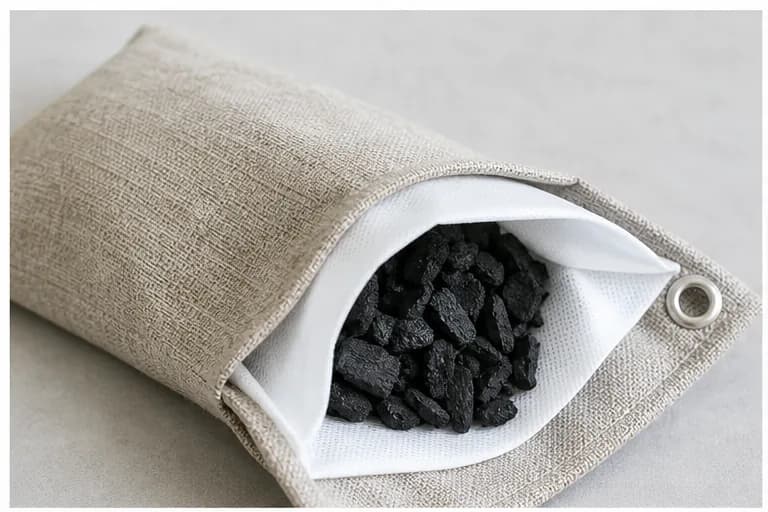
When a buyer sends us a reference sample, I use a simple cutaway review to separate cosmetic choices from the details that affect containment, handling and consistency. This guide follows that same sequence so you can compare quotations, question samples and write a clearer purchase specification.
What components should a buyer find inside the finished bag?
A reviewable construction normally includes carbonized bamboo charcoal, an inner containment pouch, an outer textile shell, a closure seam and any approved eyelet, cord, label or printed branding.
The outer pouch is the visible layer, but it is not the whole product. In our sample room, I lay out each component separately before we discuss price. That makes it easier to see where a lower quotation may have removed material, changed a liner or reduced fill.
| Component | What it does | What to record on the approved sample |
|---|---|---|
| Charcoal filling | Provides the porous solid surface used for adsorption | Source specification, particle format, net fill and tolerance |
| Inner liner | Contains particles and dust while allowing air contact | Material, basis-weight reference, seam and closure method |
| Outer fabric | Carries color, touch, printing and structural shape | Fiber blend, weave, color, cut size and shrinkage expectation |
| Stitching | Holds the filled construction through handling | Stitch path, seam allowance and visual acceptance standard |
| Hardware | Supports hanging or placement | Eyelet, cord, strap, reinforcement and position |
| Branding | Identifies the retail product | Print, embroidery or sewn-label artwork and placement |
This construction view also explains why two bags with the same outside dimensions can behave differently. The internal volume, fill particle format and liner can change finished thickness and air contact.
For buyers building a home-care range, our air-purifying bag product page shows how common formats can be developed around different spaces and pack counts.
Why does the charcoal specification matter?
Adsorption happens at a solid surface, so material specification, available surface area and operating conditions matter more than a vague claim that a bag contains "natural charcoal."
The US Environmental Protection Agency describes activated-carbon adsorption as the transfer of gaseous pollutants to the surface of a solid adsorbent. It also notes that capacity is finite and performance depends on conditions such as temperature, moisture and flow (EPA activated-carbon overview). A passive consumer pouch is not an industrial control system, but the same basic principle explains why buyers should avoid universal performance promises.
When I review incoming charcoal, I look for the agreed particle format, visible contamination and consistency before filling. A sample that uses one particle mix should not silently become another in bulk production. The signed specification should identify the material and define how it will be checked.
The EPA's residential air-cleaner guide also says there is no widely used performance rating system for gas-removal filters and that the amount of adsorbent and airflow influence effectiveness (EPA Guide to Air Cleaners in the Home). That is why our copy uses cautious wording such as "supports odor care in enclosed spaces" rather than promising to remove every contaminant.
Need a cutaway sample for review? Send your target format, fill weight and market requirements.
How does an SMS inner liner control charcoal dust?
The liner creates a second containment layer between the charcoal and the decorative shell, reducing direct particle contact with the outer seam while preserving a breathable construction.
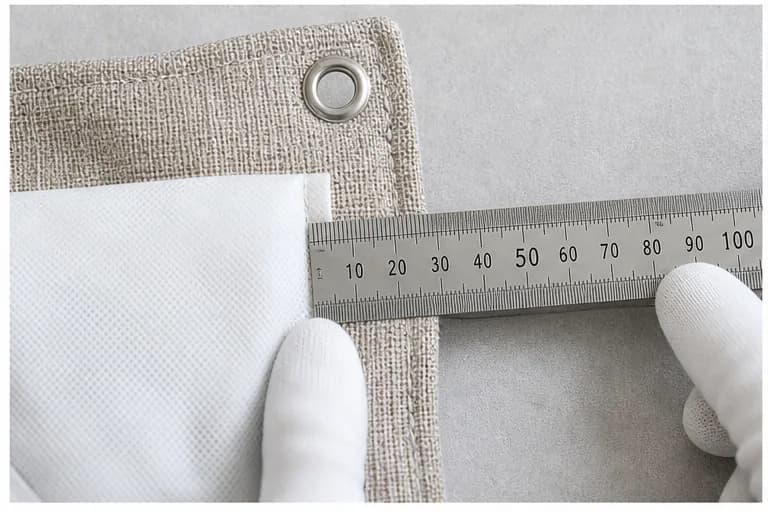
For selected BamveraEco programs, a reference 65 gsm white SMS nonwoven liner is used as the internal pouch. This is a development specification, not a universal standard for every charcoal bag. The buyer should approve the actual liner sample, seam and fill combination.
During inspection, I do not treat "SMS liner" as enough information. We check:
- whether the liner fully encloses the specified fill;
- whether its closure is continuous;
- whether the outer seam can abrade or pinch the inner layer;
- whether handling produces visible dust at seams or eyelets; and
- whether the finished thickness still matches the approved sample.
The liner also changes how the pouch feels. If it is too large, it can fold inside the shell. If it is too small, the finished bag may become tight and uneven. A physical sample is more useful than a material name by itself.
Which outer fabric and branding details should be locked?
Approve the exact fabric, color, cut direction, logo method and artwork position because these details influence both appearance and production repeatability.
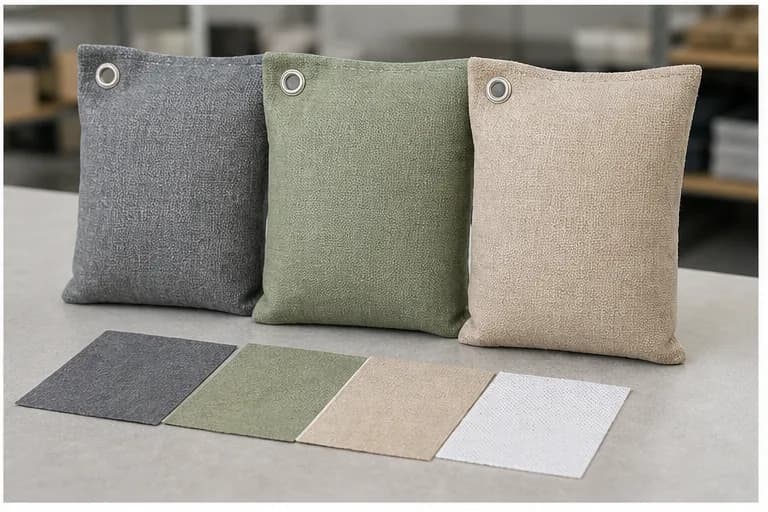
Faux linen is common because it presents well and supports several branding methods, but "faux linen" is still too broad for a purchase specification. Color batches, weave density and hand feel can vary. I ask buyers to approve a swatch beside the finished pouch rather than relying on a screen image.
The branding method should match the artwork. Screen printing suits many flat, limited-color graphics. Heat transfer can support more detailed artwork, while embroidery adds texture but also changes local stiffness and cost. Sewn labels work well when a brand wants consistent identity across several fabric colors. Our customization guide compares these methods with packaging and color options.
Broad environmental terms need particular care. The US Federal Trade Commission advises marketers not to make unqualified general claims such as "green" or "eco-friendly" because they are difficult to substantiate (FTC Green Guides summary). Artwork approval should therefore include the actual claims, not only the logo.
How should fill weight be specified and checked?
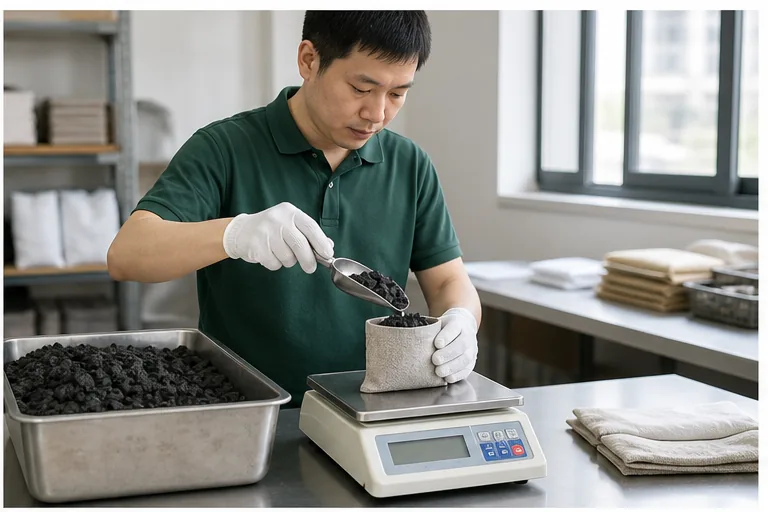
Record nominal net fill, an agreed production tolerance, the weighing method and the finished thickness so purchasing and quality teams evaluate the same product.
Net fill affects cost, shape and handling, but more material does not automatically guarantee a better result. The correct amount depends on pouch dimensions, target placement and the buyer's positioning. Overfilling can create hard corners and strained seams. Underfilling can make the product look flat and inconsistent.
For US packaged goods, NIST Handbook 133 provides procedures for checking net contents and distinguishes lot-average requirements from individual-package requirements (NIST Handbook 133). Your legal and quality teams should determine which rules apply in the destination market. In factory control, we use the approved order specification and documented checks rather than inventing a marketing tolerance.
I recommend that buyers place these items on one approval sheet:
| Approval item | Practical evidence |
|---|---|
| Nominal net fill | Signed sample record and order specification |
| Production tolerance | Written buyer-supplier agreement |
| Scale check | Calibrated or verified weighing equipment record |
| Finished dimensions | Measurement method and sample photo |
| Finished thickness | Reference range under agreed handling condition |
| Pack count | Unit, inner-pack and carton count |
What should be checked before the golden sample is signed?
Open one sample, measure another and handle a third. A useful approval covers construction, appearance, containment, labeling and packing rather than preserving one untouched display piece.
At minimum, I would verify charcoal format, liner closure, outer seams, hardware reinforcement, logo position, net fill, finished size and pack count. If the product will hang in a closet, fit the loop to the intended rail. If it will sit in footwear, check thickness inside the target shoe rather than on a flat table.
Barcode placement also belongs in sample approval. GS1 recommends considering the packaging process and avoiding positions where a barcode can be obscured, folded or damaged (GS1 barcode placement steps). This is easy to miss when the supplier only receives front artwork.
Finally, retain the signed golden sample and an approved specification sheet. One controls what the product should look and feel like; the other records values that a visual sample cannot explain.
Frequently Asked Questions About Bamboo Charcoal Bag Construction
Ask questions that produce evidence: a component list, cutaway sample, fill record, material swatches, artwork proof and packing specification.
Is a liner included in every quoted option?
Not necessarily. Ask the supplier to state the construction of each quotation and confirm it in the sample.
Can the same outside size use different fill weights?
Yes, within practical limits. Each option should be sampled because thickness, seam stress and appearance can change.
Is sunlight "reactivation" a guaranteed restoration process?
Do not treat that phrase as a universal technical guarantee. Care instructions should be based on the finished product and supported claims, with clear limits and replacement guidance.
Should buyers request laboratory data?
Request relevant reports when a claim or market requirement depends on them, but confirm that the test method, sample and scope match the product being sold. A generic material report should not be presented as proof of every finished-product claim.
Conclusion: what construction details belong in the purchase specification?
The most reliable purchase specification joins the charcoal, liner, shell, seam, hardware, branding, fill and pack into one approved product system.
When these parts are reviewed separately and then approved together, quotations become easier to compare and repeat orders are less dependent on memory. That is the practical value of a construction teardown: it turns an attractive pouch into a product a buyer can define, inspect and reorder.
Planning a private-label program? Send your construction brief and request a reviewable sample.