
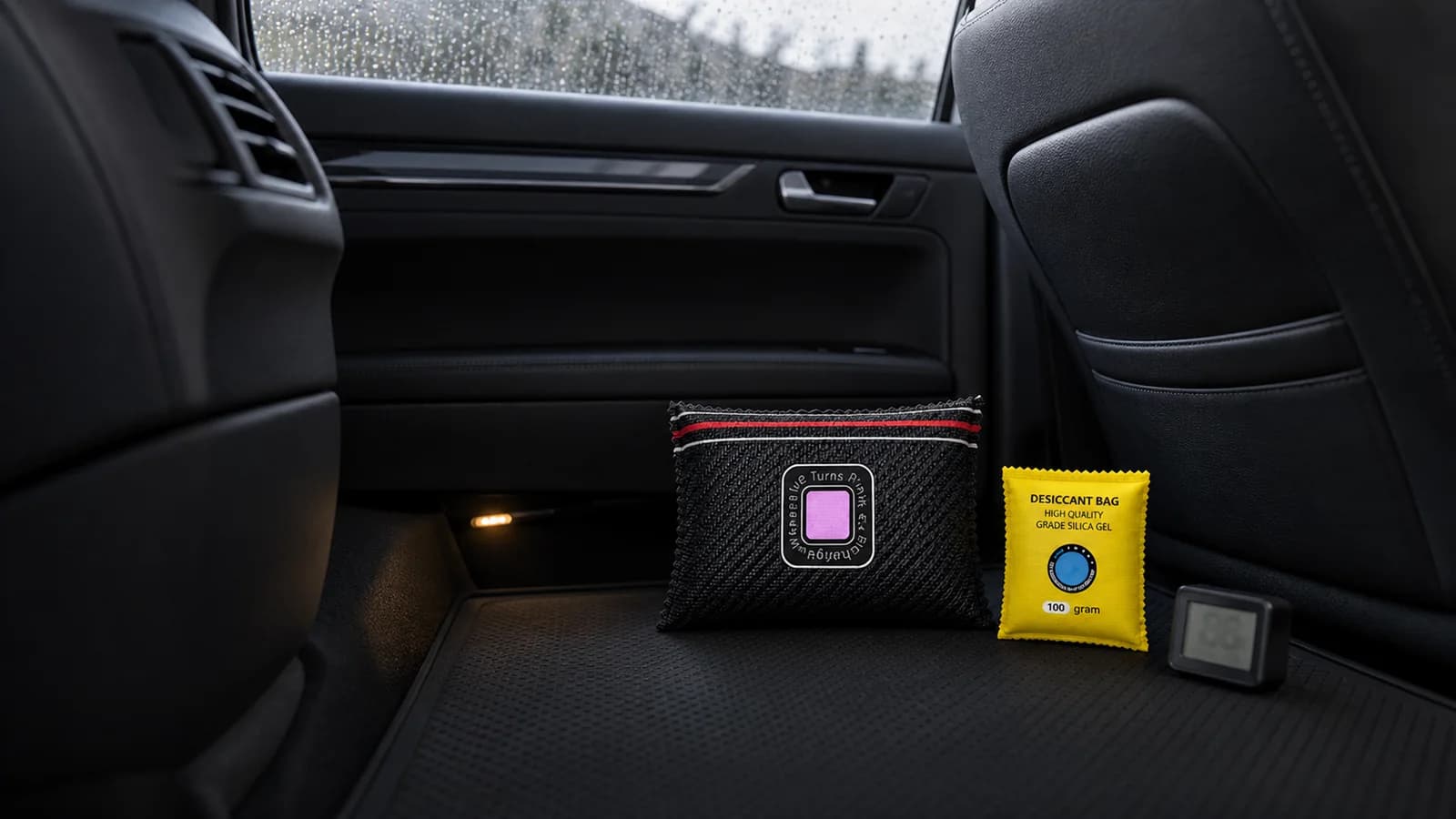
A driver leaves a moisture absorber in the car overnight, finds the windscreen misted again the next morning and decides the bag does not work. That verdict may be right, but the window alone does not tell us whether the product failed or faced the wrong job.
Car dehumidifier bags can reduce water vapour in the surrounding air when they contain enough active silica gel, remain exposed to cabin air and are serviced before saturation. They cannot repair a leak, quickly dry soaked carpet or guarantee clear glass under every weather condition.
The useful evidence begins after the beads are sewn into fabric. In sample reviews, I check fill condition, breathable area, seam integrity, indicator behaviour and the unit-pack seal before discussing performance. Those details explain why two bags labelled "silica gel" can behave differently in the same car.
Do car dehumidifier bags actually remove moisture from the air?
Yes. Silica gel can adsorb water vapour from the air, so a correctly made and correctly used bag can reduce part of the moisture load around it. Its useful effect is finite and depends on the finished bag, the environment and the moisture source.
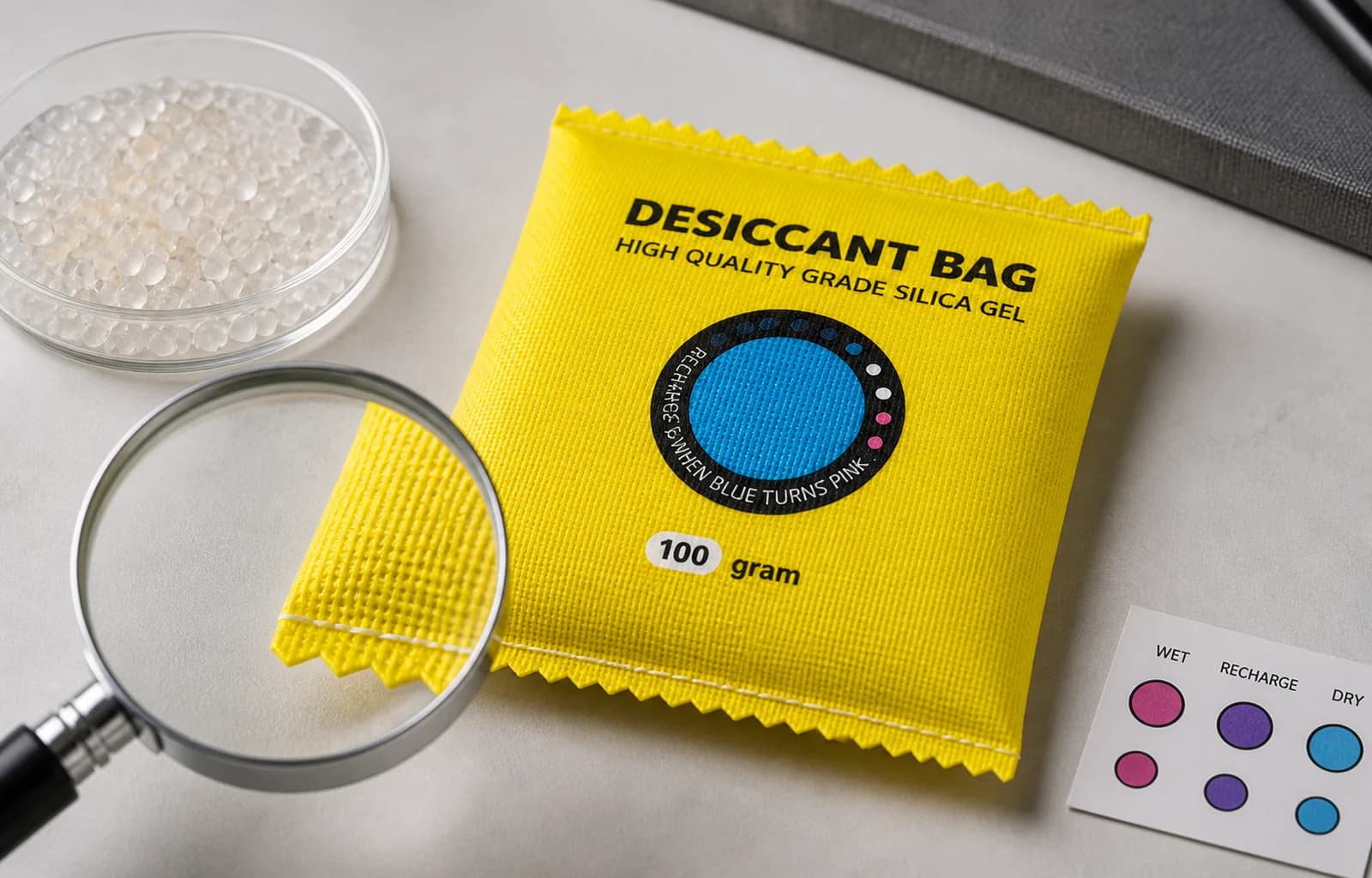
The word is *adsorb*, with a "d." The IUPAC definition of adsorption describes material collecting at an interface. In a silica gel pouch, water molecules are held on the large internal surface of the porous beads. The bag does not pump air, condense water into a tank or soak up a puddle like a towel.
Silica gel also behaves differently at different relative humidity levels. The CCI silica gel bulletin documents how sorbent type, temperature, surrounding humidity, leakage and the amount of material affect passive humidity control. Those variables explain why a result measured on loose beads cannot automatically become a promise for every finished car pouch.
The outer construction matters too. Air must reach the desiccant through a breathable surface, while the seams must contain beads and dust during handling and repeated care. A heavy decorative layer, blocked surface or poorly sealed edge can change the result even when the label lists the same net fill weight.
Which car moisture problems can a passive bag help with?
A reusable silica gel bag is best suited to moderate airborne humidity and residual dampness after the main water source has been removed. It is a supporting product for a parked vehicle, not an emergency drying machine.
Common moisture enters a cabin through wet shoes, damp coats, umbrellas, breathing and humid outdoor air. Small amounts can remain in carpet, fabric and the luggage area after the occupants leave. A passive bag has time to adsorb some of that vapour while the vehicle is parked.
It may also help a car that is used infrequently, provided the interior is otherwise dry and the pouch is checked. A vehicle in storage still exchanges air with its surroundings. Every air exchange introduces another moisture load, which is why no honest supplier can give one service interval for every climate and parking condition.
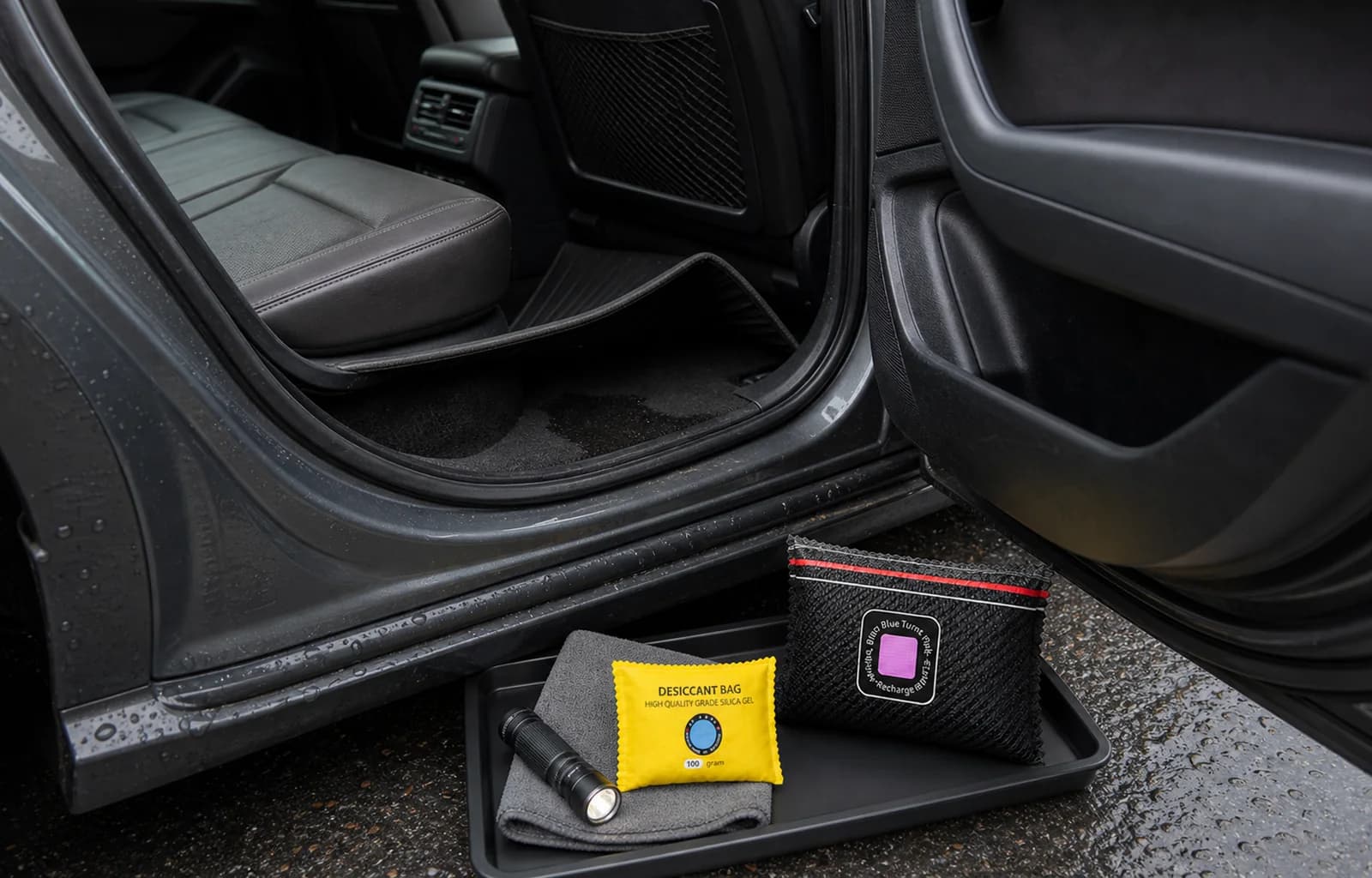
If the cabin has visible liquid water, start with removal, ventilation and source diagnosis. Our guide to getting moisture out of a car covers that sequence. The absorber belongs after the large water load has been dealt with, not before.
What can a silica gel moisture absorber not fix?
A car dehumidifier bag cannot stop water entering the vehicle, replace the demisting system while driving, rapidly dry saturated padding or remove established mold. Continued wetness requires diagnosis and direct drying.
Condensation is not controlled by humidity alone. The NOAA guide to humidity explains that dew point is the temperature at which water vapour condenses into liquid droplets. A cold windscreen can therefore mist even when a bag has removed some vapour, especially after passengers enter with wet clothing or the outside temperature drops sharply.
| Observed problem | Can a passive bag help? | More important first action |
|---|---|---|
| Light residual humidity after wet shoes | It may reduce part of the vapour load while parked | Remove or dry the wet items and ventilate when practical |
| Windscreen mist after a cold night | It may reduce one contributing factor | Use the vehicle maker's demisting settings before driving |
| Damp carpet returning after rain | Not until the entry path is controlled | Inspect seals, drains, glazing and the area beneath the carpet |
| Standing water or soaked padding | No, the load is too large for passive treatment | Extract water and dry the affected materials directly |
| Visible mold or persistent musty contamination | It is not a cleaning or remediation method | Correct the moisture source and arrange appropriate cleaning |
| Exterior body corrosion | No | Address coating damage, road salt and exterior water exposure |
The EPA moisture and mold guide makes the same practical distinction for buildings: moisture control starts with drying wet surfaces and fixing the water source. A humidity-control product may support a drier environment, but it does not clean existing growth or make a leak harmless.
Why can a car dehumidifier bag appear not to work?
The most common explanations are saturation, insufficient active material, restricted air contact, poor placement, an unsealed product before first use or a moisture source that continually adds water faster than the bag can manage.
A driver usually sees the symptom, not the moisture balance. If the windscreen still mists, several different conditions may be hiding behind the same result.
- The silica gel is already carrying moisture. A pouch stored without a moisture-barrier unit pack may begin adsorbing during transport, warehousing or retail display. It can arrive with less useful capacity than expected.
- The indicator has reached its service state. An approved color indicator can help signal when care is due, but it is not a cabin hygrometer and does not measure the remaining capacity of every bead.
- The fill is too small for the job. Vehicle size is only one factor. Climate, wet materials, parking duration and air exchange can matter just as much.
- Air cannot reach enough pouch surface. A bag buried under luggage or pressed tightly inside a closed compartment has less useful exposure than one secured in an open, protected position.
- The source keeps replenishing the moisture. A blocked drain or leaking seal can add far more water than a passive pouch removes.
- The expected result is unrealistic. A bag can support overnight moisture management, but it cannot clear the driver's view quickly enough for safe departure. Climate controls and the approved demisting procedure have priority.
The CCI enclosure guidance shows why a fixed grams-per-space rule is unreliable. The amount of sorbent needed changes with air exchange, target humidity range, external conditions, duration and sorbent performance. A car is not a sealed museum case, but the governing lesson still applies: a more open, variable space creates a less predictable passive result.
How can a driver tell whether the bag is working?
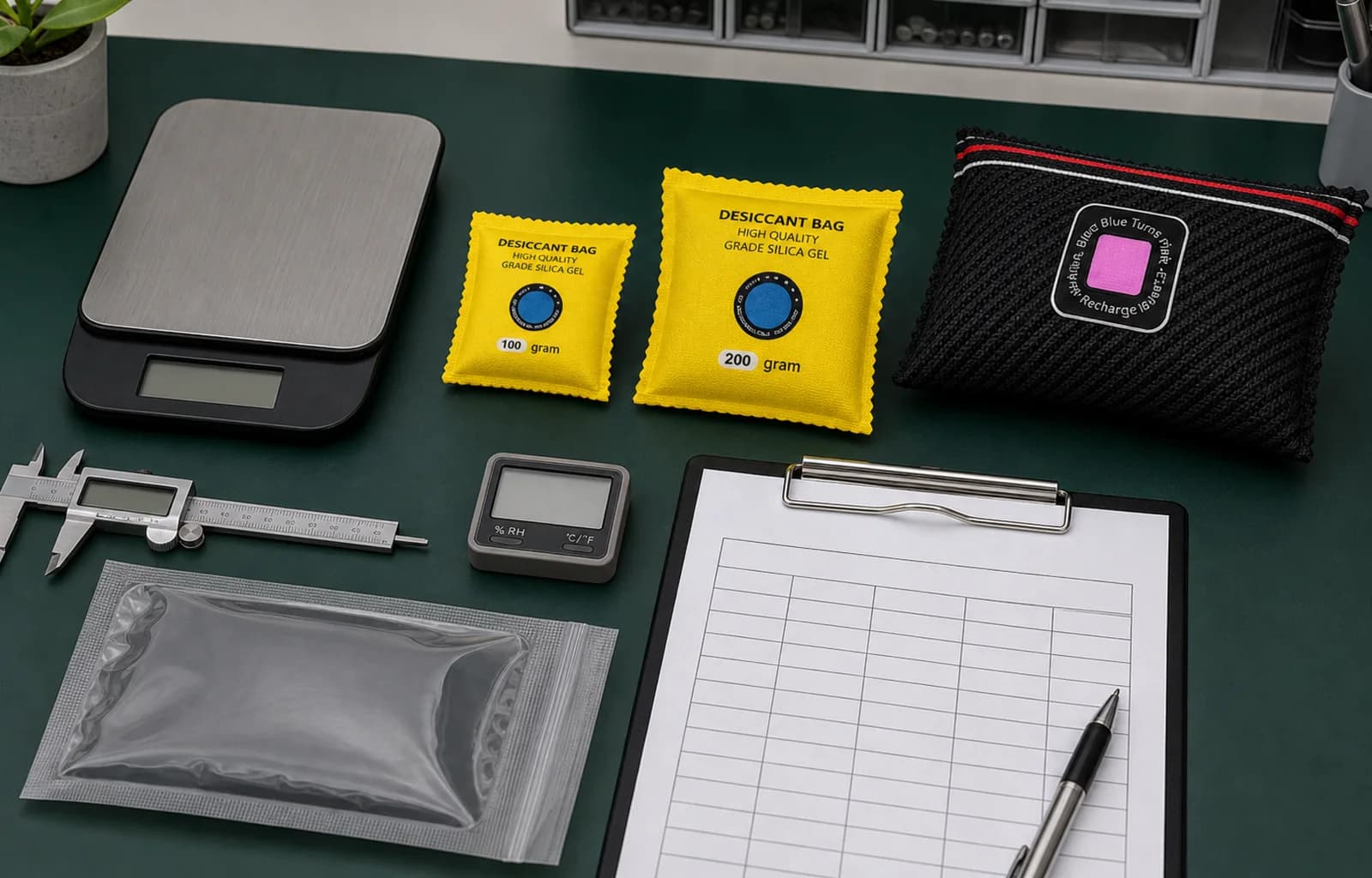
Use more than a fogged window as the test. Check the approved indicator, track the pouch under repeatable conditions and monitor cabin humidity alongside temperature, while keeping weather and moisture sources as consistent as practical.
A simple observation plan is more useful than a dramatic one-night demonstration:
- Begin with a cabin that has no active leak, standing water or soaked padding.
- Record where the pouch is placed and keep it secured in the same exposed position.
- Note the indicator state under neutral light before use.
- Use a reliable hygrometer to record cabin relative humidity and temperature at consistent times.
- If the care instructions allow weight tracking, use the same scale and procedure each time. Do not invent a saturation threshold that the supplier has not approved.
- Record rainfall, wet items and major temperature changes because they alter the moisture load.
- Repeat the observation over several comparable cycles instead of treating one morning as conclusive.
This does not turn a parked car into a laboratory. It does reveal obvious problems. A pouch that arrives at the service color, changes unusually quickly or shows no repeatable response deserves investigation before anyone increases the quantity or rewrites the claim.
For a product team, the stronger method is a defined sample comparison. Agree on the vehicle or test space, starting conditions, placement, measurement points, observation period and pass criteria before testing. Compare the finished retail sample, not loose silica gel in a separate container.
Review your moisture-absorber sample with the intended fill, indicator, unit pack and retail claim before artwork is approved.
Do car dehumidifier bags stop condensation, mold and odors?
They may reduce airborne moisture that contributes to condensation and damp conditions, but "stops condensation," "prevents mold" and "removes odors" are broader claims that need product-specific evidence and clear limits.
A short claim can imply more than the writer intended. "Helps manage moisture while parked" describes a supporting role. "Keeps windows fog free" sounds like a result the customer can expect across vehicles, climates and moisture loads. Those are not equivalent statements.
Silica gel is selected for moisture adsorption. It should not be presented as though it has the same primary function as a charcoal odor adsorber, fragrance product or antimicrobial treatment. If the target problem is mainly odor rather than humidity, compare the intended functions before choosing a format. Our car dehumidifier comparison separates passive silica gel, salt absorbers, electric units and vehicle climate controls by job.
Mold language needs particular care. Lowering humidity can make conditions less favorable for growth, but the bag does not remove spores, clean contaminated fabric or guarantee that hidden surfaces stay dry. A damp smell may also come from wet padding, drainage, the cabin filter area or old contamination rather than from airborne humidity alone.
What should importers verify before approving performance claims?
Verify the finished product, the intended use and the exact wording together. A raw-material data sheet does not by itself substantiate how a sewn, printed and packaged pouch will perform in a customer's vehicle.
The FTC advertising guide states that objective performance and effectiveness claims need a reasonable evidence basis before publication. The destination market may apply different rules, but the commercial principle is useful anywhere: define the claim first, then collect evidence that matches it.
An approval file should connect the following items:
| Review item | What to document | Why it matters |
|---|---|---|
| Intended application | Parked car, luggage area, small storage space or another approved use | Defines the environment behind the claim |
| Silica gel specification | Type, fill condition and supplier documentation | Identifies the material actually sampled |
| Net fill and dimensions | Tolerance and measurement method | Prevents a nominal size from hiding underfill or construction drift |
| Bag construction | Breathable area, seams, fabric, print and indicator position | Connects material data to the complete pouch |
| Indicator system | Chemistry, dry and service references, viewing conditions | Prevents color language from becoming a capacity claim |
| Unit packaging | Moisture-barrier structure and sealing check | Protects useful capacity before first use |
| Care method | Procedure validated on each finished construction | Keeps generic heating advice off an untested label |
| Performance wording | Test condition, limitation and prohibited overstatement | Keeps the retail promise inside the evidence boundary |
I would not approve "absorbs 200 ml," "works for three months" or "prevents mold" simply because a similar item uses that language online. Each number needs a defined method, starting condition and representative finished sample. If those details are missing, a narrower claim is more defensible and usually more useful to the customer.
The service instructions matter after purchase as well. A saturated bag cannot keep adsorbing indefinitely. The guide to recharging a car dehumidifier bag explains why heating time and method must be approved for the complete pouch rather than copied from a generic silica gel instruction.
Frequently asked questions about car dehumidifier bag performance
How long does a car dehumidifier bag take to work?
There is no universal time. A passive pouch begins interacting with surrounding air when it is exposed, but a noticeable result depends on the starting humidity, airflow, active fill, cabin volume, temperature and continuing moisture load. It is not a rapid windscreen-clearing device.
How many dehumidifier bags should I put in a car?
There is no reliable number based only on vehicle class. Start with the approved product guidance, keep the placement consistent and monitor the indicator and cabin conditions. If the bag saturates quickly, investigate hidden moisture before simply adding more pouches.
Where should a car moisture absorber be placed?
Choose a stable, exposed location where the pouch cannot reach pedals, controls, seat mechanisms, vents or the driver's sightline. A secured rear floor or protected luggage-area position is often easier to manage than a dashboard.
Does a pink indicator prove the bag is full?
It shows that the approved indicator has reached its service color under the stated viewing conditions. It does not directly measure cabin humidity or prove the exact remaining capacity of all the silica gel inside the pouch.
Can small silica gel packets replace a car dehumidifier bag?
Small packets use the same broad material principle, but their active fill and finished construction may be intended for packaging rather than an open vehicle cabin. Do not combine packets or assume equivalent performance without a defined application and test.
Can the same moisture absorber be used at home?
Sometimes, in a small closet, cabinet or storage area covered by the product instructions. A car pouch is not automatically suitable for a bathroom, basement or whole room. Placement risks, room volume, moisture source and care access all need review.
Conclusion: when is a car dehumidifier bag worth using?
A car dehumidifier bag is worth considering when the vehicle is already free of active leaks and bulk water, the remaining problem is moderate airborne or residual moisture, and the user can place, check and service the pouch as instructed.
The decision rule is practical. Use the bag for the moisture job it can perform. Use ventilation, demisting, direct drying and repair for the jobs it cannot. For a retail program, test the complete sample under defined conditions and write the claim from the result, not from a competing listing.
If you are comparing fills, pouch constructions or packaging options, review the reusable car dehumidifier bag range and share your product brief. We can discuss the intended application, sample variables and evidence boundary before the artwork turns an assumption into a promise.