
The first number in many charcoal-bag inquiries is the fill weight. That sounds precise, but grams alone can lead to a pouch that crowds a shoe, disappears inside a wardrobe or creates packaging the customer cannot easily understand.
Choose pouch size and fill weight from the application first: available space, placement, airflow, odor source, pack count and customer instructions. Then approve dimensions, net fill, particle format, liner, fabric and finished thickness together through a physical sample.
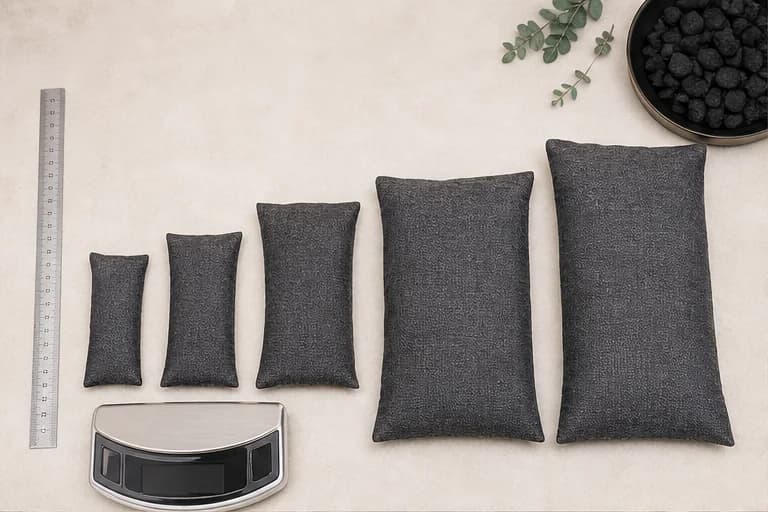
I usually ask a buyer to show me the intended placement before we discuss a final gram weight. It is a simple step, but it exposes clearance, hanging and set-count issues early. The sections below turn that placement into a size matrix a factory can sample and inspect.
What is the practical sizing answer for buyers?
There is no universal bamboo charcoal bag size for every space. Select the format by working backward from the application: enclosure volume, placement, available clearance, airflow, odor source, pack count and customer instructions. Then approve dimensions, charcoal net fill, particle format, pouch breathability and dust containment together.
A 500 g pouch is not automatically “five times better” than a 100 g pouch. It contains more material, but performance is also affected by whether air can reach the charcoal and whether the product fits the use context. The US EPA air-cleaner guide offers useful context on the limits of adsorption media. A compact shoe pouch can be better designed for footwear than a large home bag, even though it contains less charcoal.
One of the most common briefs I receive starts with a target weight, usually 200 g or 500 g. That is useful, but it is only the beginning. For private-label sourcing, I treat grams as one line in a complete specification, not as a stand-alone performance guarantee.
Why should sizing start with the application?
Before I recommend a sample format, I ask the buyer six questions:
- Where will the customer place the product?
- Is the space open, semi-enclosed or enclosed?
- What is the likely odor source and how strong is it?
- How much physical clearance is available?
- Will the product lie flat, hang or attach to another surface?
- How many pouches will be sold and used as one set?
These answers influence both product engineering and retail copy. “200 g charcoal bag” tells a buyer very little. “200 g hanging pouch for dry wardrobe storage, sold as a two-pack” is a specification direction that a supplier can sample and a customer can understand.
Which reference sizes and fill weights should buyers compare?
The following formats are practical starting points based on BamveraEco's current product-development range. I use them to start a buyer conversation, not to make universal coverage or performance claims. Dimensions and mass should follow consistent units such as those described in the NIST SI units resource. Fill, fabric, attachment and pack count can all change after we review the sample.
| Application | Reference net fill | Example dimensions | Development notes |
|---|---|---|---|
| Slim shoe pouch | 50 g | 16.5 × 6.5 cm | Compact format for one pouch per shoe |
| Standard shoe pouch | 75–85 g | approx. 17.5 × 7.5–8 cm | More finished thickness; confirm footwear fit |
| Shoe/storage pouch with hook | 100 g | approx. 18 × 8 cm | Suitable where hanging or retrieval is useful |
| Closet or car pouch | 200 g | approx. 18 × 14.5 cm | Eyelet, cord or flat placement can be developed |
| Headrest cushion | 360 g | approx. 31 × 13 × 6 cm | Attachment and driver-clearance review required |
| Large home or dry pet-area pouch | 500 g | approx. 20 × 22 or 22 × 27 cm | Placement and keep-away-from-chewing copy required |
The same nominal weight can be made in different shapes. A long, shallow pouch and a compact, thick pouch will present differently, even if both contain 200 g. Shape affects placement, air contact, shipping volume and perceived retail value.
Why is fill weight alone an incomplete specification?
Charcoal specification
Two pouches with the same net fill can use different charcoal feedstock, carbonization conditions, particle distributions and dust levels. Buyers should approve the actual material specification rather than compare grams alone.
Pouch surface area
A flatter pouch generally exposes a wider fabric area to surrounding air. A very thick pouch may be visually substantial but can concentrate the fill in the center. The best geometry depends on available placement space and construction.
Inner-liner and outer-fabric breathability
The material system must balance airflow and particle containment. BamveraEco offers a reference 65 gsm white SMS nonwoven inner-liner construction for selected programs. Fabric weight, coatings, print coverage, liner and seams should be approved as one sample because each can influence air contact.
Particle format and finished thickness
Particle size changes how the fill settles and how thick the finished pouch becomes. The golden sample should record particle presentation, dimensions after filling and acceptable thickness—not only the cut size of empty fabric.
Placement and airflow
A pouch squeezed beneath stored items has less exposed surface than one hanging freely. A vehicle headrest format experiences different airflow and heat from a drawer pouch. Placement instructions are part of the product design.
Which format works for footwear and sports gear?
With footwear, I look at fit before I look at the largest available fill weight. A slim 50 g pouch is a useful starting point because it can enter many shoes without stretching the upper. Buyers can then sample 75 g or 85 g versions for boots and wider footwear, or consider a 100 g hook format for lockers and storage. See our footwear and sports-gear application page for placement-specific development points.
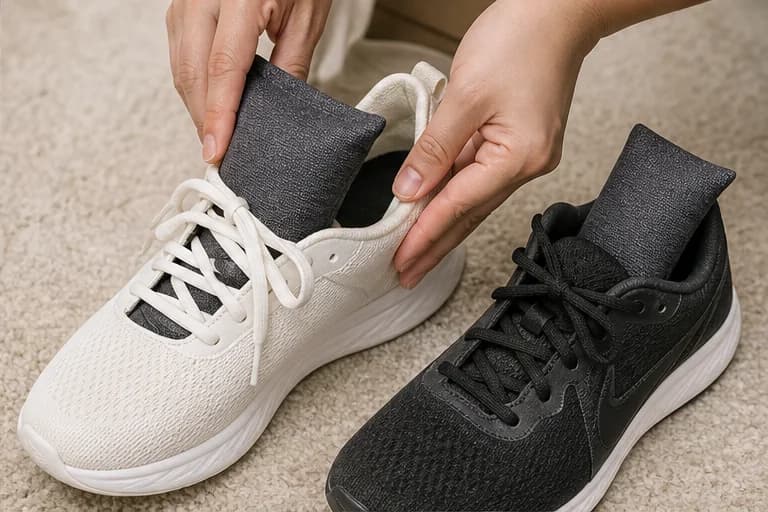
Confirm these items before artwork:
- Finished width, length and thickness
- One pouch per shoe or another set count
- Eyelet, retrieval loop or no attachment
- Fabric friction against delicate linings
- Dust containment after repeated handling
- Instructions to use only in dry footwear
- Unit packaging and suffocation-warning requirements where applicable
Do not promise that one dimension fits every shoe. A buyer serving work boots, children's footwear and athletic shoes may need more than one format or carefully qualified fit language.
Which format suits closets, drawers and storage?
A 200 g pouch is a common development starting point for wardrobes and enclosed storage. It is large enough to create visible retail value yet manageable for hanging or shelf placement. However, the correct set depends on enclosure size, airflow, loading and the buyer's intended instructions. Our home and storage guidance explains how to map those conditions before sampling.

For shallow drawers, two smaller pouches may fit better than one thick bag. For a wardrobe rail, an eyelet or reinforced hanging loop may be preferable. For folded textile storage, flat construction and a soft outer fabric may matter more than a decorative cord.
Use application-specific copy such as “place in a dry wardrobe with air space around the pouch.” Avoid a universal square-foot coverage statement unless it is supported by a defined, reproducible test.
Which format fits automotive interiors?
Vehicle programs require more than selecting 200 g or 360 g. Buyers must consider heat, sunlight, movement and placement safety. The automotive-interior application guide covers attachment and driver-clearance questions that belong in the brief.
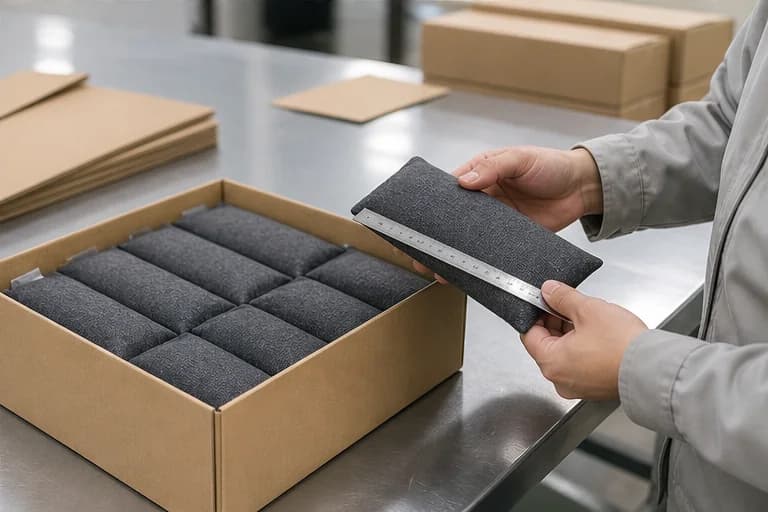
A compact 200 g pouch can be developed for a seat-back pocket, trunk organizer or other secure location. A 360 g headrest cushion offers a larger visual format, but its straps, cord length and finished dimensions must be checked in a representative vehicle.
Approval should cover:
- Intended vehicle location
- Driver visibility and control clearance
- Seat and safety-equipment clearance
- Attachment security under movement
- Material and print review for hot parked-vehicle conditions
- Fragrance-free positioning and claim boundaries
- Care, warnings and replacement guidance
Never tell users to place loose products near pedals, controls or airbags.
Which format suits dry pet living areas?
A 500 g pouch can support private-label programs for dry pet-bed, crate-storage or pet-accessory areas because it offers a larger fill and branding surface. The bag should remain dry and be positioned out of reach of chewing.
Pet odor often requires source management: laundering bedding, cleaning surfaces, maintaining litter and addressing accidents. Packaging should not imply that a passive pouch makes those steps unnecessary.
For direct litter mixing, use a product formulated and instructed for that use rather than opening a bamboo charcoal pouch. BamveraEco's pet-care range treats litter deodorizer granules and finished 500 g pouches as separate formats with different ingredients, directions and warnings.
Mid-article CTA — Ask for a specification recommendation
Send the intended space, placement, desired pack count and target quantity. We can suggest reference dimensions and fill weights for sample review.
How many charcoal bags should an end user place?
There is no defensible universal count based only on room area. A better instruction starts with a defined enclosure and a tested product set.
For development purposes, buyers can compare one proposed set against another under similar conditions. For example:
- One 50 g pouch in each shoe versus one larger pouch placed nearby
- One 200 g hanging pouch versus two smaller pouches in different wardrobe zones
- One secured 200 g vehicle pouch versus a 360 g headrest format
Record enclosure, placement, time, temperature, humidity and odor source. The result can support the selected retail set without pretending that the same count applies to every home or climate.
How does packaging change the product experience?
Private-label buyers often focus on the pouch and leave packaging until late in sampling. That can create avoidable changes.
Unit pack and set count
A pair of shoe pouches, two-pack closet set and single 500 g pouch have different packaging footprints. Confirm whether products are compressed, stacked or separated and whether the customer can understand the intended number to use.
Retail box and instructions
Care copy, warnings, barcode area and translations require space. The US Consumer Product Safety Commission business guidance helps suppliers identify product-safety responsibilities. A beautiful small box can fail if mandatory information is added after dieline approval.
Export carton
Fill weight affects shipping mass. Pouch shape affects carton utilization. Confirm unit count, inner pack, master-carton dimensions, gross/net weight and pallet requirements after the final product and retail pack are approved.
What belongs in a sample approval checklist?
Use this list for every size in the range:
- Application and intended placement
- Finished dimensions and tolerance
- Net fill and tolerance
- Charcoal identity and particle presentation
- Inner-liner specification
- Outer fabric and color reference
- Finished thickness and shape
- Seams, corners, eyelets, loops or straps
- Print, embroidery or sewn-label position
- Pack count and user instructions
- Retail pack and barcode area
- Inner pack and export-carton data
Keep a coded golden sample. Future bulk and repeat orders should be compared with that reference rather than with a catalog photograph.
What do buyers frequently ask about size and fill weight?
What is the best bamboo charcoal bag size?
The best size is the smallest practical format that provides the approved fill, breathability, containment and placement for the intended use. There is no single best size for shoes, closets, cars and pet areas.
Is a 500 g charcoal bag better than a 200 g bag?
Not automatically. It contains more charcoal, but it may be unsuitable for a narrow space. Compare material, construction, exposed area, airflow and application—not grams alone.
Can I order a custom fill weight?
Yes. Custom fill normally requires agreement on dimensions, finished thickness, tolerance, particle format, packaging and MOQ. A physical sample should be approved before bulk production.
Should a charcoal pouch be tightly packed?
The target firmness depends on format. Excessive compression can change shape and air contact, while a very loose pouch may look underfilled. The approval sample should define the finished hand feel and thickness.
Can the same 200 g bag be marketed for home and car use?
The physical pouch may be adaptable, but automotive placement, attachment, heat review and warnings differ from home storage. Use market-specific packaging and directions.
What fill-weight tolerance should buyers request?
The buyer and supplier should agree a realistic tolerance based on the filling process, scale resolution, product size and applicable market rules. NIST Handbook 133 is a useful reference for checking net contents of packaged goods. The tolerance and inspection method should appear in the approved specification.
What is the minimum order quantity?
BamveraEco publishes a reference MOQ from 2,000 bags for selected standard configurations. Custom fabric, color, printing, embroidery, packaging and fill can change the final MOQ.
Conclusion: How should buyers make the final format decision?
Choosing a bamboo charcoal bag is not a matter of selecting the largest gram number. Start with the space, customer behavior and placement. Then develop geometry, fill, breathability, liner, attachment and packaging around that use.
My recommendation is to choose the smallest format that fits the intended placement and then test whether its full specification supports the buyer's use and pack concept. Packaging and performance wording should remain specific and supportable, as the FTC Green Guides advise for environmental claims. This approach avoids a common sourcing mistake: comparing suppliers on nominal weight while overlooking the variables that shape the customer experience.
Final CTA — Build your size matrix
Tell us the application, target dimensions, preferred fill, logo method, pack count and order quantity. BamveraEco will review the brief and prepare a practical sample path.