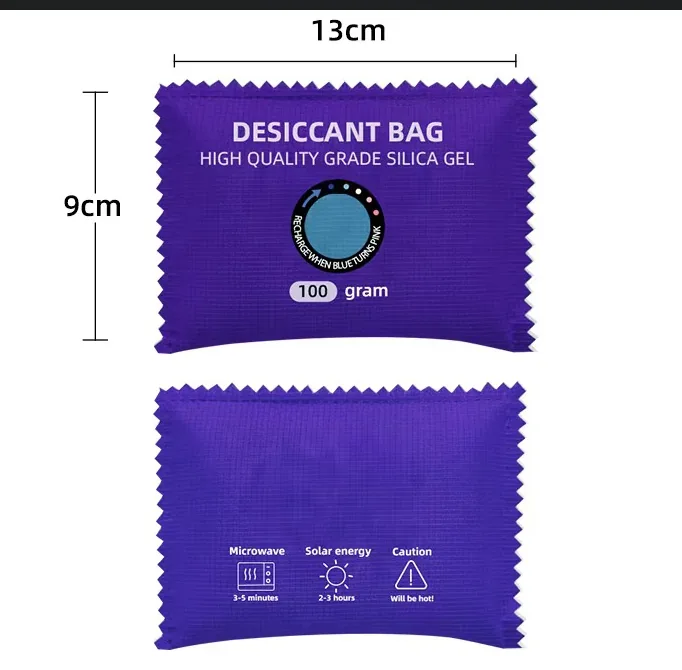
Compact cabin placement
- Reference size
- 13 x 9 cm
- Starting use
- Small vehicles, door pockets or secured placement near a seat

Automotive Products/Car Dehumidifier Bags
Factory-direct / Silica gel / OEM & wholesaleDevelop reusable car moisture absorbers for automotive accessory, RV, camper and marine retail programs. Customize silica gel fill, dimensions, fabric, indicator window, logo, care instructions and packaging.
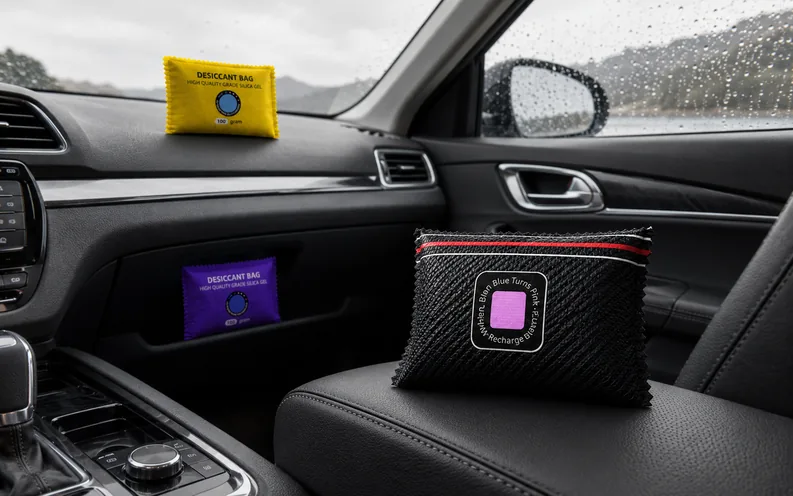
A car dehumidifier bag is a breathable pouch filled with silica gel that adsorbs water vapor from the surrounding vehicle air. Unlike a bamboo charcoal deodorizer, its primary job is moisture control rather than odor adsorption.
The silica gel is specified for uniform particle condition and repeatable regeneration. Performance still depends on cabin volume, humidity, ventilation, wet materials, water ingress, placement and the bag's remaining adsorption capacity.
Buyer claim boundary A moisture absorber can support condensation management, but it cannot repair failed seals, drainage problems or persistent vehicle leaks.
The viewing window provides a practical service cue. As the silica gel takes up moisture, the approved indicator changes from blue toward pink; after a validated drying cycle, it returns toward blue.
Specification note: Indicator chemistry is not interchangeable. Buyers should document the approved chemistry and confirm whether a cobalt-free system is required by their customer or destination market.
Blue indicates the reference dry state before the next moisture-control cycle.
A gradual color transition shows that the material is taking up moisture.
Pink signals that the approved care instructions should be followed before reuse.
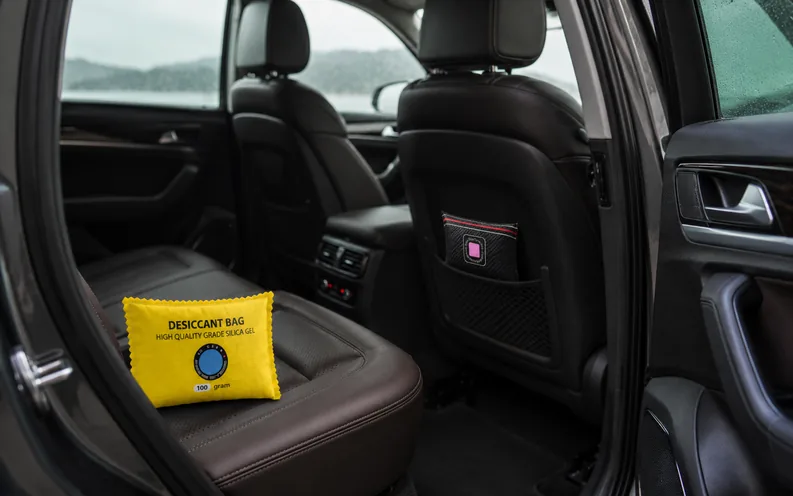
Fill weight should be selected with the vehicle volume, expected moisture load, placement space, regeneration frequency and retail price position in mind.
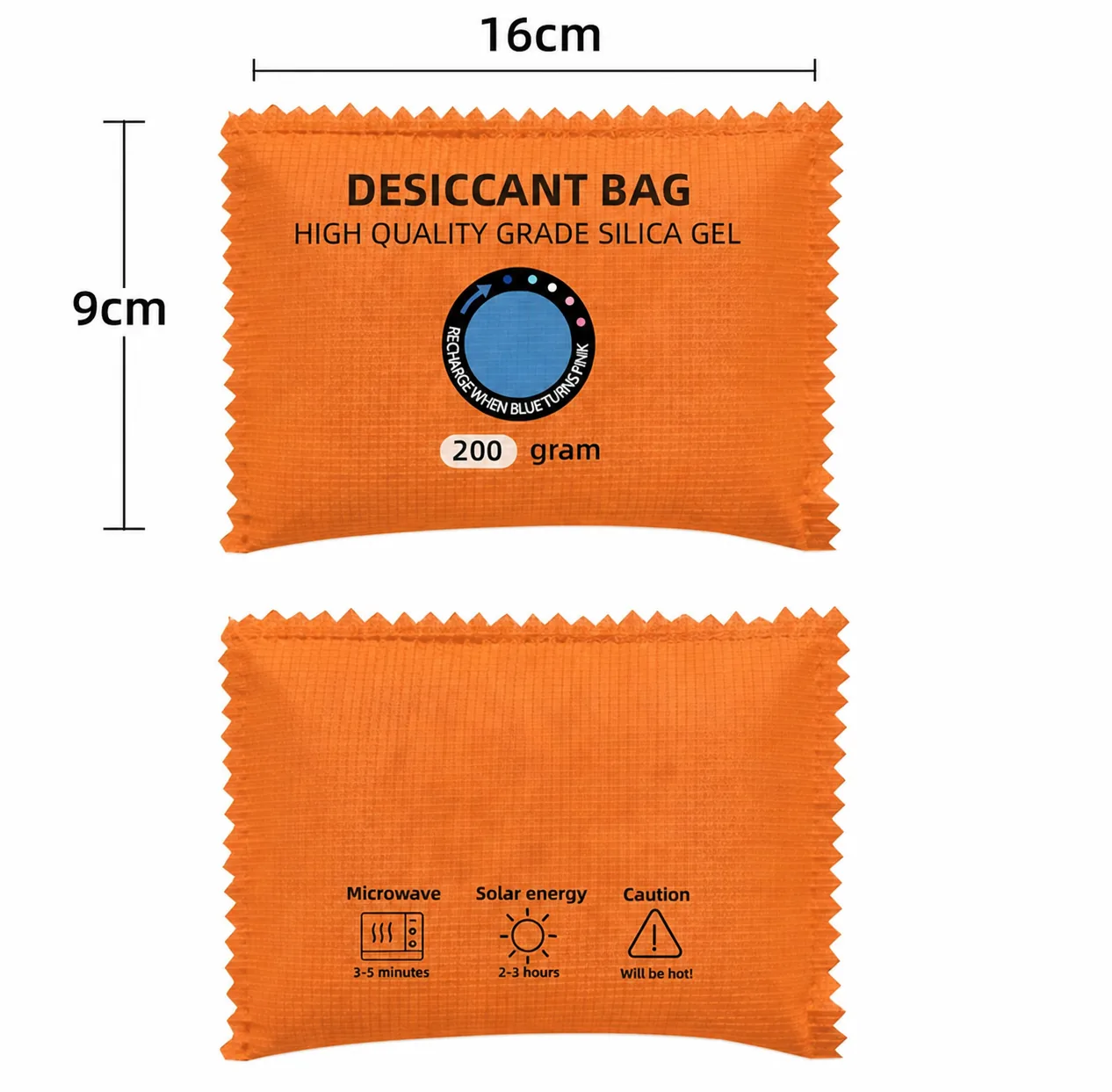
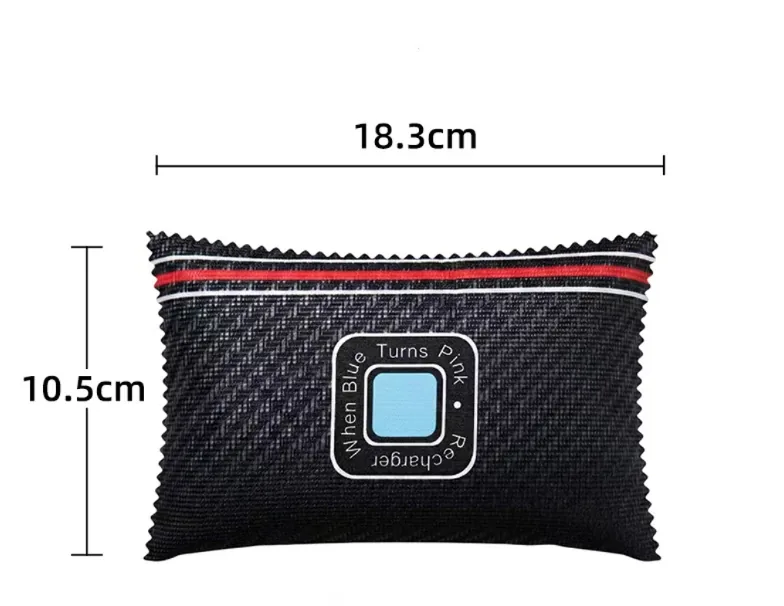
Reference dimensions are common starting formats, not fixed tolerances. Final fill, thickness, cut size and finished measurements are locked by the approved sample.
Keep the bag stable and clear of seat rails, pedals, wiring and airbag deployment zones.
Never leave a loose bag where it can obstruct the driver, controls, vents or windscreen sightlines.
Position away from spills and sharp cargo, with enough exposed fabric for air contact.
Larger or multiple formats may be evaluated for seasonal storage and enclosed transport interiors.
The heating method belongs to the complete approved product, not to silica gel alone. Fabric, printing, indicator window, seams and packaging instructions must all be suitable for the selected route.
A development trial may begin around 600W with short, supervised intervals, but this is not a universal end-user instruction. A 100g, 200g and 400g format can require different timing because fill weight, fabric, indicator chemistry and finished construction affect heating behavior.
Final wattage, interval length, total time, cooling guidance, warnings and any alternative drying route must be validated on the exact physical sample and printed on the approved care label.
Build the bag, care system and retail pack as one approved product rather than treating the logo as the only private-label variable.
100g, 200g or 400g reference fills, plus buyer-developed dimensions and finished thickness.
Breathable heat-suitable outer material in approved standard or order-specific colors.
Window position, visible color reference and regeneration cue confirmed by sample.
Surface printing, woven label or other feasible branding route with approved placement.
Use, regeneration, cooling, storage and warning copy developed for the destination market.
Unit pack, multipack, kraft box, color box, barcode area and export-carton configuration.
The golden sample should lock the moisture-control material, complete bag construction, user instructions and retail presentation.
Confirm bead consistency, dry condition, indicator response and agreed fill-weight tolerance.
Check dimensions, fabric breathability, seams, indicator window security and surface printing.
Document the indicator chemistry, including any cobalt-free requirement, and validate the heating route, timing, cooling guidance and warnings.
Lock unit protection, instructions, barcode area, multipack count, cartons and order-specific documents.
Technical guidance reviewed July 2026 by the BamveraEco product development team. Material specifications, care copy and destination-market documentation remain subject to the approved sample and buyer requirements.
Use these guides to diagnose cabin moisture, compare product types and maintain a reusable bag safely.
Follow a practical sequence for finding leaks, drying wet materials, improving ventilation and choosing a moisture absorber.
Read the guide Four options comparedCompare reusable silica gel bags, electric units, calcium chloride absorbers and the vehicle climate system.
Compare the options Reuse and care instructionsCheck the indicator, finished construction, approved heating route, cooling steps and replacement signs.
Review safe reuseIt uses silica gel to adsorb water vapor from the surrounding air. It can support moisture management in an enclosed vehicle, but it does not repair water leaks, replace ventilation or guarantee condensation-free windows.
It may help manage airborne moisture that contributes to condensation. Results depend on cabin volume, outside temperature, wet items, ventilation, leaks and the number and capacity of bags used.
The approved indicator window is designed to change from blue toward pink as the silica gel takes up moisture. The exact color threshold and indicator chemistry must be confirmed on the production sample and care label.
Only an approved microwave-compatible construction should use microwave regeneration. Wattage, interval length and total time must be validated for the exact fill weight, fabric, indicator chemistry and finished sample, then printed with the required warnings for the destination market.
A program may be developed around repeated regeneration for up to two years, but actual service life depends on moisture load, regeneration frequency, fabric condition, indicator performance and care. It should not be presented as an unconditional guarantee.
Yes. Buyers can specify fill weight, dimensions, fabric color, printed logo, indicator position, care label, unit pack, multipack and retail box, subject to feasibility and sample approval.
Send the target vehicle, placement, quantity, fill weight, fabric, indicator, logo and packaging brief. We will recommend a practical sample route for approval.