
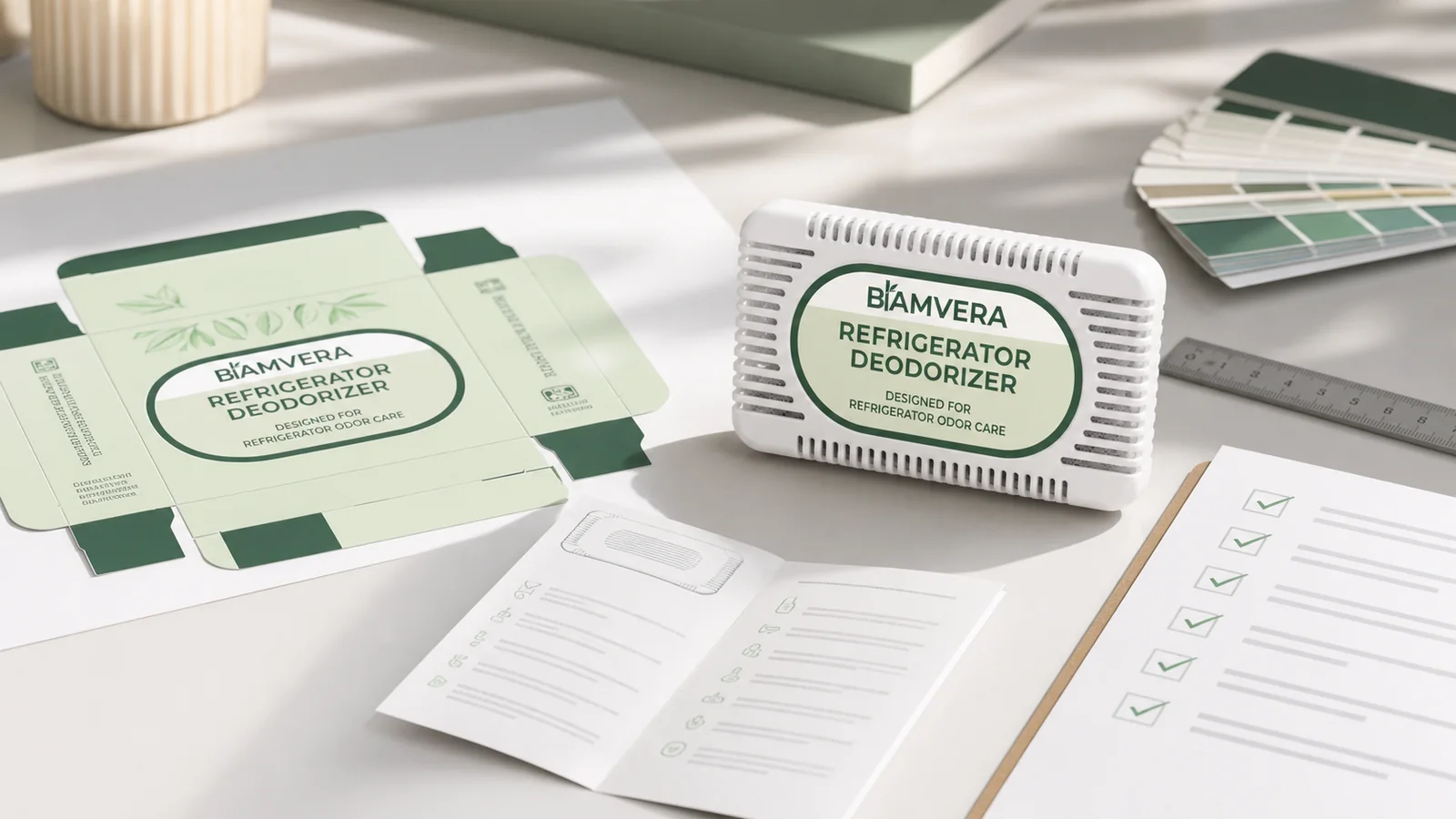
The carton artwork is almost ready. The barcode has a quiet zone, the green matches the approved swatch and the product dimensions fit the dieline. One sentence on the front panel is still doing more work than the rest: "Reusable After Sun Drying."
A buyer should approve that sentence only after the complete refrigerator deodorizer, proposed care method and repeated-use records tell the same story. Bamboo charcoal alone does not prove that the housing, liner, label and odor-care function will remain suitable after an unspecified spell in the sun.
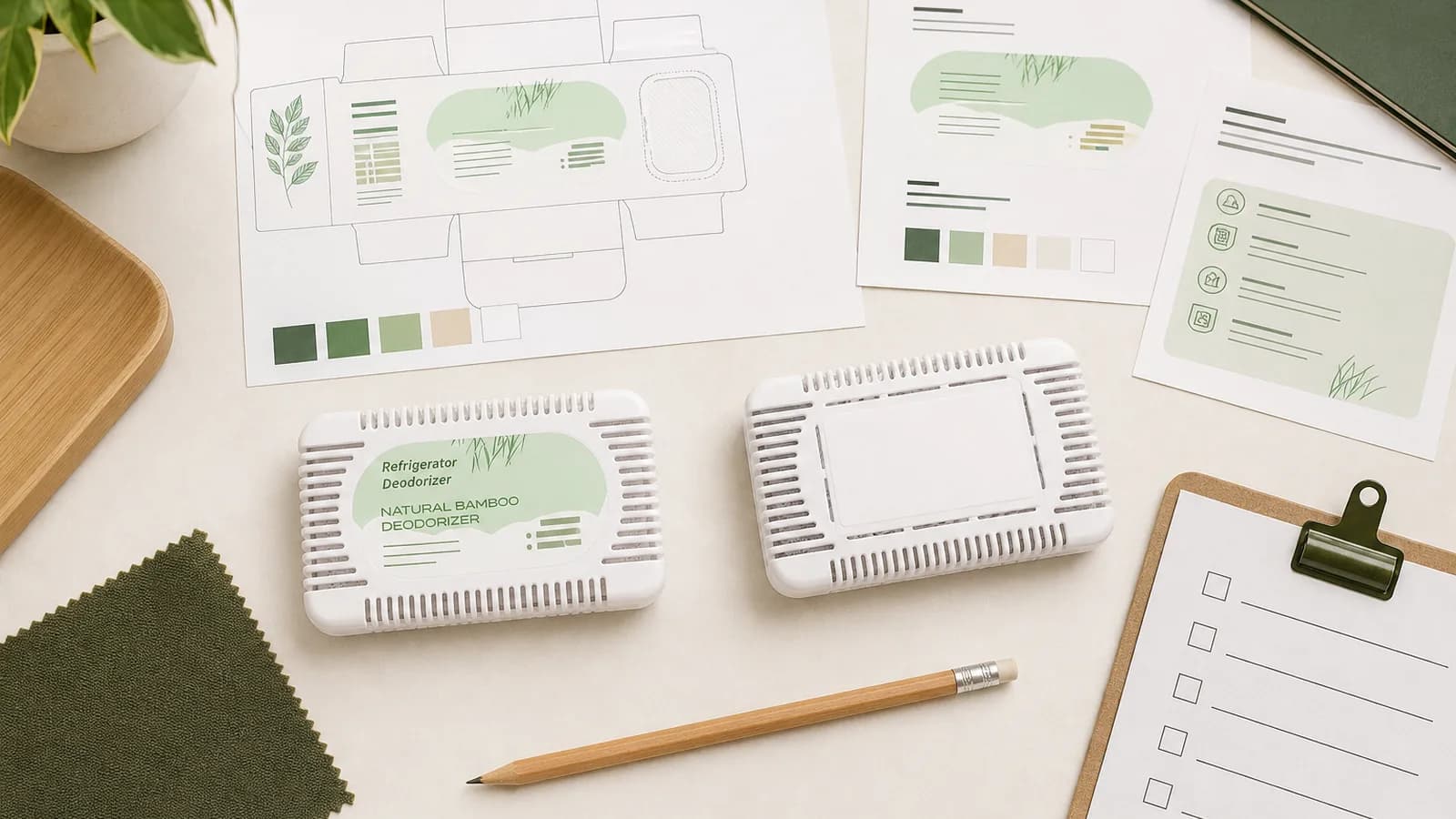
At artwork review, I put the reuse statement beside the care instruction and replacement rule. If the front panel makes a promise that the instruction panel cannot explain, the file goes back for revision. This guide shows what belongs in that review before printing starts.
What does "Reusable After Sun Drying" promise?
The phrase tells a customer that the finished unit can undergo a defined sun-drying routine and return to its intended refrigerator odor-care role. It does not, by itself, mean full regeneration, sterilization, unlimited service life or zero environmental impact.
That distinction is easy to lose on a small front panel. "Reusable" sounds simple, yet a shopper may reasonably expect more than a material that survives one sunny afternoon. The whole product must remain intact, the care route must be practical and the customer needs a way to know when continued use is no longer appropriate.
The US Federal Trade Commission says environmental marketing claims should be truthful, substantiated and qualified when a broader reading could mislead. Its Green Guides overview also asks marketers to consider both express claims and the messages consumers may infer. The UK Competition and Markets Authority takes a similar approach: conditions should be clear, close to the claim and supported by robust evidence under the Green Claims Code.
"Reusable After Sun Drying" can be a care statement rather than a sweeping green claim. Trouble starts when surrounding leaves, colors or copy turn it into "eco-friendly," "zero waste" or "lasts forever" without separate support. The artwork review needs to assess that total impression, not just the six printed words.
Which product facts must be frozen before testing?
Reuse testing should begin with the saleable specification. A loose charcoal sample cannot show whether the ventilated housing, nonwoven liner, label and instructions will remain usable together.
For the BamveraEco reference format, the starting point is a 50 g fill of high-temperature carbonized bamboo charcoal granules, a breathable nonwoven liner and a ventilated outer housing with reference dimensions of 130 x 65 x 30 mm. Label, instructions and retail packing can be customized. Buyers can inspect that construction on the bamboo charcoal refrigerator deodorizer page.
Those details must stop moving before a repeat-care record can support final copy.
| Specification item | Why it belongs in the approved sample | What can go wrong if it changes later |
|---|---|---|
| Bamboo charcoal and 50 g fill | Defines the material and amount under review | A different grade or fill creates a different product |
| Housing dimensions and vent pattern | Determines the physical enclosure and exposed air path | Revised tooling may alter fit, ventilation or drying orientation |
| Nonwoven liner | Contains granules while allowing air contact | A new fabric or seam can shift, split or block particles |
| Label stock, ink and adhesive | Faces the same light and care conditions as the housing | Print may fade or an edge may lift |
| Instruction leaflet or back label | Tells the customer what "sun drying" means | A short or translated version may omit a necessary limit |
| Unit pack | Protects the deodorizer before first use and during storage | A permeable pack can change the starting condition |
The approved item should have a sample ID or version reference. "Same as last sample" is weak control when several white housings and label revisions are on the same desk.
What should the sun-drying instruction tell the customer?
A usable instruction explains preparation, location, orientation, conditions, return to service and the reasons to stop. If time or frequency has not been checked on the finished unit, the brand should not borrow a number from another charcoal product.
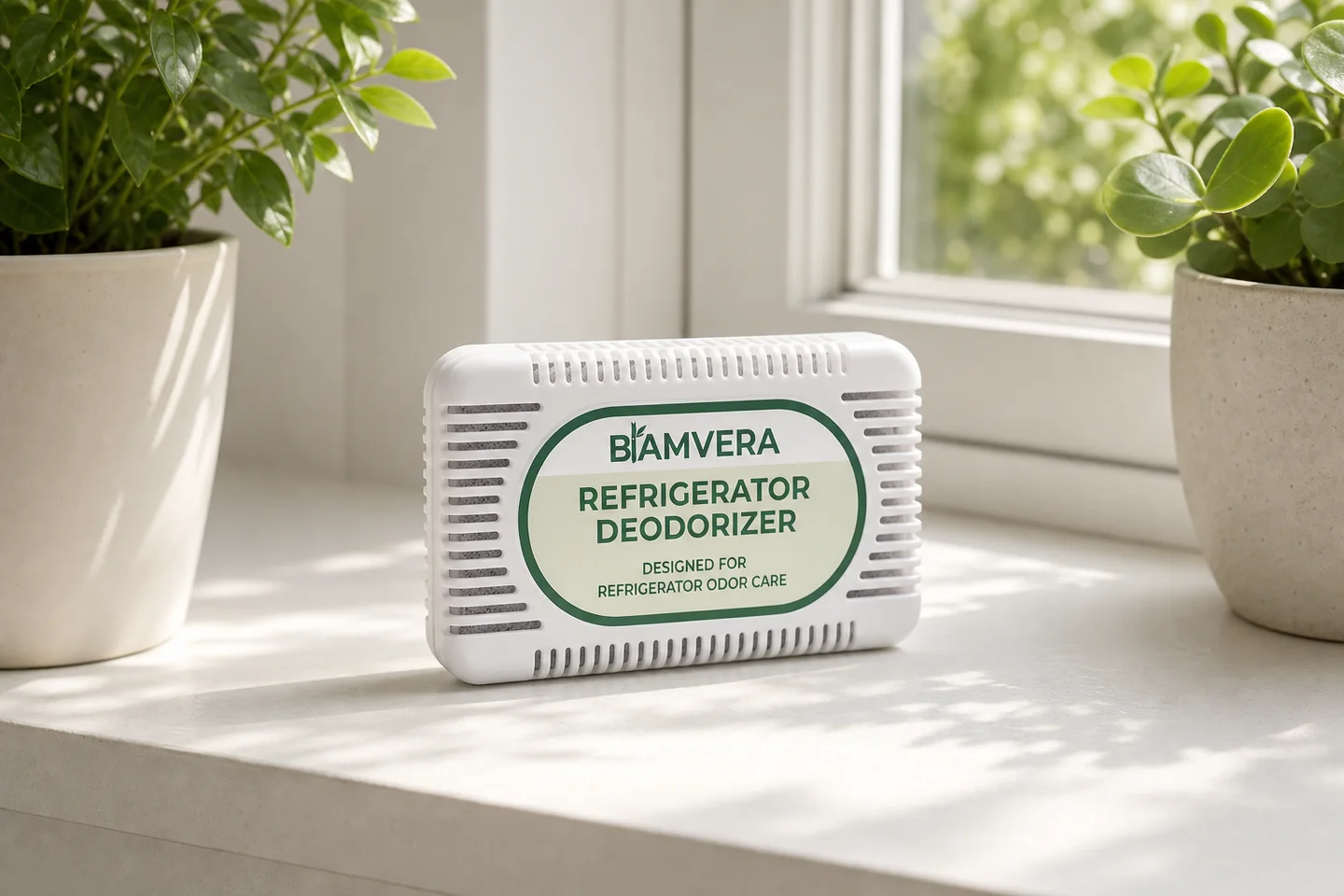
Sunlight is not one repeatable machine setting. A dry, breezy morning and a humid day after rain are different care conditions. Window glass, shade, surface temperature and the direction of the vents also change what the product experiences. That does not make sun drying impossible to describe. It means the wording needs boundaries.
A draft instruction should answer these questions:
- Should the unit be removed from the refrigerator and any retail wrap first?
- Should the housing stay closed?
- Which side or orientation should face upward?
- Does the location need to be dry, ventilated and protected from rain?
- What condition or interval triggers care?
- What validated time range applies, if the program uses one?
- Should the unit cool or rest before it returns to the refrigerator?
- Which visible damage means the product should be replaced?
- Is washing prohibited?
- Are ovens, microwaves, radiators and other heating methods prohibited unless separately approved?
A buyer also needs to decide where these answers fit. If the carton has room only for a short line, the pack can direct the user to a full instruction leaflet or a stable product page. The short claim and longer instruction still need to agree.
Reviewing a 50 g private-label format?
Compare the housing and customization options, then include the intended care wording and destination market in the sample brief.
How should buyers verify reuse without promising full regeneration?
Use a controlled, documented screening sequence on the finished product. The result should answer whether the proposed care routine leaves the unit fit for continued intended use, not whether sunlight makes every charcoal surface identical to a new sample.
The companion article on whether a bamboo charcoal fridge deodorizer works explains adsorption, airflow and the limits of passive odor care. This article starts later, at the point where a brand has chosen a product format and needs evidence for customer-facing reuse copy.
Establish the reference condition
Identify the complete sample and record its housing, liner, label, fill, unit pack and instruction version. Use controlled photographs. If the team records mass or another physical measurement, document the conditioning method and equipment rather than treating a single number as universal.
Define the use or loading step
The method should be repeatable enough to compare the same sample before and after care. Record the environment, duration and any odor source used. A refrigerator field observation can add context, but uncontrolled household use should not be presented as a laboratory result.
Apply the proposed care route
Follow the instruction exactly as a customer would see it. Record the actual weather or indoor condition, placement, orientation, duration and any interruption. Do not quietly extend a failed cycle and keep the original instruction on the artwork.
Inspect before another cycle
Check the housing for deformation or cracking. Confirm that vents remain open, the liner still contains the charcoal and the label remains readable and attached. Note any unusual odor, discoloration or granule leakage. Only then decide whether the sample continues, stops or requires investigation.
This sequence does not produce a universal claim such as "restores 100% capacity." It produces something more useful for packaging: a traceable record connecting one finished specification with one care instruction and one release decision.
What should be recorded across repeated care cycles?
A cycle record should show what was tested, what the unit experienced, what changed and who made the continue-or-stop decision. Photographs without sample IDs or conditions are not enough.
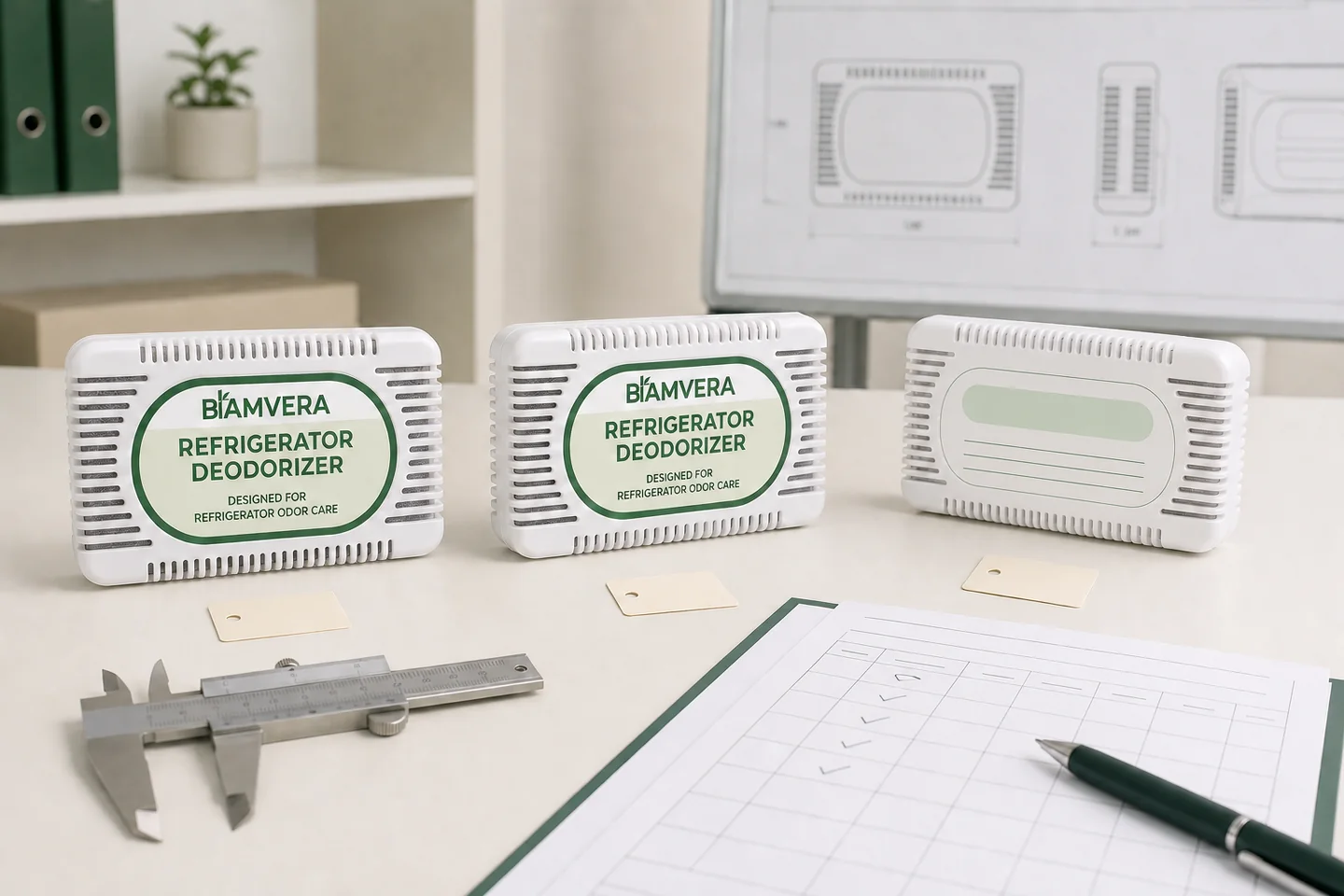
One practical record can be simple:
| Record field | Baseline | Each care cycle | Final review |
|---|---|---|---|
| Sample identity | Product and artwork version | Confirm same unit | Archive approved reference |
| Starting condition | Housing, liner, label and agreed measurements | Condition before care | Compare with baseline |
| Care conditions | Proposed method | Date, location, orientation and duration | Confirm instruction reflects the record |
| Construction check | Photograph and pass criteria | Cracks, warping, vent blockage, liner movement or leakage | Pass, hold or replace |
| Printed components | Label and instruction version | Adhesion, legibility and color change | Approve or revise materials |
| Functional screening | Agreed method and limits | Result under the same method | State only what the evidence supports |
| Deviation | None or recorded exception | Weather change, interruption or extra time | Explain impact on approval |
The number of cycles depends on the claim being considered. A statement with a fixed lifespan or cycle count needs evidence that addresses that duration. A few successful observations cannot be stretched into "unlimited reuse."
There is another mundane issue worth recording: storage between checks. A charcoal-filled product left uncovered on a humid workbench does not start the next cycle in the same condition as a sealed reference. The record should identify whether each sample was stored in its moisture-barrier unit pack.
Where should each part of the claim appear?
The front panel may carry the short reuse statement, but the conditions, care method and replacement cues need enough space elsewhere on the same pack or in a clearly connected instruction. Hiding a material limit in tiny copy weakens the whole message.
| Customer touchpoint | Best use of the space |
|---|---|
| Front panel | Product identity and a short, supportable reuse phrase |
| Back or side panel | Care trigger, sun-drying steps, warnings and replacement cues |
| Instruction leaflet | Full sequence, drawings, storage guidance and market-specific language |
| Online listing | Intended use, realistic limits and the same care method supplied with the product |
| Internal technical file | Sample IDs, test method, cycle records, deviations and approvals |
The product page, carton and leaflet should not tell three versions of the story. If the listing says "monthly sun drying," the leaflet says "when needed" and the carton gives no trigger, the customer is left to choose. Translation can create the same problem. Local reviewers need the approved source meaning, not an isolated slogan.
The latest ISO 14021 standard covers self-declared environmental statements used on product labels, packaging, literature and digital platforms. It also addresses qualifications and documentation for assessing those statements. The standard does not certify this deodorizer, but it is a useful reference when a brand builds its own claim file.
Which claim upgrades should stop the artwork?
Put the file on hold when a narrow reuse instruction has grown into an absolute performance, health, lifespan or environmental promise. Each added meaning needs its own evidence.
| Proposed wording | What it implies | Prepress response |
|---|---|---|
| Reusable after sun drying | A defined care route permits continued intended use | Verify finished sample, instructions and repeated-care record |
| Helps maintain refrigerator freshness | Limited support for odor care under stated conditions | Keep the intended role and limitations visible |
| Restores full adsorption capacity | Return to a measured new-product condition | Hold unless the method and results directly establish it |
| Works like new after every cycle | Consistent full recovery across repeated cycles | Rewrite or supply much stronger evidence |
| Lasts for two years | A defined service life under normal conditions | Specify conditions and substantiate the period |
| Unlimited reuse | No meaningful service-life boundary | Remove unless an exceptional evidence basis exists |
| Sterilizes in sunlight | A microbiological or health outcome | Remove from this evidence file and review separately |
| Eco-friendly or zero waste | A broad environmental benefit | Qualify and substantiate separately, or delete |
European rules are also moving toward tighter treatment of environmental and durability messages. Directive (EU) 2024/825 addresses environmental claims, circularity characteristics and false claims about durability. Member States were required to adopt measures by March 27, 2026, with application from September 27, 2026. A seller still needs market-specific legal review because national implementation, language and channel requirements can differ.
This is why a supplier's material sheet and an importer's claim approval are different documents. The factory can identify the agreed construction and support a finished-sample review. The brand owner or importer decides which marketing statement enters each destination market.
What belongs in the prepress release packet?
Release the artwork with a compact evidence packet that links the approved product, care method and exact wording. The goal is not paperwork for its own sake. It is to prevent a later sample, translation or carton revision from breaking the claim.
The packet should contain:
- the finished golden sample and its ID;
- bamboo charcoal, fill, liner and housing specifications;
- approved label, leaflet, carton and unit-pack versions;
- the proposed sun-drying method and its customer wording;
- baseline and repeated-care records;
- construction, label and functional screening decisions;
- photographs tied to the sample and cycle number;
- deviations and the action taken;
- replacement and storage instructions;
- destination markets and sales channels;
- approved translations;
- the final artwork filename and sign-off date.
I also keep the short front-panel phrase in the same review view as the long instruction. That simple layout catches contradictions faster than two approval emails sent a week apart. It also gives the translator the conditions that belong to the phrase.
For refrigerator cleaning, food checks and odor-source removal, direct customers to the separate guide on removing bad fridge smells naturally. A reusable deodorizer is an odor-care accessory after those basic steps, not a reason to leave spoiled food or a hidden spill in place.
Ready to review the claim before print?
Send the artwork and care brief with the target market and intended sample specification.
Conclusion: print, hold or rewrite?
Print when the finished sample, repeated-care record and customer instruction support the same narrow promise. Hold when the product or method is still changing. Rewrite when the words claim more than the evidence shows.
A print decision is reasonable when the approved construction has been reviewed through the proposed care route, the label and liner remain fit for use, and the customer receives clear conditions and replacement cues. Keep the versioned evidence packet with the final artwork.
Put the file on hold if testing covered loose charcoal, a different housing or an unfinished label. Do the same when the team had to change the care method to make the sample pass but has not changed the instruction.
Rewrite the claim if sun drying is presented as complete regeneration, sterilization, unlimited service life or proof that the whole product has no environmental impact. A restrained reuse statement can still be commercially useful. It just needs to say what this finished product can do under conditions a customer can follow.