
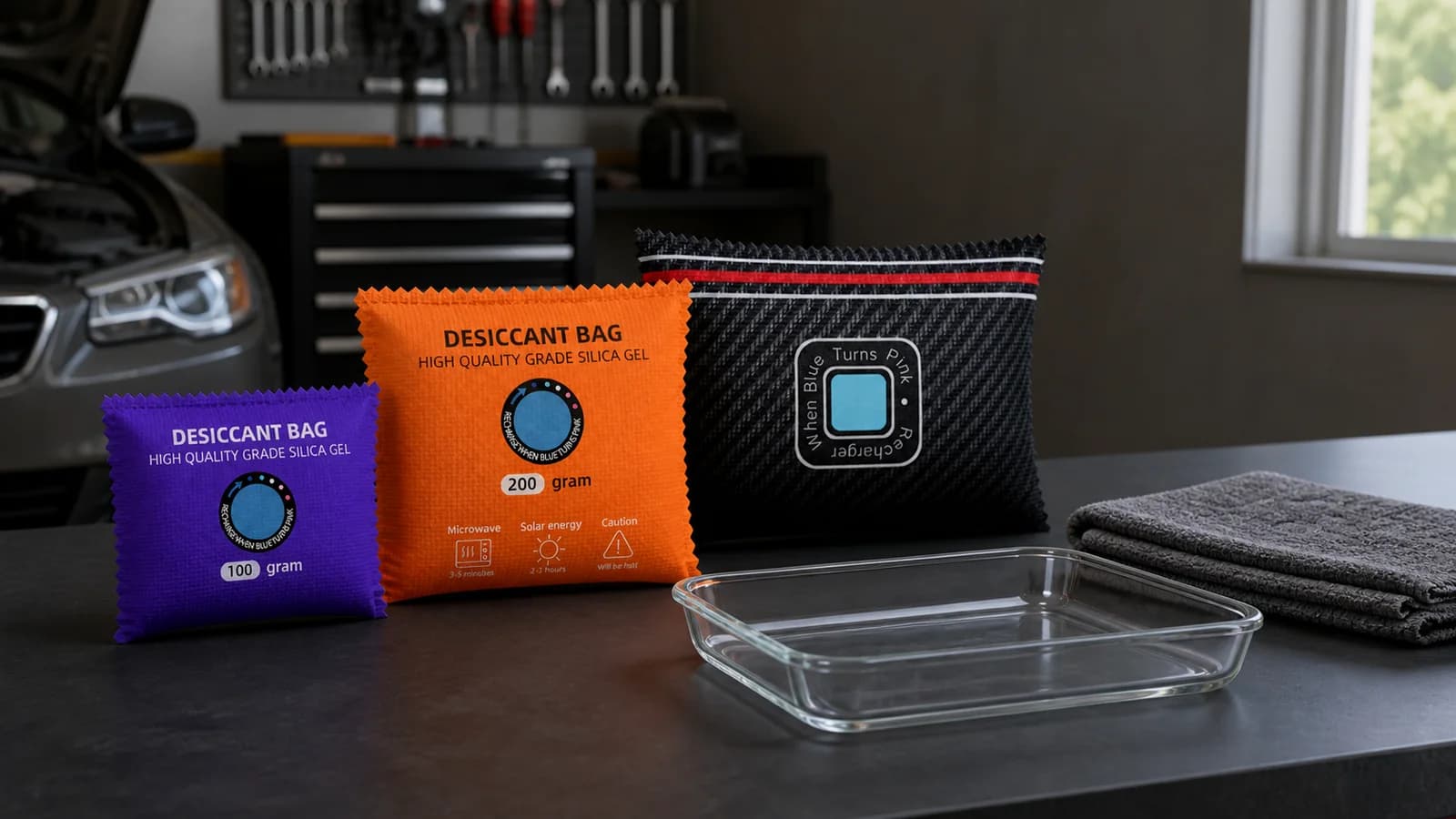
The indicator on a reusable car dehumidifier bag has turned pink, but the drying advice online is all over the place. One label says three minutes in a microwave. Another says six. Some products allow oven drying, while others warn against it. Those instructions are not interchangeable.
Recharge the bag only by the method printed for that exact finished product. The fill weight, fabric, printing, seams and indicator window all affect how it heats. If the label does not name an approved method, wattage, timing and cooling procedure, do not invent one from a different bag.
When I review a reusable dehumidifier sample, I do not approve its care instructions from the silica gel specification alone. I compare the proposed method with the filled and printed bag that a customer will handle. This guide follows the same product-level check from first use to replacement.
How does a reusable car dehumidifier bag work?
A reusable car dehumidifier bag holds a moisture sorbent, usually silica gel, inside a breathable pouch. Water vapor moves through the fabric and adsorbs onto the porous gel surface until the available capacity declines. Drying releases much of that water so the bag can be used again.
Adsorption is a surface process. It is different from a calcium chloride absorber that gradually produces liquid brine, and it is not the same as an electric dehumidifier that condenses water into a tank. Our comparison of car dehumidifier options explains where those systems fit.
The amount of gel is only one variable. The Canadian Conservation Institute's guide to silica gel humidity control describes how sorbent quantity, enclosure leakage, temperature and surrounding humidity affect passive control. A vehicle is a different enclosure from a museum case, but the same variables explain why one bag cannot have a universal service interval.
The outer pouch is part of the working product. It must let air reach the fill and keep the particles contained through repeated drying. A failed seam or melted window ends the product's useful life even if the silica gel could still adsorb moisture.
When should a car dehumidifier bag be recharged?
Recharge the bag when its approved indicator reaches the stated wet reference, or when another validated service cue says that its useful capacity has declined. Do not heat it every few days as a precaution. Unnecessary cycles add wear without solving an active leak or wet carpet.
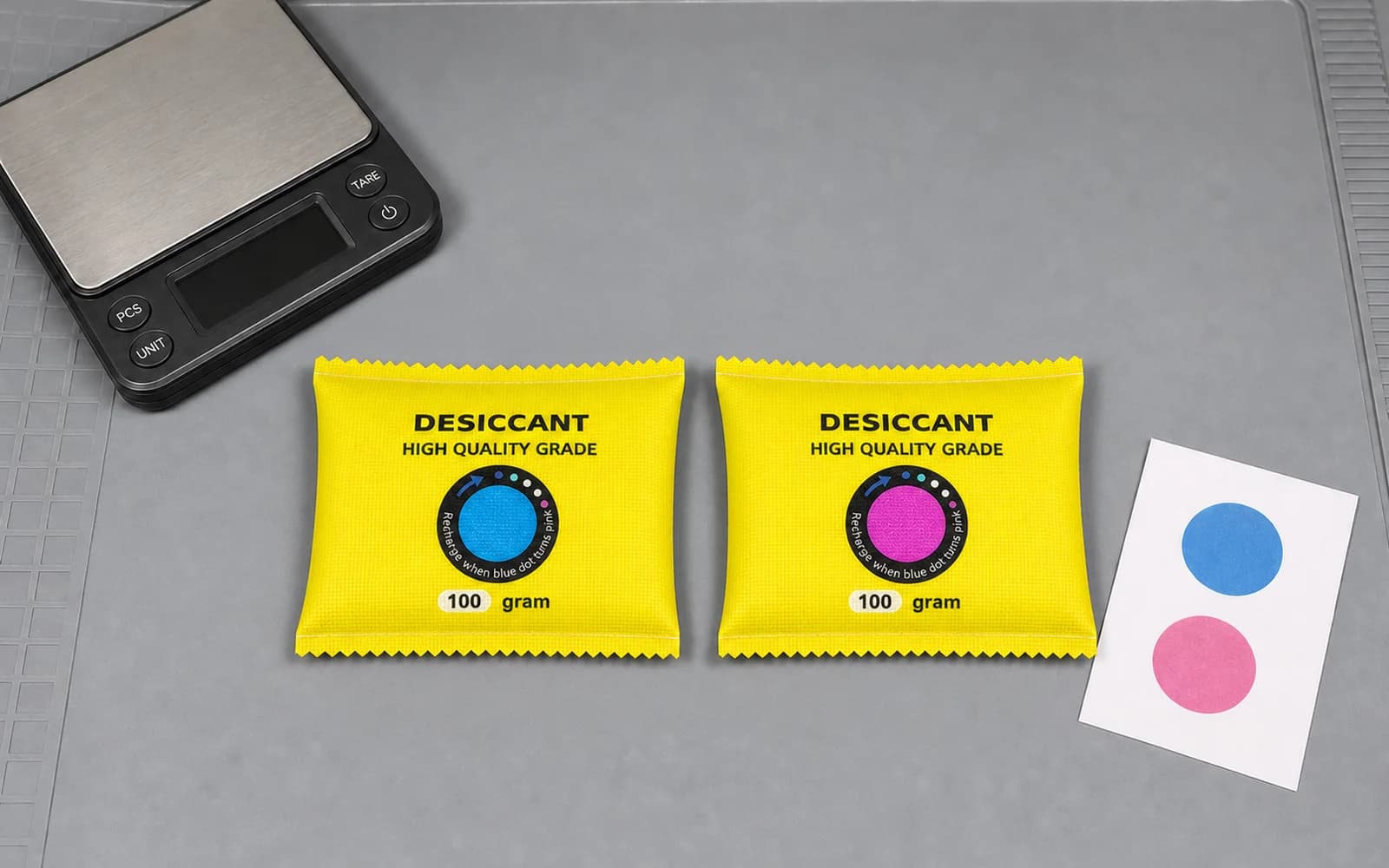
Many reusable bags have a window that changes color as the nearby indicator material takes up moisture. On a blue-to-pink design, a complete change toward the approved pink reference normally means it is time to follow the care label. A partly changed window may simply show that the bag is loading.
Treat the color as a service cue, not a cabin hygrometer. It does not give a relative-humidity percentage, and the visible area may not represent every bead inside a large bag. Compare it under neutral light with the printed references. Some programs add a tested weight trigger, but a 100g and 400g pouch cannot share the same gram increase.
If the bag appears to load unusually fast, inspect the car before increasing the bag count. The earlier guide on removing moisture from a car covers wet mats, blocked drains, damaged seals and other sources that a passive bag cannot repair.
Can every silica gel bag go in a microwave?
No. Some finished bags are designed and validated for microwave regeneration, while others are not. Even if loose silica gel can tolerate heating, the pouch may contain fabric, ink, thread, labels, an indicator window or trim that is unsuitable for a microwave.
The distinction matters because heat comes from the water held in the product. The US Food and Drug Administration's microwave safety guidance notes that containers can become hot through contact with heated contents, some plastics can melt, and users should follow the appliance manufacturer's instructions. A moist desiccant bag can become much hotter than its dry appearance suggests.
Metal eyelets, foil labels and metallic decoration should never enter a microwave unless the complete product and method have been expressly approved. The same caution applies to small packets from food, medicine or electronics. Their paper, adhesive, ink or indicator may never have been designed for consumer regeneration.
What should you check before heating the bag?
Check the label, construction and surface condition while the bag is cool. Stop if the instructions are missing, the approved method is unclear, or any part of the pouch is damaged. Heating is not a way to rescue a leaking or contaminated product.
| Check | Continue only when | Stop and replace or seek advice when |
|---|---|---|
| Care label | Method, power or temperature, interval and cooling steps are readable | Instructions are missing or belong to another size |
| Fabric and seams | Pouch is clean, intact and fully closed | Fabric is scorched, torn, oily or separating at a seam |
| Indicator window | Window is secure and the reference color can be read | Window is loose, cracked, cloudy or distorted |
| Hardware and decoration | Construction matches the approved heating sample | Bag has an unapproved eyelet, foil, metallic print or added label |
| Work area | Approved microwave-safe or heat-safe tray is clean and stable | Tray, appliance or surrounding area is unsuitable or damaged |
Do not regenerate a bag soaked in liquid water or exposed to fuel, coolant, cleaning chemicals or an unidentified spill. Keep children and pets away, and choose a safe cooling location before heating starts. A hot pouch can mark a vehicle seat, plastic trim or delicate counter.
How should an approved microwave-compatible bag be recharged?
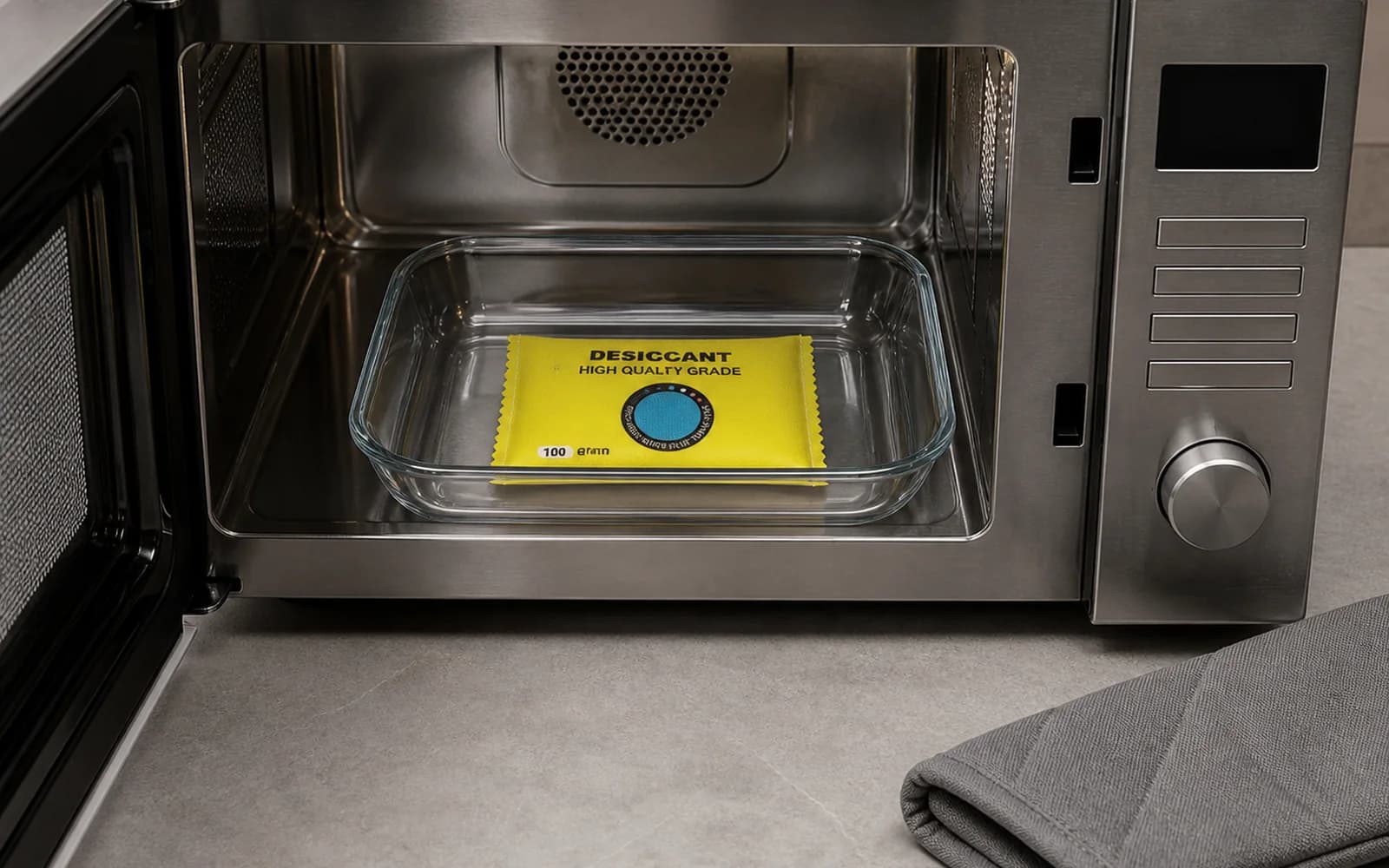
Follow the sequence on the exact product label. A safe process normally includes inspection, controlled heating, cooling and a final condition check, but the label must supply the actual wattage, interval length and total limit for that bag.
- Remove the retail barrier packaging and any accessory that the instructions say must not be heated.
- Inspect the cool pouch, seams, print and indicator window.
- Place the bag in the orientation and microwave-safe tray stated by the manufacturer.
- Select the approved power setting and heat only for the stated interval.
- Supervise the appliance and stop if there is sparking, smoke, a strong unusual odor or visible deformation.
- Follow the approved turning or rest steps rather than extending one cycle because the indicator has not changed immediately.
- Let the bag cool completely in a protected place before touching it with bare hands or judging the final color.
- Recheck the seams, window and dry-state reference before returning it to service.
The indicator may continue to settle while the bag cools. Heating it again immediately because the window still looks pink can push the fabric or window past its approved temperature. The care copy should state whether another short interval is allowed and the maximum total exposure for one regeneration session.
Developing care instructions for a reusable vehicle product?
Review available bag formats, then send the target fill weight, heating route and destination market for a sample discussion.
Why do recharge time and wattage vary?
Recharge settings vary because two bags can hold different amounts of water and respond differently to the same appliance. Fill weight matters, but so do starting moisture, microwave output, bag thickness, load position, fabric, print and indicator construction.
| Variable | What changes during drying | What the product team should validate |
|---|---|---|
| Silica gel fill | More material can hold more water and creates a thicker heat load | Dry and wet reference weights for each size |
| Starting condition | A partly loaded bag needs less drying than a fully loaded one | Clear indicator or weight trigger before heating |
| Appliance output | Nominal wattage and energy distribution differ between models | Workable power range, interval and maximum total time |
| Bag geometry | Thickness and fill distribution affect local heating | Orientation, turning and rest instructions |
| Fabric and printing | Materials can shrink, discolor, transfer or lose strength | Appearance and seam condition after repeated approved cycles |
| Indicator system | Chemistry and window materials respond differently to heat | Dry color, wet color, recovery and window security |
This is why a development starting point should not reach a consumer label until the complete bag has been evaluated. When I compare 100g, 200g and 400g formats, I expect separate records. Increasing time in direct proportion to fill weight is tempting, but heat distribution rarely behaves that neatly. The appliance instructions still apply.
Are oven, radiator and sunlight drying interchangeable?
No. They expose the product to different temperatures, humidity levels and heating patterns. A bag approved for one route is not automatically approved for the others, and "low heat" is too vague for a consumer instruction.
Loose sorbent guidance illustrates the problem. The Canadian Conservation Institute discusses oven temperatures for particular raw or specialist sorbents, but it also says microwave drying must be confirmed by the manufacturer or distributor. Those conditions do not certify a printed consumer pouch, especially one with a plastic viewing window.
An oven still needs a verified temperature, duration, tray, orientation and cooling method. A radiator introduces distance and surface-temperature variation, so the pouch should never touch its heating element. Sun drying depends on solar intensity, humidity and airflow. A fixed number of hours cannot produce the same result in a damp winter and a dry summer.
How do you know when regeneration is complete?
Judge the bag only after it has cooled. The approved dry reference may combine indicator color, a cooled weight range and an intact condition check. A warm bag can give a misleading color or weight reading and may damage the surface where it is placed.
For sample validation, record the conditioned dry weight, load the bag under a defined method, repeat the proposed regeneration cycle and reweigh it after cooling. The check asks whether the actual sample returns to a usable state without damage. Document the indicator's dry reference, wet reference and expected return with controlled photos and an approved physical sample.
Do not assume that blue always identifies one indicator chemistry. Importers should request the material declaration and decide whether a cobalt-free system is required. The European Chemicals Agency's cobalt dichloride classification shows why a visible color system should be specified by chemistry, not ordered only as "blue to pink."
When should a reusable dehumidifier bag be replaced?
Replace the bag when its containment, indicator or approved care response is no longer reliable. Silica gel can survive many adsorption and drying cycles, but the consumer product also depends on fabric, seams, printing and window security.
Retire a bag if beads or fragments escape, a seam opens, the fabric scorches, the print transfers, the indicator window deforms, or the indicator no longer responds after an approved cycle. An unexplained chemical smell or contamination is another reason to stop. Continued heating will not restore a damaged construction.
Claims such as "reusable for two years" need conditions. Moisture load, care frequency, handling and heating all affect service life. If a time-based claim is commercially important, validate it against the finished specification and state its limits. Store the cooled, dry bag in its moisture-barrier pack when it will not be used.
What should importers approve before printing the care label?
Approve the care system with the physical product, not as a separate artwork exercise. The product specification should connect the silica gel, fill tolerance, fabric, indicator, heating route, warnings, unit pack and destination-market language.
The EU General Product Safety Regulation summary lists clear instructions and safety information among an importer's checks. Its product safety requirements also address traceability and the responsible EU economic operator. Other markets have their own rules, so review must match the destination and channel.
For sample approval, record at least:
- Exact silica gel and indicator specification, including any cobalt-free requirement
- Net fill and agreed tolerance for every marketed size
- Finished dimensions, breathable fabric, seam and window construction
- Approved regeneration method, appliance range, intervals and maximum session limit
- Cooling, handling, child, pet, ingestion and damage warnings
- Dry and wet indicator references under controlled lighting
- Moisture-barrier unit pack, instruction insert and batch traceability
- Local-language copy reviewed for the destination market
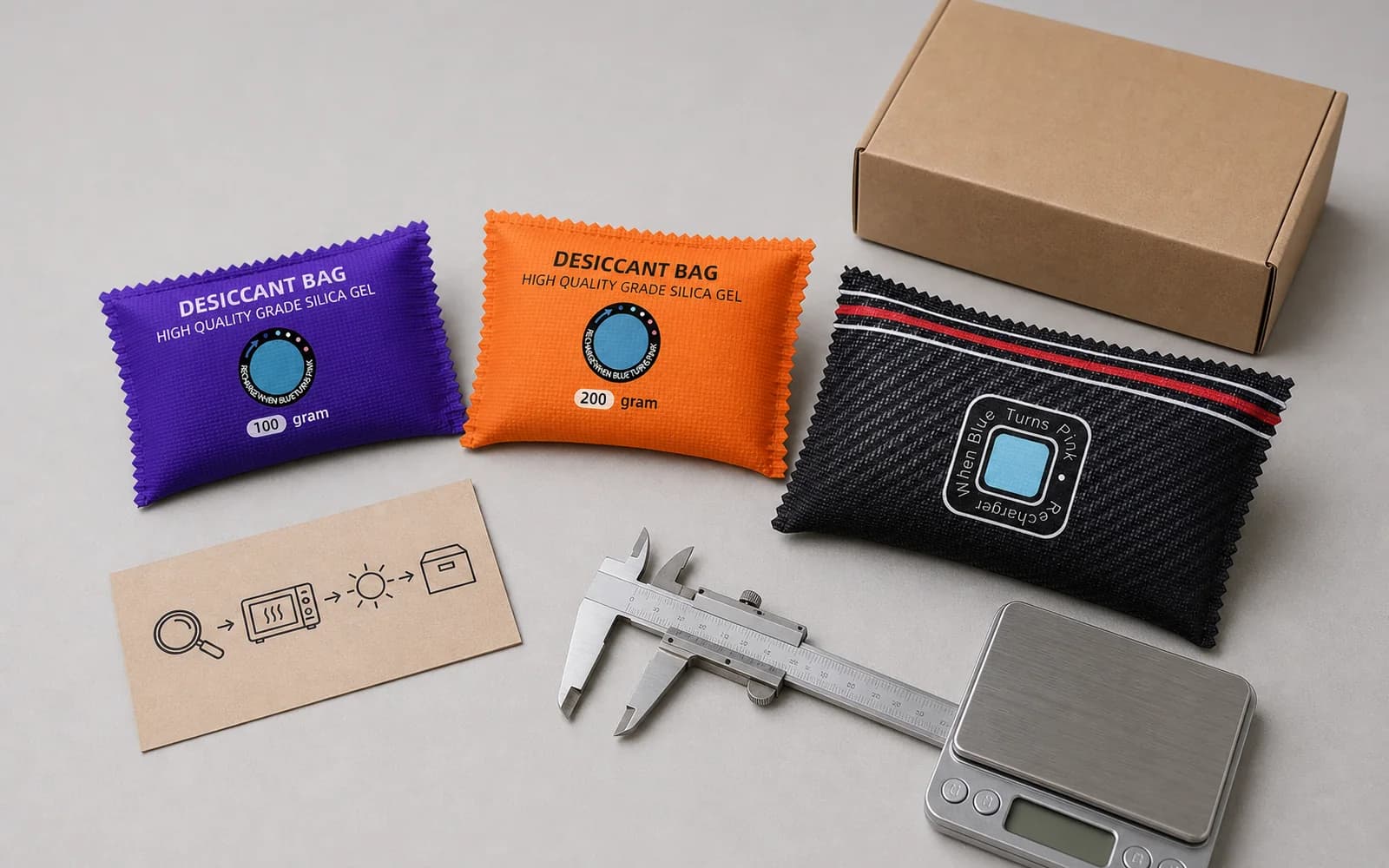
Our customization process covers fabric, logo, indicator position, care information and retail packaging. The useful approval set is a filled golden sample plus its final label and unit pack. A loose fabric swatch and an unprinted bag cannot prove that the sellable product will tolerate the proposed regeneration cycle.
Ready to validate a private-label care system?
Send your product requirements, including fill size, bag construction, indicator, target market and packaging. We can use them to define the sample checks that need agreement before artwork is released.
Frequently asked questions about reusing car dehumidifier bags
Can I microwave a car dehumidifier bag without an indicator?
Only if the instructions for that exact bag approve it. An indicator is convenient, but its absence does not prove that the pouch is safe to heat. Use the stated schedule or another validated trigger.
Why is the indicator still pink after drying?
The bag may still contain moisture, need more cooling, or have an uneven or damaged indicator. Follow the label's rest and repeat limits. Never add time after the maximum approved session.
How often should the bag be recharged?
There is no universal interval. Vehicle volume, wet items, leaks, weather and fill weight change the loading rate. Recharge at the approved cue, and inspect the cabin if the interval suddenly becomes much shorter.
Can a warm bag go straight back into the car?
No. Let it cool completely in the location specified by the instructions. A hot pouch can burn skin, mark a seat or trim surface, and give a misleading indicator reading.
Can the same bag be used in a closet at home?
Sometimes. The complete product must permit that placement, and it should remain away from food, children, pets and delicate surfaces. A small passive pouch can support a wardrobe or cabinet, but it is not a whole-room dehumidifier.
How long does a reusable silica gel bag last?
Service life depends on construction and use. Replace the bag when its fabric, seams, indicator or regeneration response no longer meets the approved condition. A fixed lifespan is a qualified claim, not a guarantee for every climate.
Conclusion: what is the safest rule for reusing the bag?
The safest rule is simple: if the regeneration method has not been validated for the complete finished bag, do not turn a generic silica gel drying instruction into an end-user care label.
For drivers, that means following the exact label, supervising heating, allowing full cooling and replacing damaged products. For importers and product teams, it means testing each fill and construction with the final indicator, print and packaging instructions. The result is a care method the user can follow without guessing.