
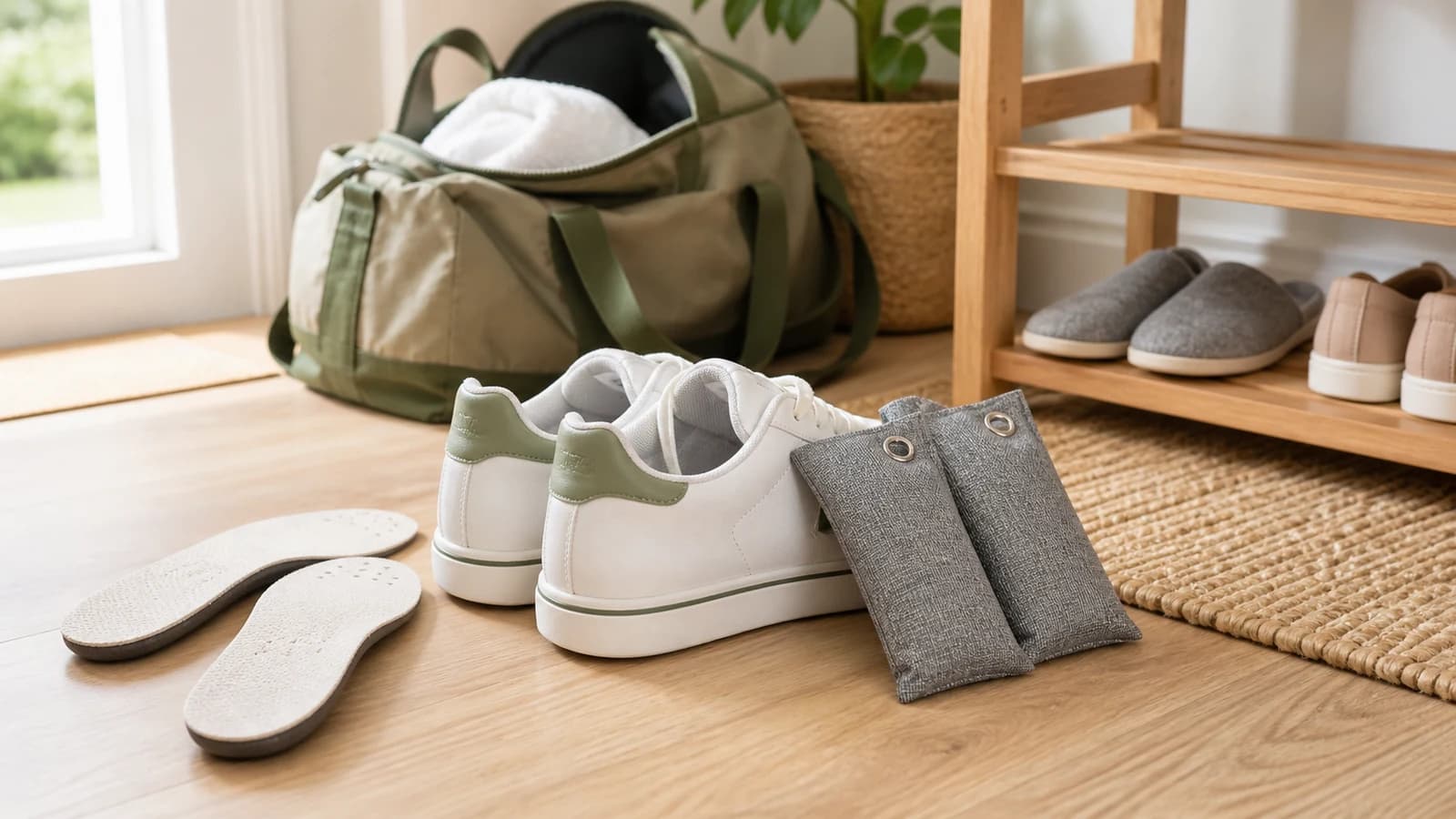
A pair of training shoes can look clean and still announce itself when you unzip the gym bag. A fragrance spray may cover that first breath, but it cannot tell you whether the trouble sits in damp lining, a removable insole, dirty socks or the wearer's feet.
To get smell out of shoes, open them up, remove the laces and removable insoles, follow the shoe maker's cleaning instructions and let every layer dry completely. A passive deodorizer belongs after those steps. It supports dry storage; it does not clean a wet or dirty shoe.
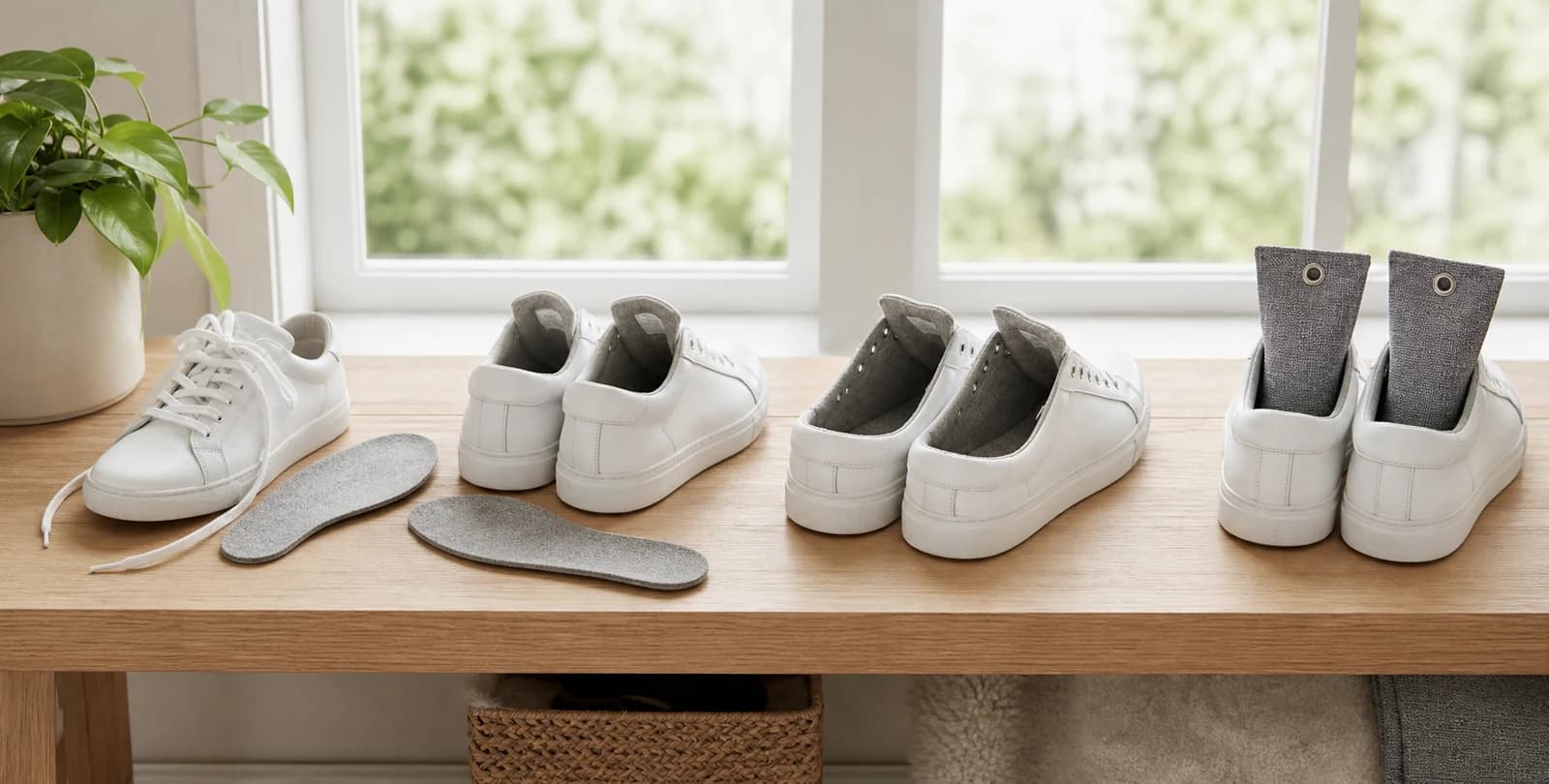
The quickest route is to sort the problem into four states: wet, washable, dry but still odorous, or persistent despite normal care. Responding to the state in front of you also shows where a charcoal pouch can help and where it would only delay the proper fix.
What is the fastest way to get smell out of shoes?
Start by taking the shoe apart as far as its design allows, then clean only as the maker recommends and dry the upper, lining and insole fully before the next wear. If a mild odor remains once the shoe is dry, use ventilation and a passive deodorizer as maintenance rather than as a substitute for cleaning.
"Shoe smell" can describe different jobs. A running shoe may hold sweat in its foam, a work boot may have a footbed that never dried, and a leather shoe may retain odor after repeated wear. The same liquid, powder or heating method will not suit all three.
The NHS guidance on smelly feet identifies sweat, bacteria and fungal infections among the common causes of foot odor. It advises keeping feet clean and dry, letting footwear dry before it is worn again and avoiding the same socks or shoes on consecutive days. Those habits deal with a continuing source. A scent only changes what reaches your nose for a while.
Begin with a simple check. Is the shoe damp? Does the insole smell stronger than the upper? Is there visible dirt or a spill? Does the odor return only after one person wears the pair? Those answers point to drying, material-appropriate cleaning, a change in wear routine or advice beyond ordinary shoe care.
Which shoe-odor problem are you actually dealing with?
Classify the shoe before choosing a remedy. A wet pair needs drying, a dirty washable pair needs care-label cleaning, a dry pair with a mild residual odor may suit passive adsorption, and odor that keeps returning with foot symptoms deserves attention beyond the shoe itself.
This check avoids judging an odor product while the source is still active. It also avoids repeatedly washing a clean shoe that is simply poorly aired between uses.
State 1: The shoe is still damp
Loosen the laces, open the tongue and remove the insole if permitted. Give air access to the toe box and underside of the footbed. Do not seal a damp pair in a locker, plastic bag or closed cabinet.
Avoid an unapproved heat shortcut. Direct heat can affect adhesives, foams, waterproof membranes and leather finishes. The correct drying method comes from the footwear maker, not from a universal internet recipe.
State 2: The shoe is dirty and the care instructions allow cleaning
Deal with dirt or residue before adding an odor absorber. Clean laces and removable insoles separately when permitted, since these parts may hold more residue than the outer surface suggests. Let the pieces dry apart.
If a shoe cannot be washed, that does not mean it should be soaked in a home remedy. Leather, suede, technical membranes and bonded constructions each have their own limits. A material-safe method is more useful than the strongest-smelling treatment.
State 3: The shoe is dry but has a mild residual odor
This is the most sensible point for a charcoal shoe deodorizer. Place a correctly sized pouch in each dry shoe during storage, keep the pair in a ventilated area and remove the pouches before the shoes are worn. Expect gradual support, not instant sanitizing.
The pouch still needs air contact. If it is tightly folded, sealed inside another bag or forced into a toe box with no clearance, less odor-bearing air can reach its surface. Placement and fit matter even when the charcoal fill has not changed.
State 4: The odor returns despite normal cleaning and drying
Look outside the shoe. Socks, repeated wear, excessive sweating and foot conditions can keep feeding the problem. The CDC foot-hygiene advice recommends washing and drying feet completely, changing socks regularly and checking feet for skin or nail problems.
Persistent odor accompanied by itching, cracked skin, soreness, swelling or nail changes is not a job for a charcoal pouch. A pharmacist, podiatrist or other qualified healthcare professional can help identify whether treatment is needed.
A useful rule: wet shoes need air, dirty shoes need appropriate cleaning, dry shoes may benefit from odor maintenance, and persistent symptoms need investigation.
What does a practical 24-hour shoe reset look like?
For a recently worn pair, use the first day to separate, dry and inspect before adding anything to the shoe. The clock is not a guaranteed drying time. Thick boots, humid rooms and absorbent insoles may need longer, so the physical condition of the shoe decides when the next step begins.
In the first 15 minutes
Take the shoes out of the gym bag or locker. Loosen the laces, pull the tongue forward and remove detachable insoles. Check the toe box, heel lining and underside of each insole with clean, dry hands. If any part feels damp, keep the pieces apart.
Wipe away loose surface dirt according to the shoe's care guidance. If there has been a spill, identify it before it dries into the lining. A food spill, muddy water and normal perspiration are not the same cleaning problem.
During the next few hours
Leave the shoes open where air can circulate. Do not put the insoles back simply because the outside feels dry. Foam and layered fabric can hold moisture below the surface, especially in padded trainers and work footwear.
Drying takes longer in a humid, closed space than in a ventilated one. Follow any approved drying-aid instructions, and do not improvise with a radiator, clothes dryer or high-temperature air.
Before overnight storage
Recheck the lining and insole. If both are dry and the shoe is clean, return the insole and place the pair in an open rack or another suitable storage area. A passive pouch can now support the storage period without being asked to manage a large moisture load.
Before the next wear
Remove every loose pouch from the footwear. Inspect the pouch for open seams, damage or escaped dust, and check the shoe for any remaining dampness. A charcoal bag is a storage accessory, not an insole, and it should never stay under the foot while the shoe is worn.
| Reset stage | Ready-to-continue signal | Next action |
|---|---|---|
| Open and separate | Laces are loose and removable insoles are out | Inspect lining, toe box and footbed |
| Clean as permitted | Visible dirt or spill residue has been addressed | Keep components apart for drying |
| Dry and recheck | Upper, lining and insole feel dry throughout | Return the insole and begin ventilated storage |
| Before wearing | Pouches are removed and no damp area remains | Inspect the pair, then wear or continue drying |
How should cleaning change with the shoe construction?
Use the footwear manufacturer's instructions as the controlling reference for water, detergent, brushing and drying. Mesh, leather, suede and waterproof footwear can react differently to the same household treatment, so there is no responsible one-formula cleaning method for every shoe.
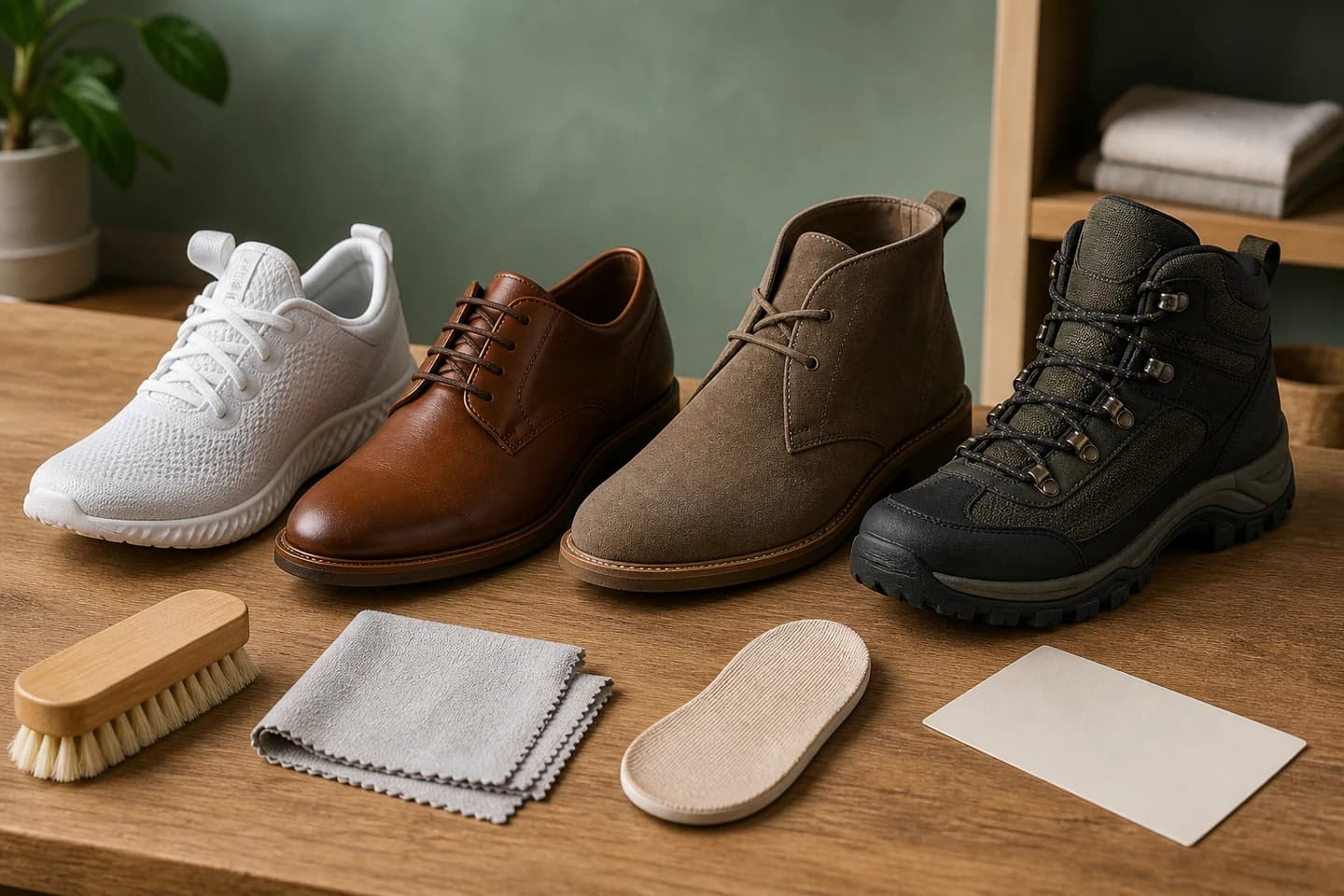
The table below is deliberately a check matrix, not a recipe. Its purpose is to show what must be confirmed before cleaning, not to prescribe a chemical or temperature.
| Shoe construction | Check before cleaning | Do not assume |
|---|---|---|
| Mesh athletic shoe | Whether the insole is removable and whether hand or machine washing is permitted | That hot washing or tumble drying is safe for foam and adhesive |
| Smooth leather shoe | Finish, lining material and the maker's approved cleaner | That soaking the upper will reach odor held in the footbed without damage |
| Suede or nubuck | Brush direction, stain guidance and any specialist care requirement | That a general liquid cleaner is suitable for the nap |
| Waterproof or bonded boot | Membrane, seam and adhesive care limits | That direct heat is safe because the outer surface looks rugged |
Removable components are useful because they expose hidden surfaces. Clean and dry them separately only when the maker permits it. If the insole remains strongly odorous after normal care, replacement may be more practical than repeatedly treating the whole shoe.
Vinegar, baking soda and essential oils are often presented as universal fixes, but they are not universal care instructions. Liquids can mark leather or suede, powders can remain in textured linings, and fragrance can obscure whether the original odor improved.
Why must shoes dry before deodorizing?
Drying comes first because a passive odor pouch is not designed to remove the active moisture load from a recently worn or washed shoe. If the lining remains damp, the conditions that contribute to odor continue while the product is being asked to handle their output.
Warm, dark and moist environments also matter for foot health. The CDC notes that fungi associated with athlete's foot thrive in such conditions. That does not mean every smelly shoe contains a fungal infection, but it is a sound reason to keep feet, socks and footwear dry rather than treating odor alone.
The RDaSH advice on sweaty feet explains that shoe uppers and insoles can absorb substantial perspiration. It recommends rotating footwear and allowing each pair to dry before it is worn again. Rotation gives thick or padded shoes something a spray cannot provide: time.
A dry shoe also gives you a cleaner test. If the odor remains after suitable cleaning and complete drying, you can evaluate ventilation or a passive deodorizer without a fresh moisture source changing the result from hour to hour.
When can a charcoal shoe deodorizer help?
A charcoal shoe deodorizer is best used in clean, dry footwear during storage, where air can pass through the breathable pouch and reach the charcoal surface. It may support gradual adsorption of some airborne odor compounds, but it does not wash the lining, kill microorganisms, dry a wet shoe or treat a foot condition.
Adsorption occurs at a surface, and different compounds do not behave identically on every carbon. One activated-carbon odor study found different adsorption behavior across several body-odor compounds. That research helps explain why broad "removes every odor" language is weak. It does not prove the performance of a particular finished bamboo-charcoal pouch.
The finished product adds charcoal specification, particle format, fill amount, lining, fabric, seams, dimensions and the air path inside the shoe. A useful material can still disappoint when the pouch is blocked, wet, damaged or poorly matched to the footwear.
Fragrance-free positioning is different from odor elimination. A charcoal format need not add perfume when the approved materials contain no added fragrance. That can suit a neutral storage range, but it is not an untested health or safety claim.
Buyers can review the available paired formats, construction and packaging routes on the charcoal shoe deodorizer product page. The sample should be judged inside representative footwear rather than only on a flat table.
Choosing a format for sneakers, boots or sports gear?
Where should the pouch sit, and when should it come out?
Place one appropriately sized pouch inside each dry shoe after wear, without forcing the upper or tightly folding the bag. Remove both pouches before the next wear, and inspect them periodically for wetness, seam damage or dust escape.
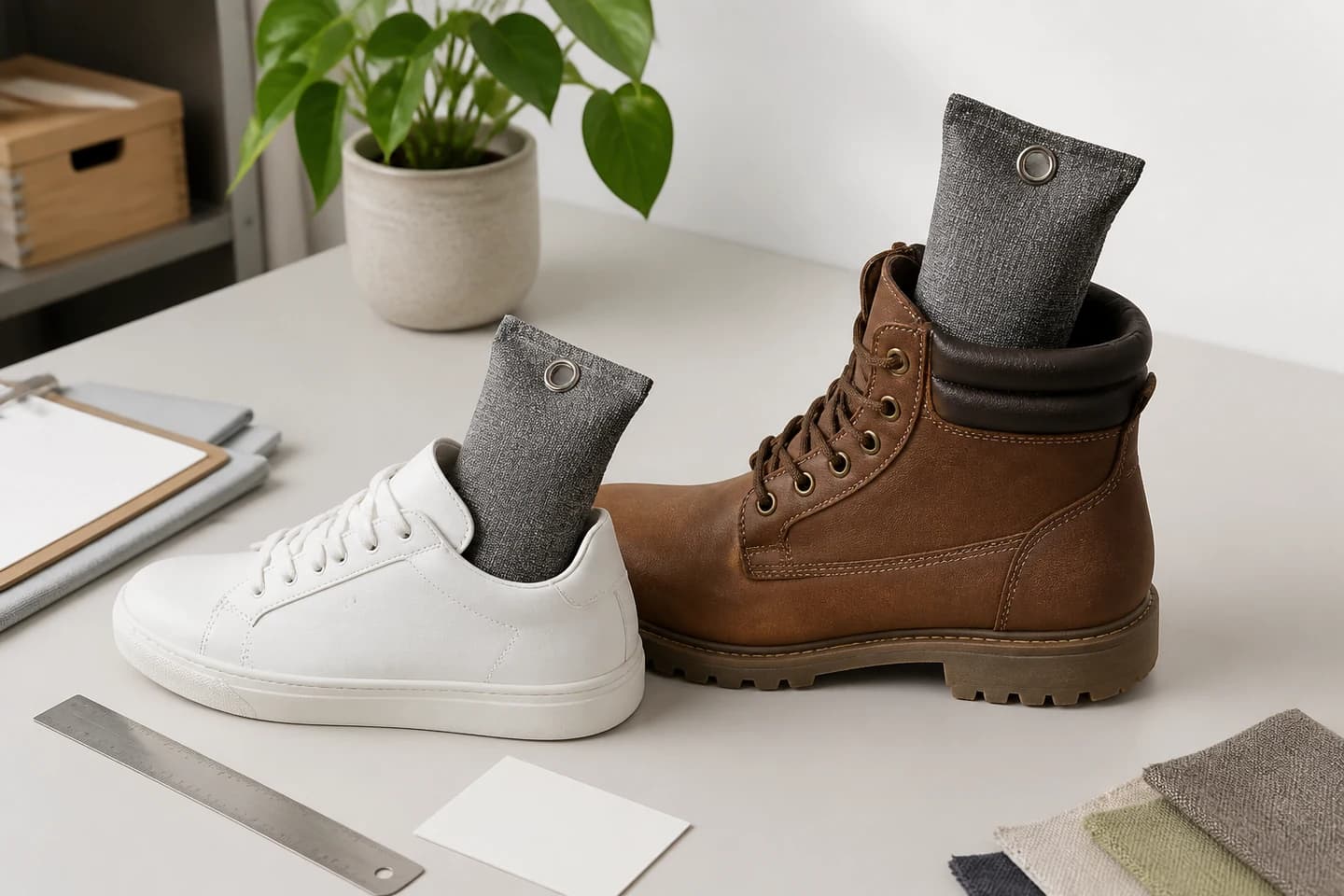
Low-profile trainers, children's footwear and narrow dress shoes have less clearance than work boots. A pouch that fits a boot shaft may push against the tongue of a running shoe. The footwear and sports-gear application guide explains why available clearance, finished thickness, pair count and handling should be approved together.
During shoe-pouch sample reviews, I check the finished thickness inside the target footwear before focusing on fill weight. A well-sewn pouch can still be awkward if it forces the upper of a low-profile shoe. The customer should be able to insert and remove it without stretching the shoe or spilling the contents.
Fill weight is therefore not a stand-alone measure of suitability. A slim 50g reference format may suit many everyday shoes, while wider footwear can accommodate another profile. The final choice still depends on charcoal density, particle size, construction and approved dimensions. The size and fill-weight guide covers those variables in more detail.
Do not hide the removal instruction in small print. "Remove before wearing" belongs where the user will see it during setup, along with a clear statement that the pouch is not an insole and should not be cut open.
What should you check if the smell keeps returning?
If odor returns after suitable cleaning, complete drying and a change of socks, review the wear routine and the condition of the feet as well as the shoe. Repeated moisture, consecutive-day wear, a spent insole or a health issue can keep recreating the same problem.
Compare the pair. If only one shoe smells strongly, inspect that shoe and the corresponding foot. If every pair develops odor quickly, the common factor may be socks, perspiration or a condition that shoe maintenance will not correct.
Check how footwear is stored. A dry pair placed in a crowded, unventilated cabinet can pick up odors from neighboring shoes and sports gear. Cleaning the storage space and improving air movement may matter more than adding several pouches to one shoe.
| Pattern you observe | What it may indicate | Practical next step |
|---|---|---|
| One shoe smells much stronger | A local spill, worn insole or issue affecting the corresponding foot | Compare the two shoes and feet rather than treating both identically |
| Every pair develops odor quickly | Socks, perspiration or the wear routine may be the shared source | Review foot care, sock changes and footwear rotation |
| Odor returns in the storage cabinet | The surrounding space or neighboring gear may be contributing | Clean the cabinet and improve airflow around stored footwear |
| Odor remains with skin or nail changes | Ordinary footwear care may not address the cause | Seek advice from a pharmacist or qualified healthcare professional |
Seek qualified advice when odor is persistent or comes with itching, redness, broken skin, pain, swelling or nail changes. The role of a shoe deodorizer stops at storage support. It should never be presented as a treatment for athlete's foot, hyperhidrosis or another medical condition.
What should footwear-care brands put in the instructions?
Retail instructions should tell the user when to insert the pouches, when to remove them, how to keep them dry and when damage requires replacement. The wording must match the finished sample and must not imply cleaning, disinfection, moisture removal or medical effects that the product was not designed and tested to provide.
A practical instruction panel can cover these points without becoming a wall of text:
- Use only in clean, dry footwear.
- Place one pouch in each shoe after wear.
- Remove both pouches before wearing the shoes.
- Keep the product dry and follow the approved care method.
- Do not wash, cut open or use as an insole.
- Stop using and replace the pouch if it is wet, damaged or leaking.
Objective performance claims need evidence. The FTC substantiation policy says advertisers should have a reasonable basis for express and implied objective claims before publishing them. A material description, an unrelated activated-carbon paper or one informal smell check does not automatically substantiate a quantified finished-product claim.
For a private-label range, approve the instructions with the pouch, pack count and artwork. A two-pouch set should look and read like a pair, and the removal warning should remain visible after translation. The customization process shows how product specification, branding and retail packaging are reviewed before bulk production.
Conclusion: which action matches the shoe's current state?
Use the condition of the shoe as the decision rule. Dry a wet pair. Clean a dirty pair according to its maker's instructions. Use passive odor maintenance only when the shoe is clean and dry. Investigate beyond the shoe when normal care does not change the pattern.
A charcoal shoe deodorizer has a credible place in that sequence: inside dry footwear during storage, with enough clearance for the pouch and clear instructions to remove it before wear. It cannot rescue poor hygiene, replace drying or turn every odor into the same adsorption problem.
Developing a footwear-care range?