
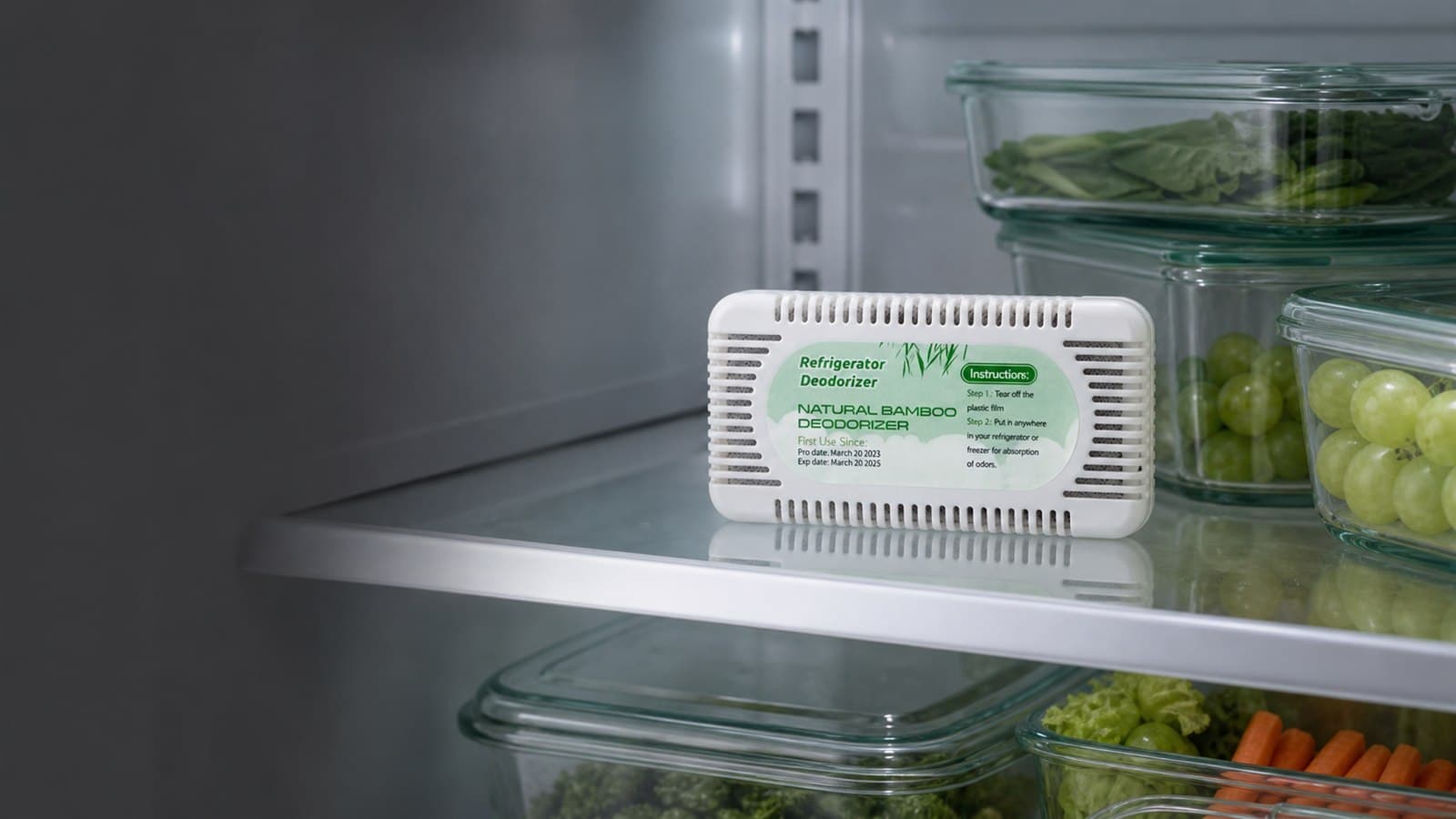
Place the same 50g deodorizer on two refrigerator shelves and it may seem like two different products. On an open shelf, air can pass around its housing. Wedged behind cartons and containers, the vents may barely see the air carrying the odor.
Bamboo charcoal fridge deodorizers can help with some lingering airborne odors, but their effect is passive, gradual and finite. They do not remove spoiled food, wash a spill, sanitize a surface, preserve food or repair a refrigerator that is not holding a safe temperature.
The useful question is therefore not simply whether charcoal works. It is whether odor-bearing air can reach an appropriate charcoal surface through the finished housing and liner, under the refrigerator's cold and humid conditions, before the available adsorption capacity is used.
Do bamboo charcoal fridge deodorizers actually work?
Yes, a properly constructed bamboo charcoal refrigerator deodorizer can support routine odor control when the source has already been removed or contained. Its role is to give certain airborne compounds a porous solid surface on which to collect.
That answer has three important limits. First, adsorption is selective: one charcoal specification may interact more readily with one gas than another. Second, a passive box only treats the air that reaches it. Third, every adsorbent has a finite capacity. A unit that has been blocked, wetted, damaged or left in service beyond its useful condition can disappoint even when the material name sounds suitable.
This is why a finished refrigerator deodorizer should be discussed as a small system rather than a loose quantity of charcoal. The system includes the charcoal specification, particle form, net fill, breathable liner, slot area, housing position, refrigerator conditions and end-user care.
The IUPAC definition of adsorption describes enrichment of a substance at an interface. In plain terms, odor molecules are held at the charcoal surface. They are not pulled into the middle of the material in the same way that a sponge takes up liquid. That difference is also why adsorb is the accurate word here, not absorb.
What has to happen before charcoal can capture an odor molecule?
An odor molecule must leave its source, travel with refrigerator air, pass through the housing slots and breathable liner, then reach an available site on the charcoal surface. A break anywhere along that path reduces the chance of useful contact.
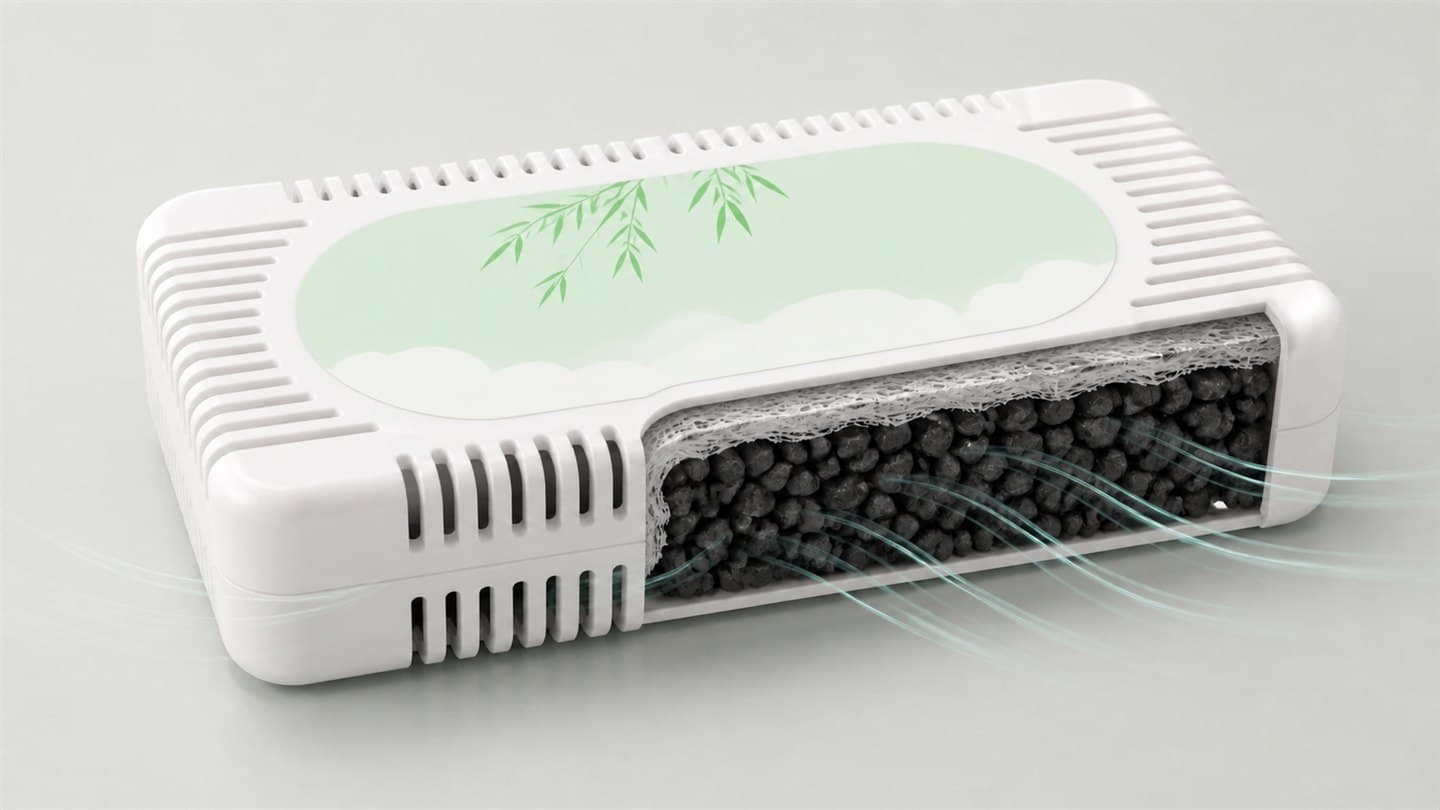
Think of the path in five stages:
- Release: a volatile compound moves from food residue, packaging or another source into the compartment air.
- Transport: natural air movement and the refrigerator's circulation carry that compound away from the source.
- Entry: the air reaches uncovered ventilation slots in the deodorizer housing.
- Contact: the breathable liner allows gas contact while containing charcoal granules and dust.
- Retention: a compatible molecule encounters an available surface site and remains there for some period.
The EPA's technical summary on gas-phase air cleaners is not a test of a passive refrigerator box, but it explains a relevant principle: adsorbent capacity is limited, affinity varies by pollutant, and both material depth and airflow affect contact. Those principles help describe why a label or fill weight alone cannot predict a finished unit's performance.
The reference 50g bamboo charcoal refrigerator deodorizer uses a slotted outer housing and a breathable nonwoven liner to keep this path open while containing the granules. Buyers should still verify the complete assembly in a representative refrigerator, because a material description does not validate the housing around it.
Why can airflow matter as much as charcoal fill weight?
Charcoal that never meets odor-bearing air cannot do useful adsorption work. A heavier fill may add surface area, but it does not compensate for covered slots, a housing pressed flat against a wall or a liner that restricts air contact.
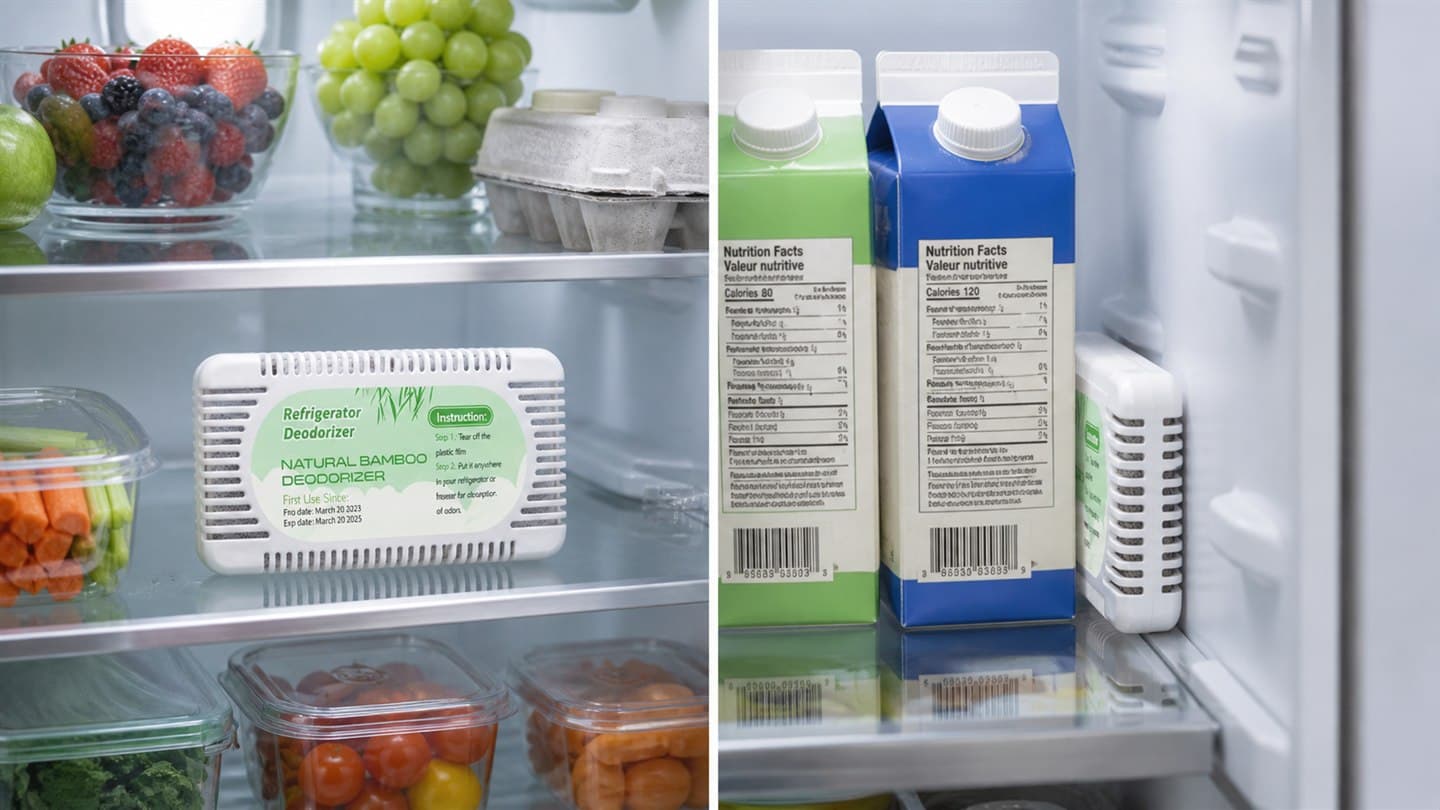
Passive refrigerator deodorizers have no fan. They rely on the air movement already present inside the cabinet, so placement changes the delivery of molecules to the surface. An open shelf position generally offers a clearer air path than a cramped door pocket or the narrow space behind large cartons. The unit should also remain away from standing water, spills and direct contact with unpackaged food.
Airflow does not need to feel like a breeze. It only needs a workable route around the case and through the exposed slots. The practical check is visual: can air reach more than one face of the housing, and will normal loading leave those faces open?
Fill weight still matters because it is part of the specification. However, 50g describes net contents, not coverage area, odor-removal speed or guaranteed service life. Two products with the same stated fill can behave differently if their charcoal, particle size, liner, slot design or assembly differs.
Open-shelf rule: leave the housing vents visible and dry. If food packages close every air path, move the unit before deciding that the charcoal is ineffective.
How do temperature, humidity and odor chemistry change the result?
Cold storage changes both the odor source and the adsorption environment. Temperature, water vapor and the chemistry of each odor compound influence how readily molecules move through the air and interact with a charcoal surface.
Lower temperatures can favor adsorption for some systems, yet refrigerators are also humid and dynamic. Doors open, warm air enters, condensation can form and food releases a changing mixture of compounds. Water vapor competes for surface access in many adsorbent systems. That makes a simple room-temperature material result a poor substitute for a finished-product refrigerator trial.
Charcoal specification matters too. An ITTO bamboo utilization manual lists refrigerator deodorization among bamboo-charcoal applications. It does not establish a universal removal rate for every bamboo species, carbonization process, particle format or housing.
A laboratory study of ammonia adsorption by bamboo charcoal also found that carbonization temperature and later treatment changed performance. The study is useful evidence that material preparation and target gas matter. It is not proof that an untreated 50g retail unit will remove every refrigerator odor at a stated speed.
This distinction protects both buyers and end users. “High-temperature carbonized bamboo charcoal” is a supportable material description for the reference product. “Activated carbon” should not be printed unless the supplied material is actually specified and verified as activated carbon.
Which refrigerator odor problems are realistic targets?
The most realistic target is a residual airborne odor that remains after its source is removed, cleaned or properly contained. A passive deodorizer can also support routine control of low-level mixed food odors between normal refrigerator checks.
| Refrigerator situation | Reasonable role for charcoal | First action before relying on it |
|---|---|---|
| Covered but aromatic food | Help manage some escaped airborne compounds | Check that the container seals correctly |
| Mild mixed odor in an otherwise clean cabinet | Support routine background odor care | Confirm safe temperature and open airflow |
| Residual smell after a cleaned spill | Help with the remaining airborne trace | Dry the cleaned area and inspect hidden edges |
| Spoiled food or leaking package | No suitable first-line role | Remove the food and clean the contamination |
| Strong odor inside a drawer or drain area | Limited until the source is reached | Inspect, clean and dry the affected part |
| Persistent musty smell with moisture | Not a repair or mold treatment | Investigate wet surfaces, drainage and appliance condition |
Food safety remains separate from odor control. The FDA's cold-storage guidance recommends keeping the refrigerator at 40°F (4°C) or below, cleaning spills promptly and covering food. A deodorizer cannot extend a food's safe storage window or turn questionable food into safe food.
For a step-by-step source audit and cabinet reset, use the companion guide on removing bad fridge smells naturally. This article begins where that cleaning process ends: with the remaining air path and the passive product placed inside it.
Why might a 50g fridge deodorizer appear not to work?
Most disappointing results can be traced to the odor source, the air path, the product condition or an expectation the format could never meet. Diagnosing those variables is more useful than immediately adding another unit.
| What the user notices | Likely explanation | Sensible next check |
|---|---|---|
| No change beside an open food container | The source is still releasing compounds faster than a passive unit can manage | Seal, remove or clean the source |
| Little change behind tightly packed containers | Housing slots are blocked from compartment air | Move the unit to an open shelf |
| Odor returns quickly after cleaning | Residue remains in a gasket, drawer track or drain area | Repeat the source inspection |
| Housing or liner is wet | Condensation or a spill has affected the finished unit | Follow the product instructions and replace if damaged |
| Product worked earlier but now seems weak | Available adsorption sites may be occupied or the unit may need labeled care | Inspect condition, service time and care status |
| Strong odor persists throughout the cabinet | The source or appliance condition may be outside passive-product scope | Check food, temperature, drainage and appliance guidance |
Adding a second 50g unit only makes sense after these checks. More material may help in a larger or heavily loaded cabinet, but quantity cannot repair poor placement or remove contamination. If the odor is severe, the USDA refrigerator odor procedure provides a more extensive cleaning sequence and explains that some deeply absorbed odors may be difficult to remove.
Does sun drying make the deodorizer fully reusable?
No. “Reusable After Sun Drying” can describe a care step for the reference product, but it should not be interpreted as a complete factory reset, sterilization or a promise of unlimited reuse.
Gentle sun drying may help remove some moisture and some weakly held compounds, depending on the charcoal, odor chemistry, exposure conditions and finished construction. Other compounds can remain more strongly held. Capacity can also decline with use, contamination or physical damage.
The care instruction must therefore belong to the approved finished sample. It should specify how the unit is removed, where it is placed, how long or under what conditions it is dried, when it is cool and dry enough to return, and which damage signals require replacement. Users should not improvise oven or microwave heating unless that method has been validated for the housing, liner, label, adhesive and charcoal.
A careful label can say that the unit is reusable after the stated sun-drying procedure. It should not say that sunlight restores all adsorption capacity, kills all microorganisms or makes the product new again.
How should a finished refrigerator deodorizer be tested?
Test the product that will be sold, not charcoal granules by themselves. The useful trial keeps the housing, liner, label, placement, refrigerator loading and care instructions together.
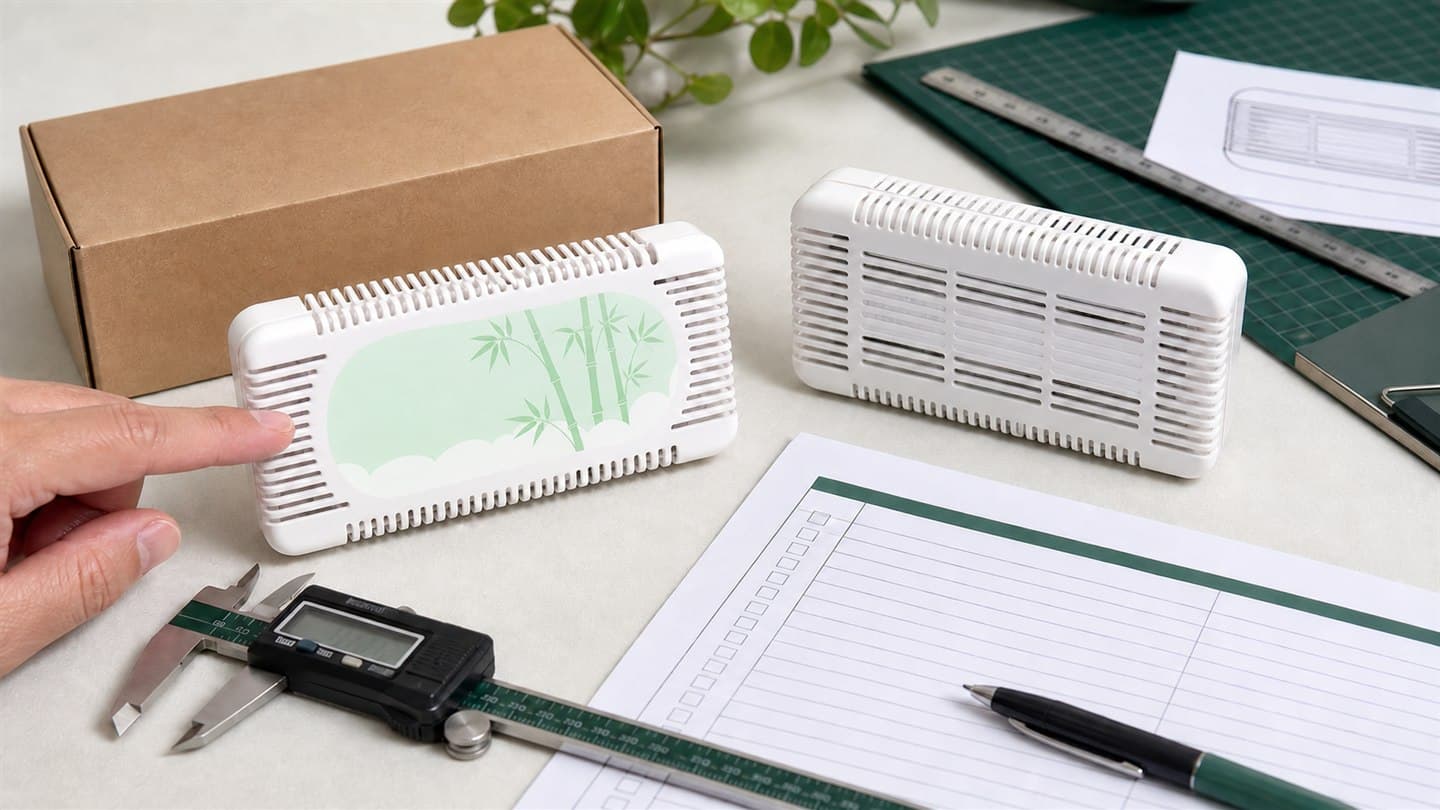
During a finished-sample review, I do not judge the unit from charcoal weight alone. I first check whether the housing slots remain usable, the liner contains the granules, the label survives refrigerator conditions and the placement instructions leave a workable air path.
A practical sample protocol can record:
- Identity: bamboo source description, carbonization specification, particle format and net-fill tolerance.
- Assembly: housing dimensions, closure, slot condition, liner seam and dust containment.
- Environment: refrigerator temperature range, humidity observations, shelf load and door-opening pattern.
- Challenge: a defined odor source that is safe to handle, controlled between trials and relevant to intended use.
- Placement: orientation, clearance around vents and distance from the odor source.
- Observation: time points, trained panel method or appropriate instrument, control condition and acceptance rule.
- Care cycle: labeled sun-drying procedure, return condition and any change after repeated cycles.
- Artwork: wording that does not promise more than the trial actually demonstrated.
Run a control under the same conditions without the product. Otherwise, natural odor decline, food removal or normal air exchange may be mistaken for product performance. One household anecdote can reveal usability problems, but it cannot establish a universal duration or removal percentage.
Review your sample brief: send your sample requirements before artwork is treated as final.
What claims can retailers responsibly put on the packaging?
Responsible packaging describes the product's construction and intended supporting role without turning a passive odor-care item into a sanitizer, preservative or appliance repair.
A practical claim ladder is:
- Strongest factual ground: “Contains 50g high-temperature bamboo charcoal granules,” subject to the approved specification and fill tolerance.
- Construction claim: “Ventilated housing with a breathable inner liner,” confirmed on the finished sample.
- Use claim: “For routine refrigerator odor care” or “helps manage some unwanted refrigerator odors,” supported by a representative product trial.
- Care claim: “Reusable after sun drying,” only with the approved procedure and replacement guidance.
- Claims requiring separate evidence: quantified removal, fixed service life, named-gas performance or comparison with another product.
- Claims to avoid without specific proof and authorization: eliminates all odors, antibacterial, mold prevention, keeps food fresh longer, sanitizes the refrigerator or works instantly.
Retail language also needs to tell the user what the product cannot replace. Clear directions should say to remove spoiled food, clean spills, keep the refrigerator at a safe temperature and leave ventilation slots open. The broader guide to whether bamboo charcoal bags work explains why performance language has to follow the tested format rather than the ingredient name.
For private-label work, housing artwork, instructions and retail packaging should be reviewed together. The customization process can then use one approved product brief instead of separate assumptions about fill, case and claims.
Conclusion: when is a bamboo charcoal fridge deodorizer worth using?
A bamboo charcoal fridge deodorizer is worth using when four conditions are met: the odor source has been removed or contained, the refrigerator is clean and safely cold, air can reach the housing vents, and the user's expectation is gradual support rather than instant elimination.
Its effect comes from adsorption at available charcoal surfaces. The result depends on the material specification, odor chemistry, humidity, airflow, liner, housing and care history. A 50g label alone cannot promise area, speed or lifespan.
That modest conclusion is also the most useful one for a retail program. It gives buyers a product they can specify, place, test and explain without borrowing claims from unrelated activated-carbon studies or asking a passive box to solve a hygiene problem.
If you are developing a refrigerator deodorizer line, send your product requirements, including the target market, housing, fill, label and pack direction. The finished sample can then be judged as an airflow and adsorption system, not as a charcoal weight printed on a box.