
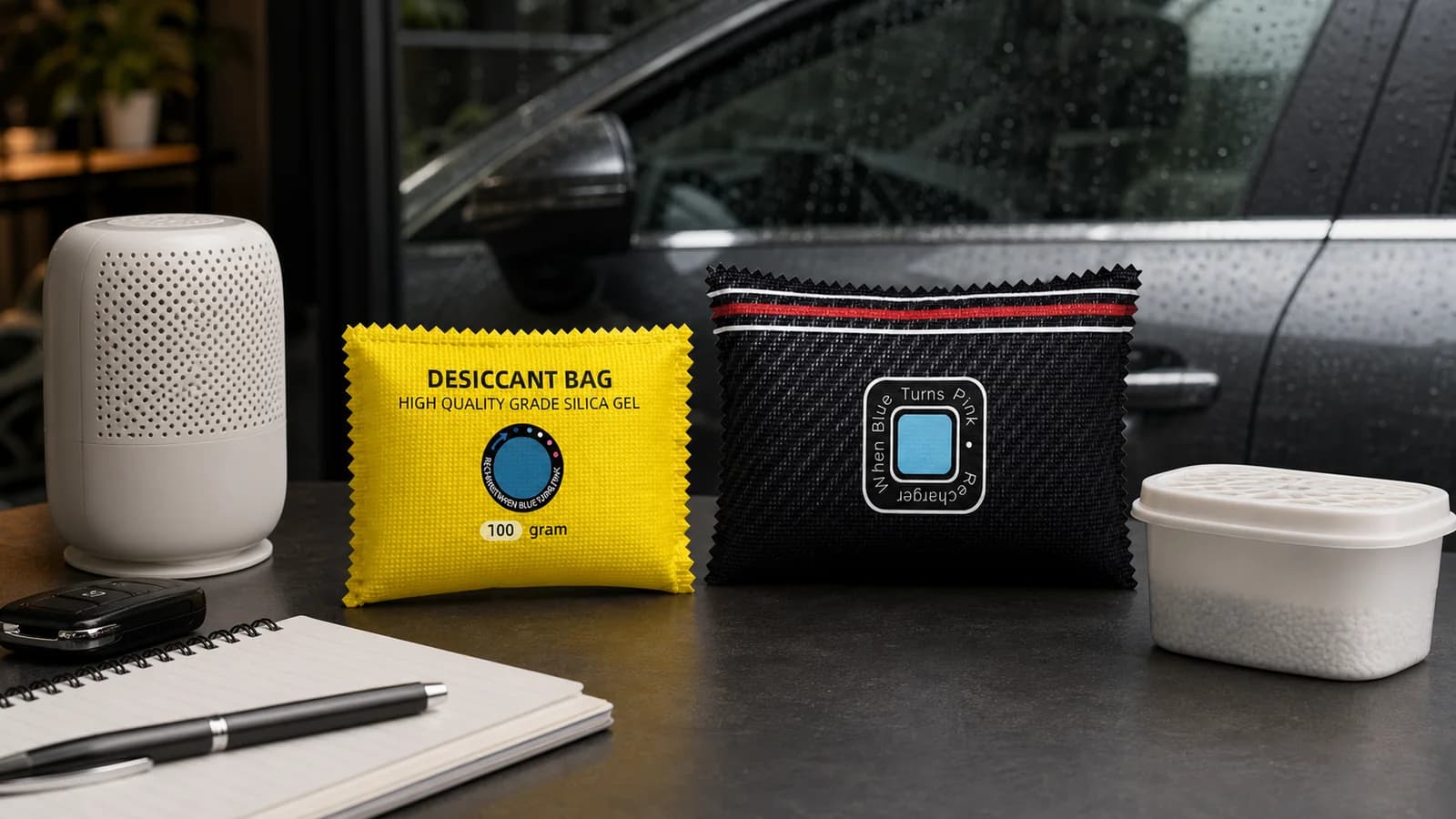
A search for the best dehumidifier for a car brings up products that do very different jobs. A reusable silica gel bag, a calcium chloride tub, a small electric unit and the vehicle's climate system all handle moisture differently, so a straight product ranking is not very useful.
For modest residual humidity in a parked car, a reusable silica gel bag is usually the simplest passive option. Wet carpet or an active leak needs extraction and repair first. Powered units need suitable electricity, airflow and drainage, while salt-based absorbers need secure containment for the liquid they create.
When I review a vehicle-care sample, I start with the moisture job rather than the front-of-pack promise. That keeps a convenient accessory from being presented as a repair tool. This guide uses the same approach to compare four options and turn the result into a clearer retail or sourcing decision.
What is the best dehumidifier for a car?
The best option depends on whether the car needs rapid demisting, bulk drying or quiet moisture control while parked. No single device is the right answer for all three jobs.
Use the vehicle's approved demist and air-conditioning controls when visibility is affected during a journey. Remove standing water and dry wet trim after a larger water load. Once the source is under control, a passive bag can help with the smaller amount of water vapor left in the closed cabin.
Product capacity is only part of the decision. Match the option to the moisture load, the time the car is parked, available power, acceptable maintenance and a secure placement. A silica gel pouch avoids cables and a liquid tray, but it still has finite capacity and needs monitoring.
Which moisture problem are you trying to solve?
Separate active water from airborne humidity before comparing products. A passive absorber can support a dry cabin, but it cannot keep pace with rainwater entering through a failed seal or water held deep inside carpet padding.
| What is happening | Immediate priority | Useful follow-up | Poor first choice |
|---|---|---|---|
| Windscreen mists while driving | Use the vehicle's approved demist, heating and air-conditioning settings | Reduce wet items and check recurring moisture sources | A loose absorber on the dashboard |
| Light condensation appears after wet-weather use | Remove wet coats, umbrellas and mats; ventilate when safe | A monitored silica gel bag while parked | A room dehumidifier powered inside an unattended vehicle |
| Carpet, seats or luggage area are wet | Extract water, dry hidden padding and find the entry path | Controlled drying after the bulk water is removed | Several small pouches expected to dry soaked material |
| Vehicle is stored for weeks | Put the vehicle away dry and inspect seals and drains | Passive moisture control with a regular check schedule | An open liquid collector that can tip or overflow |
The dividing line is simple: a maintenance product works on the moisture that remains after basic source control. If dampness returns in the same footwell or luggage well, investigate the cause instead of adding more absorbent material. The earlier guide on how to get moisture out of a car covers that diagnostic process in detail.
How do the main car dehumidifier options compare?
Compare each option by its mechanism, not by the shared word "dehumidifier." The practical differences are power, water handling, speed, placement and maintenance.
| Option | How it works | Power | Water after use | Best fit | Main limitation |
|---|---|---|---|---|---|
| Vehicle climate and demist system | Moves and conditions cabin air while the vehicle operates | Vehicle power | Managed by the vehicle system | Fast visibility control during a journey | Does not provide passive control while the vehicle is off |
| Reusable silica gel bag | Adsorbs water vapor on the porous desiccant surface | None | Water remains held in the sorbent until approved regeneration | Residual humidity in parked cars, trunks and small storage spaces | Capacity declines as the gel loads with moisture |
| Small electric dehumidifier | Condenses water from moving air, often into a tank | External or dedicated power | Liquid in a tank or drain | Controlled stationary drying when the unit is approved for the setup | Requires power, airflow, stable placement and water handling |
| Calcium chloride absorber | Attracts moisture and gradually dissolves into brine | None | Liquid salt solution | Stationary cupboards, rooms or protected storage areas | Liquid containment makes moving-vehicle use harder to manage |
Product reviews often conflict because users test different jobs. One wants less overnight mist; another expects saturated carpet to dry. A powered unit can collect water faster under its rated conditions, while a silica gel bag works gradually without a continuous power source. Buyers should define the job before treating either result as evidence.
When is a reusable silica gel bag the better fit?
A reusable silica gel bag suits modest residual humidity in an enclosed, parked vehicle when the user wants a compact product without a cable or liquid collection tray. It must still be sized, placed and maintained for the intended use.
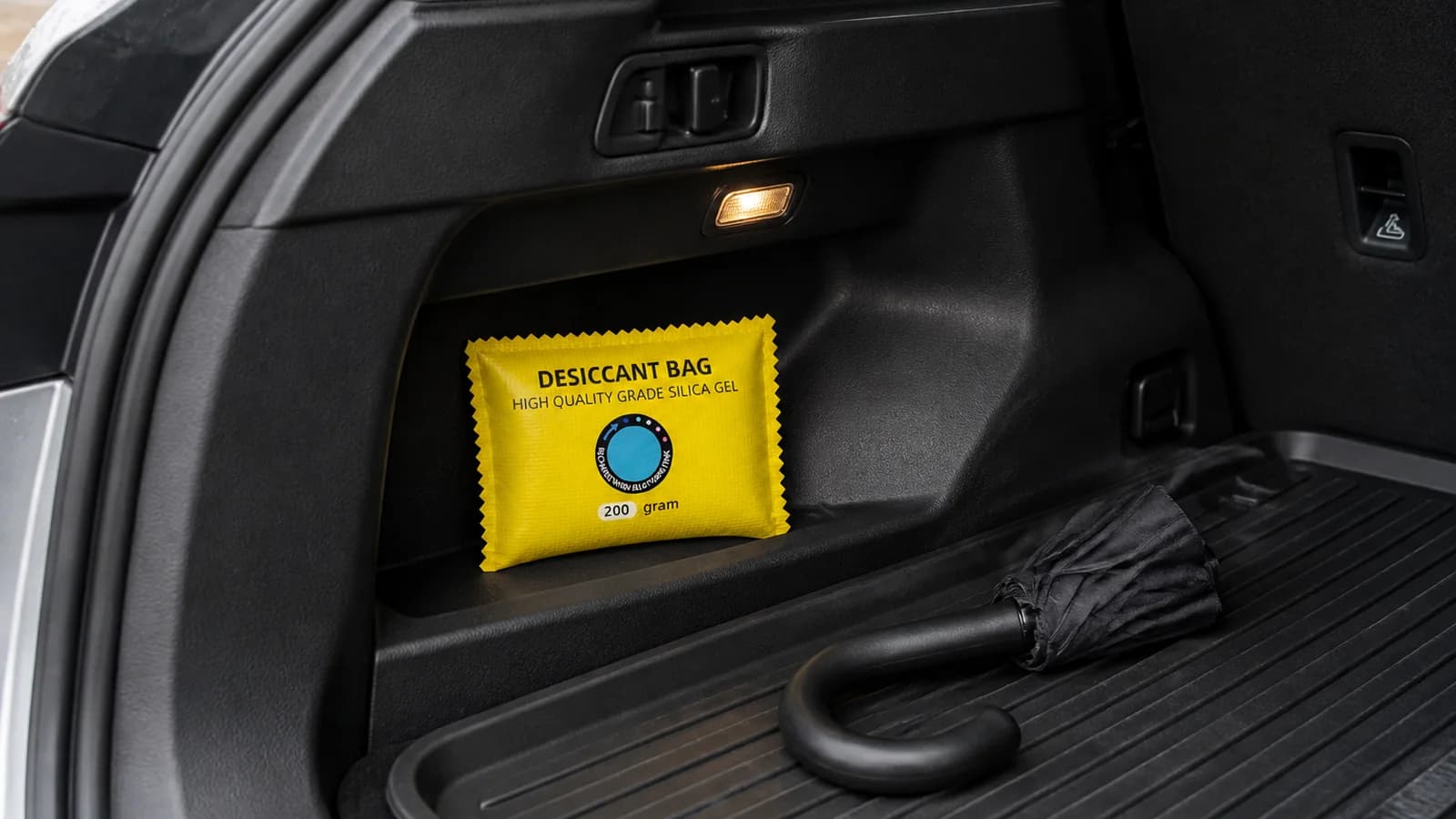
Silica gel is a moisture sorbent rather than a miniature refrigeration device. The Canadian Conservation Institute's technical bulletin on passive relative-humidity control with silica gel explains that performance in an enclosure depends on the sorbent, its quantity, the surrounding conditions and how much outside air enters. A car is not a museum display case, but the same variables explain why one fixed coverage claim cannot suit every cabin.
For a vehicle program, the working pouch needs breathable surface area and a stable location. It should stay clear of pedals, seat rails, vents, controls and the driver's field of view. A rear footwell position is only appropriate if the bag cannot slide forward. A protected trunk or side-storage position may be easier to manage. The automotive interior application guide provides a broader placement framework for car-care products.
The moisture indicator is a service cue, not a cabin hygrometer. Its chemistry, dry color, loaded color and change threshold need to be confirmed on the approved sample. Once the indicator or care schedule shows that drying is due, the user should follow the instructions for that exact finished bag.
Our reusable silica gel car dehumidifier bags use 100g, 200g and 400g reference formats as development starting points. They are not universal coverage ratings. Cabin size, wet cargo, parking conditions and check frequency all change the result.
Comparing passive formats for a vehicle-care range?
Send the intended vehicle, placement, fill weight and pack quantity for a sample review.
When does an electric dehumidifier make more sense?
An electric dehumidifier makes more sense when there is a larger moisture load, a safe stationary setup and enough time, power and airflow to operate the equipment correctly. A room model is not automatically approved for use inside a vehicle.
ENERGY STAR describes portable room dehumidifiers by water-removal capacity in pints per day and recommends sizing them for the space and dampness level. The guidance also calls for air circulation around the unit, a grounded electrical connection and safe management of the tank or drain hose. Those conditions are straightforward in a room and much less straightforward in a parked car.
A compact thermoelectric unit may draw less power than a compressor model, but the same questions remain: voltage, cable, upright stability, condensate, ventilation and parked-cabin temperature. Professional drying in a controlled workshop is not the same as leaving a consumer appliance in an unattended car. Follow both the equipment and vehicle instructions.
Why is a calcium chloride absorber different from a silica gel bag?
Calcium chloride is deliquescent: it can attract enough moisture to dissolve into the water it collects. That makes it useful in some stationary absorbers, but it also creates a liquid-handling decision that a silica gel pouch does not.
The US National Library of Medicine's PubChem entry for calcium chloride describes the material as hygroscopic and deliquescent. In a consumer moisture absorber, the product therefore needs a reservoir, membrane or containment system designed for the resulting solution.
This does not make every salt absorber unsuitable. It makes orientation and containment part of the application. A stable tub on a cupboard shelf is easier to supervise than one in a vehicle that accelerates, brakes and carries loose luggage.
Silica gel behaves differently. Water remains associated with the porous solid until it is released through an approved conditioning or regeneration process. A damaged pouch can still leak beads or fragments, so it needs inspection, but a sound bag does not normally create a tray of brine during use.
Retail copy should not blur these mechanisms. "Moisture absorber" can describe both categories, yet replacement, disposal, warnings and customer expectations are different. The label and images should show which system the buyer is actually purchasing.
Can the same dehumidifier be used in a car and at home?
Some passive products can serve both vehicle and home-storage applications, but the claimed space and placement must stay realistic. A car pouch may suit a wardrobe or cabinet; it is not a whole-room or basement dehumidifier.
A closed vehicle, trunk, wardrobe and storage cabinet are all small enclosures, although their temperature cycles and air exchange differ. A reusable bag can be evaluated in each of them if the finished construction and care instructions permit the use. The package should name specific spaces instead of stretching "home use" into a promise to control an entire building.
Room moisture is a different scale. Bathrooms, basements and rooms with recurring dampness may need ventilation, drainage, repair or a powered unit sized for the space. Home placement can also bring the bag closer to children, pets, food or delicate surfaces. If one SKU serves car and storage uses, the artwork should describe both accurately.
What should private-label buyers specify before ordering?
A sourcing brief should connect the moisture-control job to the material, construction, indicator, care method, packaging and claim language. A quoted fill weight alone is not enough to reproduce the same finished product.
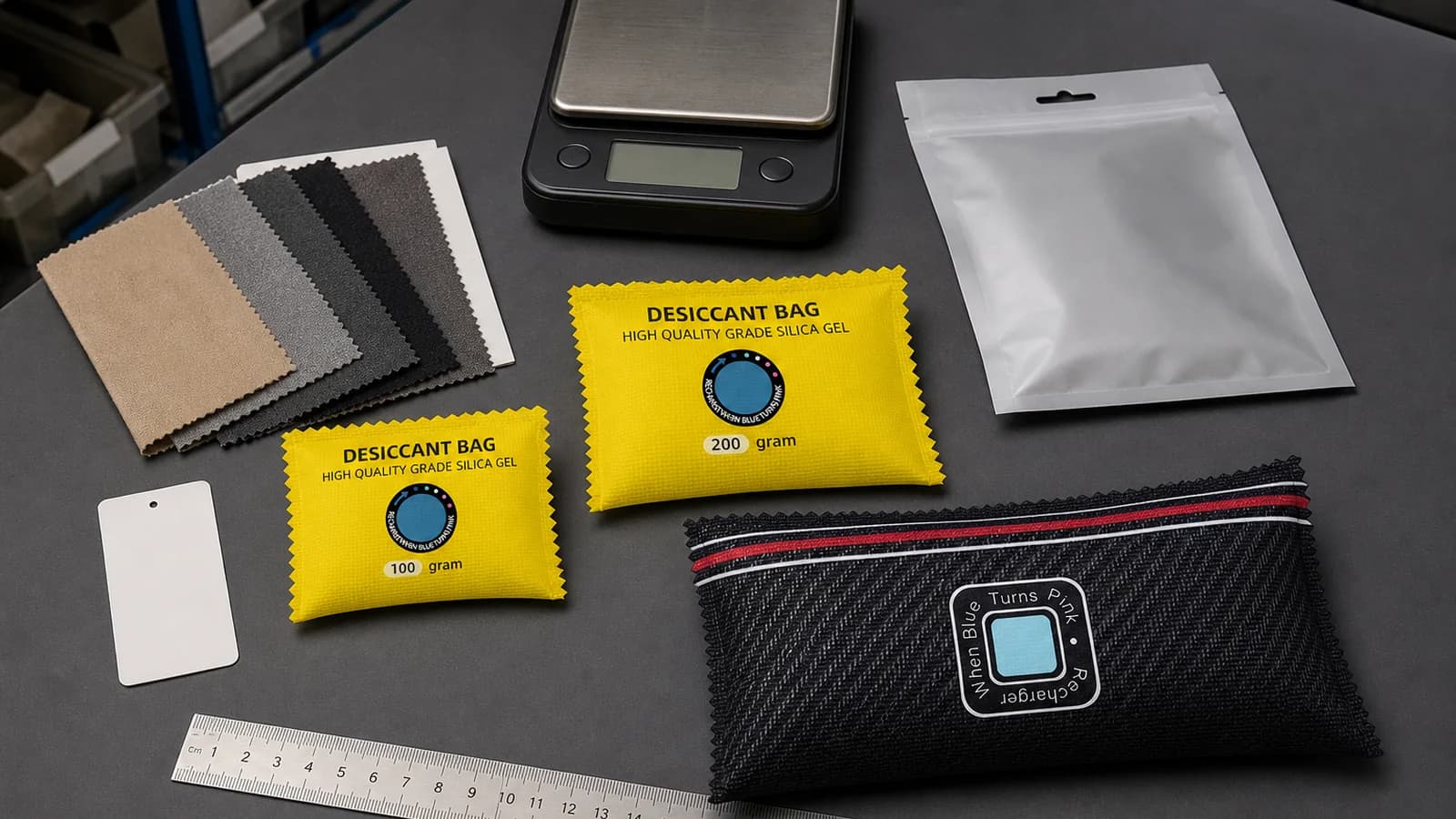
When I compare samples, I look for agreement between the pouch and its instructions. If the pack says "reusable," the drying route has to suit the final fabric, print, seams, indicator and fill. If it says "for cars," placement cannot depend on a loose product in the driver's sightline.
| Approval field | What to record | Why buyers need it |
|---|---|---|
| Intended use | Vehicle type, parking state, home-storage spaces and excluded uses | Keeps the claim tied to a defined moisture job |
| Desiccant system | Material specification, fill weight, tolerance and bead condition | Controls cost, capacity and repeatability |
| Indicator | Chemistry, location, dry reference, loaded reference and acceptance method | Prevents unexplained color changes or substitution |
| Pouch construction | Fabric, breathable area, seams, print, window and finished dimensions | Affects air contact, handling and regeneration suitability |
| Care instructions | Approved drying route, power or temperature conditions, cooling, stop-use signs and storage | Makes reuse specific to the finished product |
| Unit packaging | Moisture barrier, seal, set count, barcode and instructions | Protects dry capacity before first use |
| Claims | Exact performance, lifespan and application wording with supporting evidence | Reduces the gap between material behavior and retail promise |
Indicator chemistry deserves a named specification. The European Chemicals Agency lists cobalt dichloride and its regulatory obligations. This does not mean every colored indicator uses cobalt or that one rule applies worldwide. It means a buyer should identify the actual chemistry and confirm destination-market requirements rather than approving a color description alone.
Claims need the same discipline. The US Federal Trade Commission's advertising substantiation policy states that objective product claims require a reasonable basis before publication. A silica gel datasheet can support the material description, but it does not prove that a finished 200g pouch will prevent condensation in every vehicle.
For products sold in the EU, the General Product Safety Regulation summary also points to clear instructions, safety information, traceability and product risk analysis. Market-specific legal review remains the buyer's responsibility, but care copy should be part of the sample approval rather than an afterthought.
The private-label customization process can then turn those decisions into fabric, branding, indicator placement, care information and retail packaging that are reviewed as one program.
Frequently asked questions about car dehumidifiers
What if a silica gel bag appears not to work?
Check whether the bag arrived dry, has reached its service state, is exposed to cabin air and is facing a continuing moisture source. The car dehumidifier bag evidence guide covers the failure signals and observation steps in detail. A different product type will not solve an active leak or soaked padding either.
Is a silica gel bag better than an electric dehumidifier?
It is more convenient when passive, cable-free moisture control is the priority. An electric unit can be more suitable for a larger drying job in a safe stationary setup. They solve different problems, so neither is universally better.
How many dehumidifier bags should a car use?
There is no defensible universal number. Start with vehicle volume, moisture pattern, bag fill, available placement and the desired check interval. A buyer developing a retail recommendation should test the proposed configuration in representative conditions.
Can a calcium chloride moisture absorber be used in a car?
Only if the complete product is designed and instructed for that use, including movement, orientation and liquid containment. An open household tub that must remain level is a poor match for a moving cabin.
Can a car dehumidifier bag be used in a closet?
It may suit a small wardrobe or storage cabinet if the approved instructions allow it and the bag is protected from children, pets, food and delicate surfaces. It should not be promoted as a replacement for room ventilation or leak repair.
Can every reusable silica gel bag go in a microwave?
No. Microwave suitability belongs to the complete bag, not the loose silica gel alone. Follow the instructions validated for the exact fill, fabric, printing, seam and indicator system. Do not copy the time from another size or brand.
Conclusion: how should you choose a car dehumidifier?
Choose the moisture job first. Use the vehicle system for rapid demisting, remove bulk water before it settles into trim, reserve powered equipment for a safe controlled setup, and use a passive absorber for the residual humidity it can reasonably manage.
For many parked-car maintenance programs, a reusable silica gel bag offers the cleanest balance of compact placement, no external power and no liquid reservoir. That recommendation changes when the cabin is wet, the product cannot be secured or the user will not monitor and regenerate it.
A strong product specification makes those boundaries visible. It defines placement, maintenance, the indicator and supportable claims. That gives the retail customer a useful choice instead of another product labeled simply "car dehumidifier."
Building a car or home-storage moisture-control line?
Share the intended space, product format, indicator, care method, quantity and packaging brief.
We will organize the requirements into a practical sample route for review.