
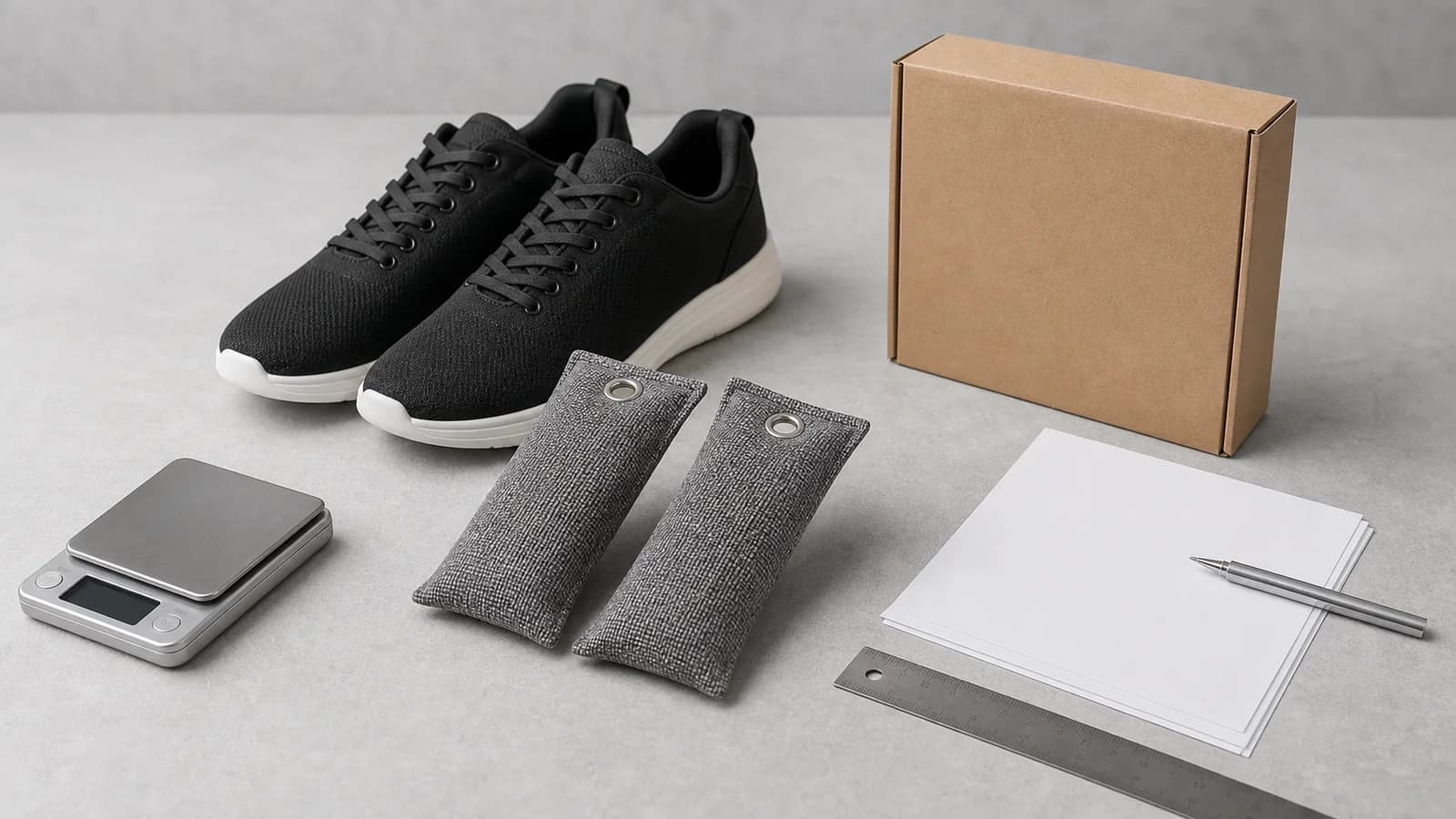
A pair of charcoal shoe deodorizer bags seems simple until two quotations describe it differently. One supplier prices 100 grams per pair, another assumes 100 grams in each pouch, and both may still call the result the same product. The disagreement only becomes visible when samples arrive.
A reliable specification for private-label charcoal shoe deodorizer bags connects the intended footwear, finished pouch dimensions, fill basis, materials, construction, branding, retail pack, instructions and inspection method. It gives the supplier enough information to quote one defined product and gives the buyer something objective to approve.
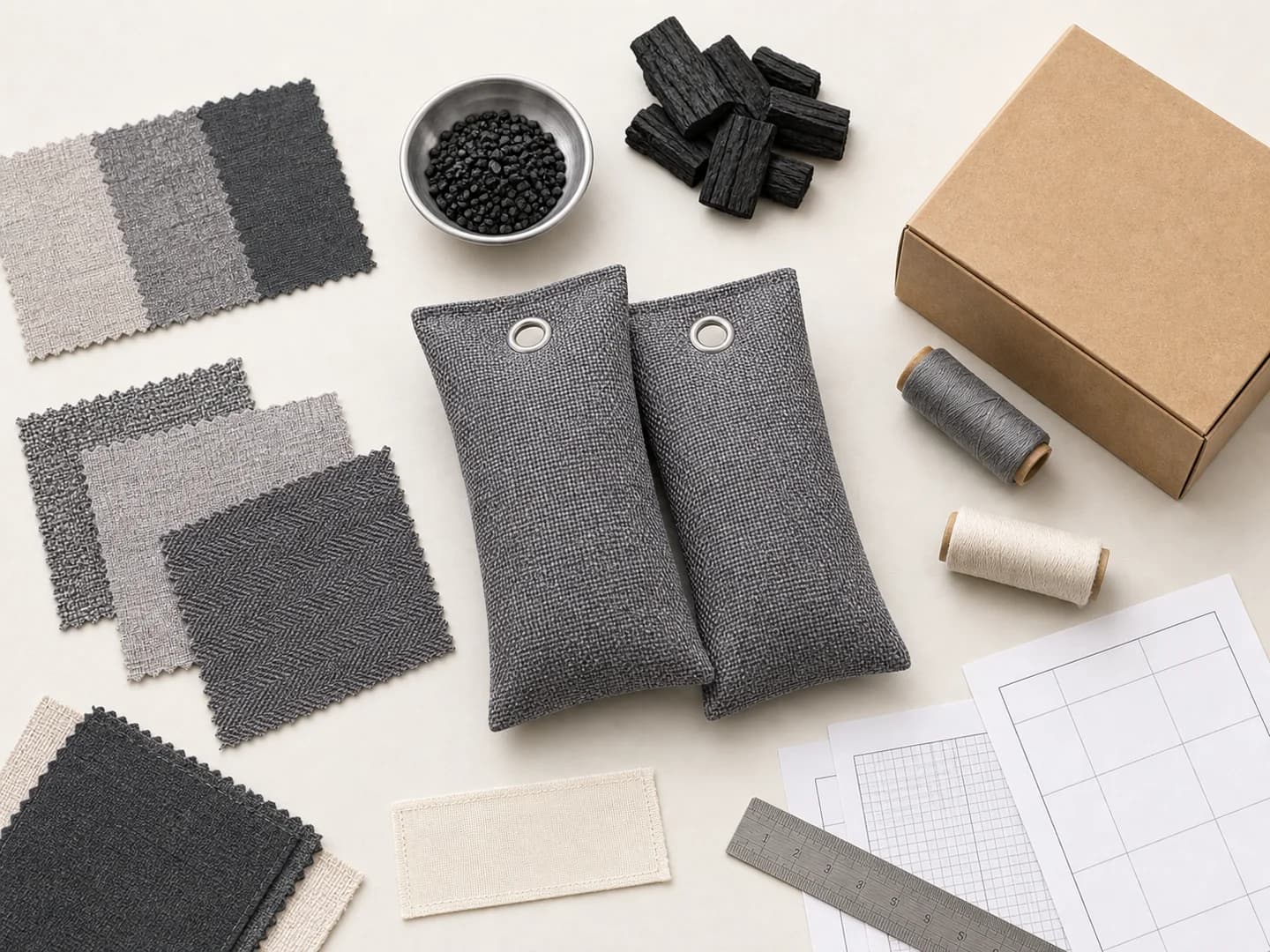
My first pass through a product brief is usually a red-pen exercise. I mark every phrase that two teams could interpret differently. Terms such as "standard size," "premium fabric," "reusable" and even "one set" need a measurement, reference sample or approval record before they can control production.
What should a complete private-label specification settle before quotation?
A complete specification should identify the commercial unit, intended use, finished product, branding, packaging and acceptance method before the buyer compares prices. Some details can be confirmed by sample, but the document must say which details are open and who will approve them.
A useful brief begins with the job the product has to perform. A slim pouch intended for low-profile sneakers faces a different space constraint from a pouch intended for work boots or locker storage. That decision affects dimensions, finished thickness, fill amount and the wording printed on the retail pack.
The next step is to remove unit ambiguity. A quotation should state whether price, fill weight and carton quantity refer to one pouch, one pair, one multipack or one retail unit. "Two pack" can mean two pouches or two pairs. Writing the unit once at the top of the specification is not enough if later tables use a different basis.
| Specification layer | What the buyer should define | Approval evidence | Risk if left open |
|---|---|---|---|
| Commercial unit | Piece, pair, set and retail pack relationship | RFQ and quotation | Quantity and price cannot be compared |
| Product fit | Target footwear and storage context | Fit review on a finished sample | Pouch is too thick, too short or hard to retrieve |
| Construction | Fabric, liner, seam, closure and eyelet or loop | Approved sample and detail photos | Dust escape or inconsistent finishing |
| Branding | Logo method, color and position | Artwork and branded sample | Wrong orientation, scale or color |
| Packaging | Set count, pack structure and carton basis | Pack sample and packing specification | Incorrect retail unit or carton loading |
| Inspection | Measurements, defect classes and sampling basis | Inspection sheet | Subjective pass or fail decisions |
The charcoal shoe deodorizer product range is a practical starting point for available pouch, fabric, branding and pack formats. The order specification still needs to record the exact combination selected for the project rather than treating the product page as the purchase contract.
Which product format should the RFQ actually name?
The RFQ should name a removable fabric pouch filled with bamboo charcoal if that is the product being sourced. It should not call the same item an insole, spray, powder, loose-charcoal packet or wearable insert because those formats have different constructions, use instructions and customer expectations.
Search results often mix "charcoal insert," "shoe freshener" and "charcoal insole." A sourcing document cannot afford that flexibility. Start with a plain description such as "one pair of filled fabric pouches for dry footwear storage," then add the intended shoe types and retail presentation.
Material terminology deserves the same care. Bamboo charcoal and activated charcoal are not interchangeable labels. If the approved filling is bamboo charcoal, the specification and artwork should use that name unless material documentation supports another description. A broad word such as "natural" does not identify the charcoal grade, particle condition, liner or finished pouch.
The product boundary also belongs in the brief. A fragrance-free pouch may support odor care during storage, but it is not a shoe dryer, cleaner, disinfectant, medical treatment or insole. The evidence review in Do Charcoal Shoe Deodorizers Work? explains why the finished product, airflow and use conditions matter more than a category label alone.
How should size, finished thickness and fill weight be specified together?
Length, width, finished thickness and fill weight should be approved as one fit system. Increasing the fill may change the pouch profile and how easily it rests inside a shoe, so a weight decision made without target footwear can create a sample that looks substantial on a table but fits poorly in use.
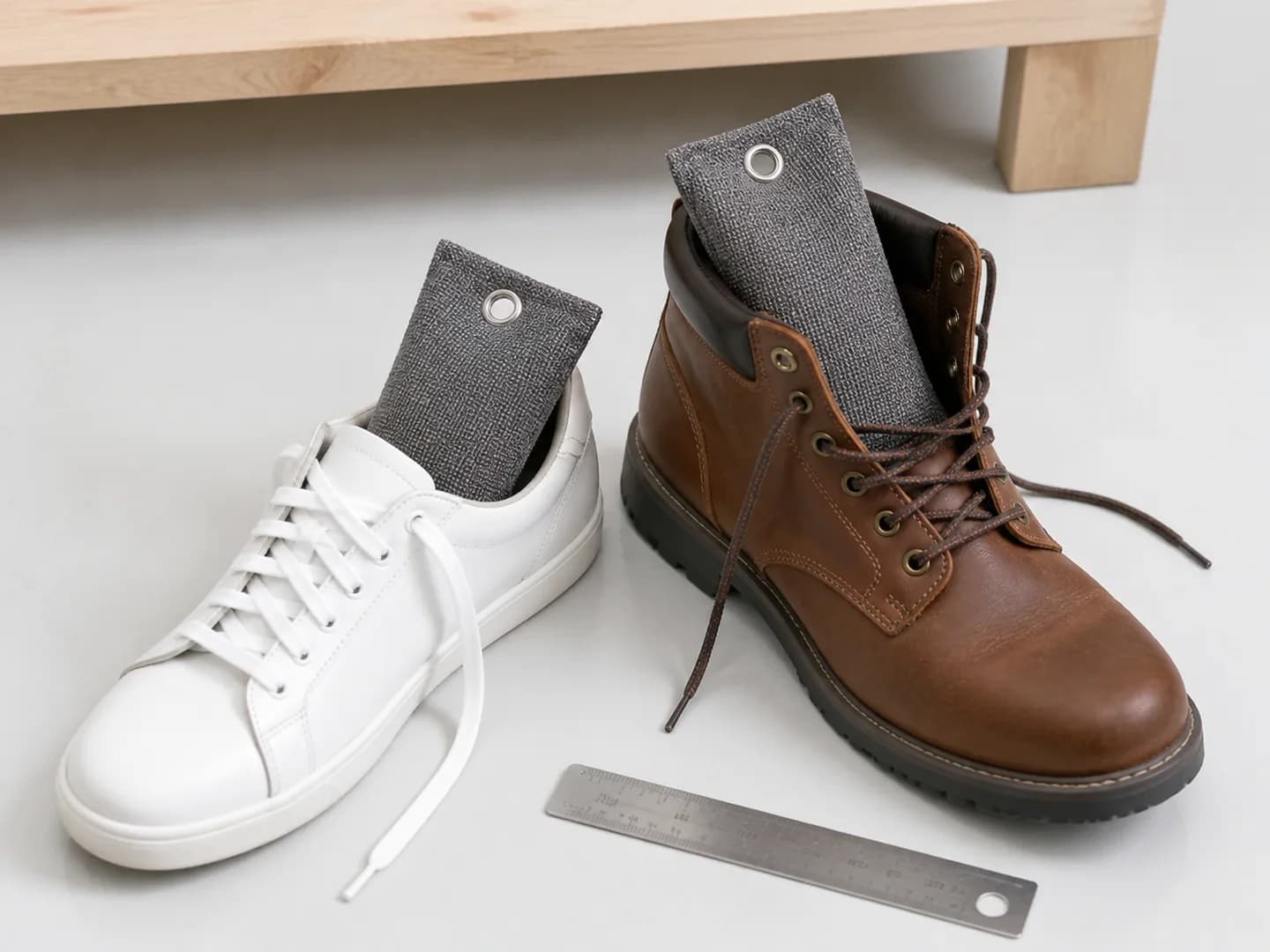
Record whether dimensions describe the empty cut piece, the sewn flat pouch or the filled finished item. The finished item is the useful buying reference, yet even that measurement needs a defined resting condition. Pulling a soft pouch flat for measurement can produce a different number from letting the filling settle naturally.
Weight needs an equally clear basis. State the nominal net fill per pouch and the corresponding amount per pair. Keep the total finished weight separate because fabric, liner, thread, eyelet and labels add mass. If the buyer wants a weight tolerance, the specification should state both the tolerance and the checking method rather than relying on an unstated factory convention.
| Fit decision | Record in the specification | Confirm on the sample | Do not approve from |
|---|---|---|---|
| Length and width | Finished external dimensions and measurement condition | Flat and naturally filled views | Cutting dimensions alone |
| Net fill | Amount per pouch and per pair | Agreed weighing method | "About 100 g" |
| Finished thickness | Resting profile after filling | Target sneaker and boot fit | Empty shell thickness |
| Quantity | Pouches per pair, pairs per pack and packs per carton | Finished retail unit | The word "set" alone |
| Retrieval | Eyelet or accessible end orientation | Insertion and removal from target footwear | A tabletop photo |
A fit trial does not need to imitate every shoe on the market. It needs a defined range that reflects the intended channel, such as a low-profile trainer, a wider everyday shoe and a work boot. Record the sample models or internal fit fixtures used so a later repeat order can follow the same review logic.
What should buyers specify about charcoal and dust containment?
The material section should record the agreed charcoal identity, fill basis, particle or dust condition, liner construction and finished-pouch acceptance criteria. Writing only "natural charcoal" leaves too much room for variation and says nothing about how the filling is contained during normal handling.
Separate the filling from the finished product. The filling may be bamboo charcoal, while the finished product also includes the outer textile, any inner nonwoven liner, thread, closure and hardware. A material certificate for one component cannot prove how the complete pouch will behave inside a shoe.
Containment should be checked at the seam, the filling closure and around any eyelet or loop. The goal is not an unrealistic promise that no microscopic dust will ever exist. The goal is a practical acceptance rule for visible escape, surface marking and seam integrity under the handling conditions agreed for the sample.
The specification should also avoid turning a material name into an unsupported performance number. Odor adsorption depends on the filling, exposed surface, air path, pouch construction, target compounds and use conditions. If the brand plans to print a lifespan, reuse or performance claim, that claim needs a separate evidence record tied to the finished sample.
How do fabric, seams and hardware become acceptance criteria?
Descriptions such as "breathable fabric" and "strong stitching" need to become identifiable construction details. Buyers should record the approved outer textile, color reference, liner, seam arrangement, thread appearance, closure, label position and any eyelet or loop that forms part of the finished product.
Fabric hand feel can help select a sample, but it is hard to enforce from memory. Keep a retained swatch or sealed sample and add the material reference used by both teams. If color matters, approve it under an agreed viewing condition. A phone photograph is useful for discussion, not as the only color standard.
Seam language can be more precise without making the specification unreadable. The current ASTM seam practice explains that fabric, seam type, stitch type, density, thread tension and end use interact. A buyer does not need to copy the standard into the RFQ, but should identify the selected construction and define visible rejection conditions.
Useful construction checks include an open seam, skipped stitching, insecure backtacking, fabric damage near the eyelet, exposed filling and a label sewn in the wrong direction. Minor thread trimming can be classified separately from a defect that allows filling to escape. That distinction becomes important during bulk inspection.
Which choices affect MOQ, unit cost and lead time?
MOQ, price and lead time depend on the selected combination of fabric, color, size, logo method, pack format, artwork, testing and SKU count. A universal number quoted before these choices are known is rarely a sound planning basis for a private-label program.
A stock textile color and an existing pouch format may require less setup than a custom-dyed fabric or new cutting pattern. A sewn label, direct print and hang tag use different materials and approval steps. The cheapest logo method on one order size may not be the most practical choice on another.
Packaging often has a larger effect than expected. A plain set bag, printed pouch, folding color box and rigid gift box involve different artwork, tooling, packing labor and carton space. The buyer should ask for product and packaging costs to be visible enough to understand which change moved the quotation.
SKU count matters too. Five colors ordered at 1,000 pairs each are not the same production plan as one color ordered at 5,000 pairs. When requesting a quote, show the quantity by SKU, the expected first-order total and any forecast separately. This lets the supplier explain where a material or printing minimum applies.
What must be approved before packaging artwork is released?
Artwork should not move to final print until the sales unit, product name, material wording, quantity statement, use instructions, limitations, market information and barcode space agree with the approved product. A polished dieline cannot repair a product decision that remains unresolved.
Begin with the front-panel identity. If the item is a pair of bamboo charcoal pouches, do not let the artwork drift into "charcoal insoles" or claim a function that belongs to a spray or desiccant. Check that net contents and pack count use the same piece, pair and retail-unit basis as the order.
The use panel should tell the customer where the pouch goes, that footwear should be clean and dry, and that the pouch must be removed before wear. The article on using charcoal shoe deodorizer bags can support that instruction review. Final wording should match the approved construction and target market.
For retail barcodes, the GS1 placement guidance explains why location and package form affect scanning. Reserve the barcode area on the correct panel before visual design fills the available space. The brand owner should supply or approve the final code and verify a printed pack rather than relying only on a screen proof.
Transport packaging needs its own decision. Carton strength, unit arrangement and the distribution route affect the appropriate test plan. ASTM D4169 provides a framework for evaluating shipping units against distribution hazards, but it does not replace a project-specific carton specification or the buyer's chosen test level.
Artwork release check
Approve the product name, piece and pair count, usage copy, claim wording, barcode area, market contacts, pack material, dieline version and master-carton marks before authorizing print.
What should a sample approval record contain?
A sample approval record should connect one physical sample to one specification version, one artwork version and any accepted exceptions. A message saying "sample approved" is not enough when the next production team cannot identify which sample, measurement sheet or packaging file earned that approval.
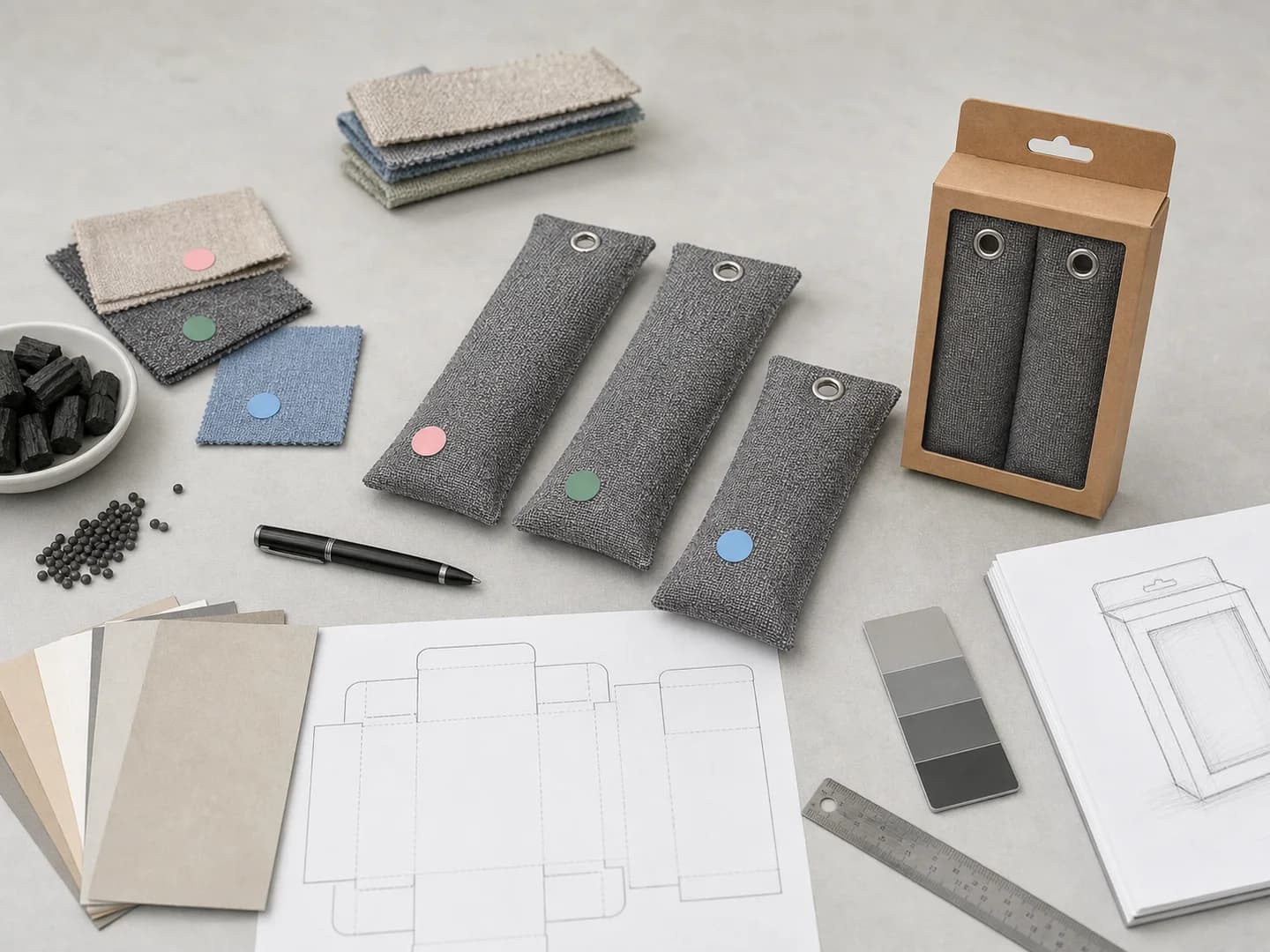
Record the project and SKU code, sample ID, date, finished dimensions, net fill basis, outer fabric, liner, seams, hardware, branding and retail pack. Attach measured values and photographs where they clarify the decision. Mark any feature that remains provisional and name the person responsible for closing it.
My strongest concern is the phrase "same as the last sample" when nobody can identify which sample was last. A retained reference controls production only when its code appears on the specification and the packaging approval. Otherwise, each department may be holding a different version of the truth.
Keep accepted exceptions visible. If the buyer allows one temporary label position for a sales sample but expects a different position in bulk, the record must say so. Silent exceptions tend to reappear because the sample is treated as the complete standard.
Preparing a specification for sampling?
Is your specification actually ready for quotation?
A specification is ready for quotation when another person can identify the product, unit, materials, construction, pack and acceptance basis without asking the original writer to explain private assumptions. If basic questions still produce different answers, the document needs another review before prices are compared.
This diagnosis is deliberately document based. It does not ask whether a finished deodorizer works, because that belongs to sample testing. It asks whether the buyer and supplier are even describing the same item. Run the check before requesting revised prices or blaming a quotation gap on supplier margin.
| What you notice | Likely ambiguity | Question that closes the gap | Evidence to add |
|---|---|---|---|
| Quotations use different weights | Piece and pair basis is unclear | Is fill stated per pouch or per pair? | Unit definition and weighing method |
| Samples fit different shoes | Target fit range was never defined | Which footwear must the pouch enter without folding? | Fit list and review photos |
| Fabric descriptions all say "premium" | Material reference is missing | Which approved textile and liner control the order? | Swatch or sealed sample ID |
| Packaging prices vary sharply | Retail unit or pack structure differs | How many pouches and pairs are in one selling unit? | Dieline and pack bill of materials |
| One team expects activated charcoal | Material terminology is inconsistent | What exact filling name is supported by the sample record? | Material specification |
| Inspection arguments stay subjective | Defects and measurement rules are absent | What is major, minor or unacceptable? | Defect list and inspection sheet |
If several rows remain unresolved, pause the quotation comparison. A lower price against a lighter fill, simpler fabric or different pack is not a saving against the intended specification. It is a quote for another product.
How should buyers write bulk inspection criteria?
Bulk inspection criteria should define what to check, how to measure it, how defects are classified and which sampling plan applies. An AQL value cannot decide whether a loose eyelet, wrong logo, short fill or open seam is major unless the buyer first defines those defects.
Build the checklist from the approved specification. Quantitative checks may include finished dimensions, fill weight, pack count and carton quantity. Visual and functional checks may include seams, dust containment, eyelet security, label orientation, artwork, barcode quality and retrieval from representative footwear.
| Inspection area | Major concern to define | Minor issue to define separately | Control reference |
|---|---|---|---|
| Product identity | Wrong SKU, material or color | Small approved appearance variation | Specification and sample |
| Construction | Open seam, exposed filling or insecure hardware | Thread trimming within the agreed limit | Detail sample and defect photos |
| Fill | Result outside the agreed weight rule | Not applicable unless specified | Weighing method |
| Branding | Wrong logo, method or orientation | Position variation within tolerance | Signed artwork |
| Retail pack | Wrong count, language or product name | Cosmetic mark within limit | Pack approval |
| Carton | Wrong units, marks or packing pattern | Agreed cosmetic carton issue | Packing specification |
The current ISO 2859-1 sampling standard provides AQL-indexed plans for lot-by-lot inspection by attributes. The buyer and supplier still need to agree on lot definition, inspection level, defect classes and acceptance rules. Sampling reduces inspection effort; it does not make an incomplete product specification complete.
Which market and claim fields belong in the specification?
The target market should appear in the first RFQ because product identification, economic-operator details, instructions, language, warning and marketing requirements depend on where and how the retail unit will be sold. There is no single label panel that can be assumed compliant worldwide.
For an EU program, the brand and importer should review the GPSR business obligations, including product identification, traceability, economic-operator contact details and clear instructions or safety information where required. The responsible party should confirm the final interpretation for the actual product and sales channel.
Environmental language requires a separate check. In the United States, the FTC environmental marketing guidance says environmental claims need reliable support and warns against broad, unqualified claims. A bamboo filling does not automatically justify "eco-friendly," "sustainable," "non-toxic" or similar language for the whole finished product and package.
"Reusable" also needs a defined meaning. State the intended care method, conditions that end reuse and any replacement guidance supported by the finished product. Do not turn sunlight refresh instructions into a promise of complete regeneration unless the evidence matches that wording.
This section is a specification prompt, not legal advice. The importer, brand owner or appointed compliance professional should determine the rules, tests and label content for each destination market.
What should buyers send in the first RFQ?
The first RFQ should give the supplier enough information to identify the intended product and expose the remaining choices. It does not need to contain every final tolerance, but it should separate confirmed requirements from items that the supplier may recommend and the buyer will approve by sample.
Copy-ready specification brief
Copy these fields into the RFQ, complete what is known and mark unresolved choices as "supplier recommendation required" rather than leaving them implicit.
- Target country, sales channel and customer type
- Product format and intended footwear
- Quantity per SKU and planned retail-unit count
- Finished pouch dimensions and target profile
- Net fill per pouch and per pair
- Bamboo charcoal description and required documentation
- Outer fabric, liner, color and seam construction
- Eyelet, loop, sewn label or printed branding
- Pouches per pair and pairs per retail pack
- Set bag, color box, gift box or bulk pack
- Use, care, limitation and claim wording
- Barcode, market contacts and language versions
- Master-carton and distribution requirements
- Sample, testing and inspection approval process
- Target schedule and information still open for recommendation
The private-label customization process can help frame logo, color, packaging and sampling choices. Send the actual footwear range, an existing benchmark or target pack when available. A physical constraint usually resolves an open specification faster than another paragraph of adjectives.
Conclusion: when is the specification ready to quote?
A charcoal shoe deodorizer specification is ready to quote when two independent suppliers can price the same commercial unit, materials, construction, packaging and inspection basis without inventing missing assumptions. It is ready for production only after the buyer connects those fields to an approved sample and final artwork.
Do not try to make the first RFQ perfect. Make it explicit. Label open choices, define the unit, record the target footwear and keep the product, artwork and inspection versions together. That discipline makes price comparisons fairer and gives the bulk order a reference that can survive beyond the people who started the project.
Developing a private-label footwear-care range?