
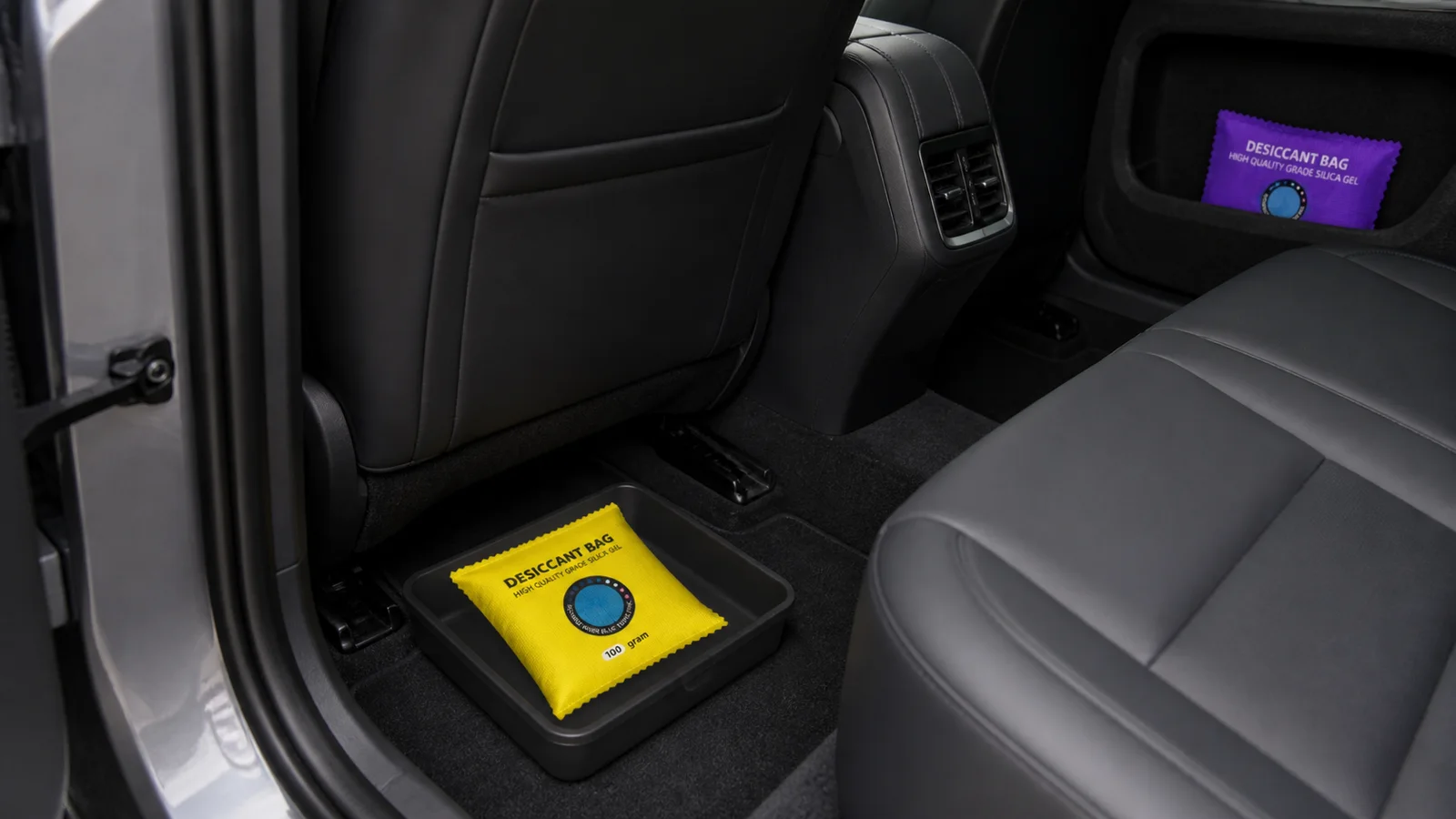
A reusable moisture absorber looks simple enough to leave anywhere in a car. That is where avoidable problems begin. A pouch on the dashboard can obstruct the driver's view, one under a front seat can meet a seat rail, and a loose bag can slide as the vehicle moves.
Use a silica gel bag only after visible water and wet materials have been dealt with. Put it in a stable, ventilated position while the car is parked, keep it away from pedals, controls, vents and sightlines, then inspect the location and moisture indicator on a planned schedule.
Placement deserves the same attention as any small in-car accessory. The sections below map suitable zones, explain why there is no universal bag count and provide a seven-day observation routine that drivers, accessory retailers and product teams can use without inventing a coverage promise.
Can you put a dehumidifier bag in a car?
Yes. A reusable silica gel bag can support residual moisture control in a parked car when the cabin is already free of standing water, the pouch is secured, air can reach it and the user follows the approved care instructions.
Silica gel is a passive moisture sorbent. It takes up water vapor from the air around it until its available capacity declines. The Canadian Conservation Institute's guide to passive silica gel control explains that the amount of sorbent, enclosure volume, air exchange, temperature and surrounding humidity all affect performance. A car is less tightly controlled than a museum display case, but those variables still matter.
That is why a car dehumidifier bag works best as a maintenance accessory. It may help after wet-weather trips, between uses of a seasonal vehicle, or in a trunk that occasionally carries damp gear. It should not be expected to remove water held in soaked carpet, compensate for a failed seal or clear the windscreen quickly during a journey.
If the vehicle is repeatedly wet, start with the earlier guide on removing moisture from a car. Placement becomes relevant after the source is controlled and the larger water load has been removed.
Where should you put a dehumidifier bag in a car?
Choose a low, stable position that receives ordinary cabin air and remains clear of all driving equipment. A protected rear footwell or secured trunk-side compartment is often easier to manage than a dashboard, front footwell or loose seat position.
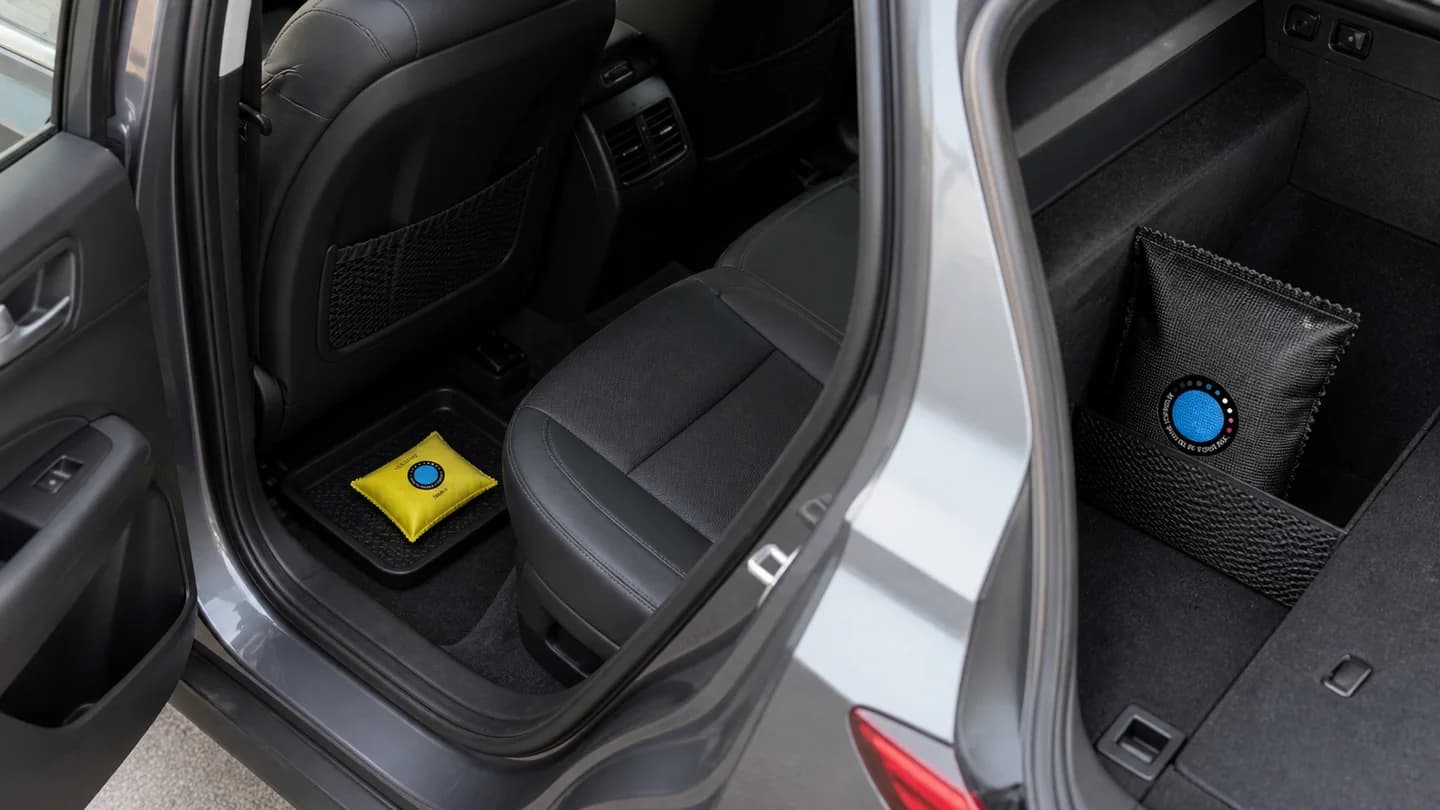
There is no single correct location for every vehicle. Seat tracks, vents, storage pockets and cargo layouts differ. Before placing a bag, move the nearby seat through its normal travel and check the surrounding space.
| Vehicle zone | Starting assessment | What to verify before use | Main reason to reject it |
|---|---|---|---|
| Rear passenger footwell | Often suitable when the car is parked | Use a non-slip tray or approved holder; keep the pouch clear of rails and rear vents | It can slide forward or be crushed by a moving seat |
| Trunk-side pocket or cargo recess | Often a practical protected position | Confirm airflow, dry surfaces and separation from sharp or wet cargo | A sealed compartment may restrict air exchange |
| Door pocket | Possible for a small format | Check that the bag fits without forcing the trim or blocking drainage | The pouch may be pinched, hidden or exposed to water |
| Dashboard or parcel shelf | Avoid | No placement test makes an obstruction acceptable | Movement, direct sun and interference with visibility |
| Driver or front passenger footwell | Avoid | Keep the entire pedal and control area free | A loose object can migrate toward pedals or feet |
| On a seat | Avoid while the vehicle moves | Move it to a secured position before travel | Braking and cornering can turn it into loose cargo |
The UK visibility guidance requires drivers to retain a full view of the road and covers objects placed in the windscreen area. Even if a product photo shows a pouch near the glass, the dashboard is not a sensible permanent location.
Do not cover the bag with luggage, a rubber mat or clothing. The outer fabric is part of the moisture-transfer path. A protected position should prevent movement without sealing the breathable surfaces away from the surrounding air.
How should the bag be secured before the car moves?
The pouch should remain in its chosen zone under acceleration, braking, cornering and seat movement. If its holder cannot do that, remove the bag before driving and put it back only after the vehicle is parked.
A shallow non-slip tray can work in a rear footwell if the tray itself cannot migrate. A fitted cargo net or trunk pocket can protect a larger format. Any hook-and-loop attachment needs to be checked for heat exposure, secure removal and compatibility with the vehicle trim.
Avoid improvised fasteners that puncture the pouch. Pins, sharp clips and exposed wire can damage the fabric or seams. Do not tie a bag across a vent, attach it to a steering component, hang it from a mirror or wedge it against safety equipment.
The same caution that applies to a floor mat applies to other loose objects near the driver's feet. NHTSA recall records document pedal interference from a floor mat and loose objects. The practical rule is straightforward: the driver footwell is not a storage zone for a moisture absorber.
Quick parked-car test
Place the bag in its holder, move every nearby seat, close and reopen the door or cargo cover, then push the pouch gently from several directions. If it can reach a rail, vent, latch, pedal area or passenger walkway, choose another position.
How many dehumidifier bags does a car need?
There is no defensible universal number. Start with the smallest practical setup for the vehicle and moisture pattern, observe it under normal use, and adjust only when the source is controlled and the finished bag is being maintained correctly.
A city car with occasional damp coats does not create the same job as an SUV carrying wet sports equipment. A 100g, 200g or 400g label states the nominal fill, not a guaranteed vehicle coverage. Temperature, air exchange, wet cargo and the bag's current moisture loading all change the result.
Use these questions before adding another pouch:
- Is the original bag still dry or has its service indicator changed?
- Is the selected location open to cabin air, or has the bag been covered?
- Does dampness return in one specific footwell, door opening or trunk well?
- Has wet clothing, snow, a pet towel or sports gear been left inside?
- Is the vehicle larger or divided into separate cabin and cargo zones?
For light residual humidity, one monitored format may be a reasonable trial. A larger vehicle or separate trunk may justify a second zone. This is an observation plan, not a coverage formula.
Our car dehumidifier bag formats use 100g, 200g and 400g reference fills. Final dimensions, fill tolerance, indicator, holder and pack count should be confirmed on the approved sample rather than chosen from a generic car-size claim.
What should you record during the first seven days?
Record the starting condition, bag location, vehicle use and any returning dampness. A short log is more useful than moving the pouch every morning because it shows whether the result follows weather, wet cargo, a specific parking condition or a possible leak.
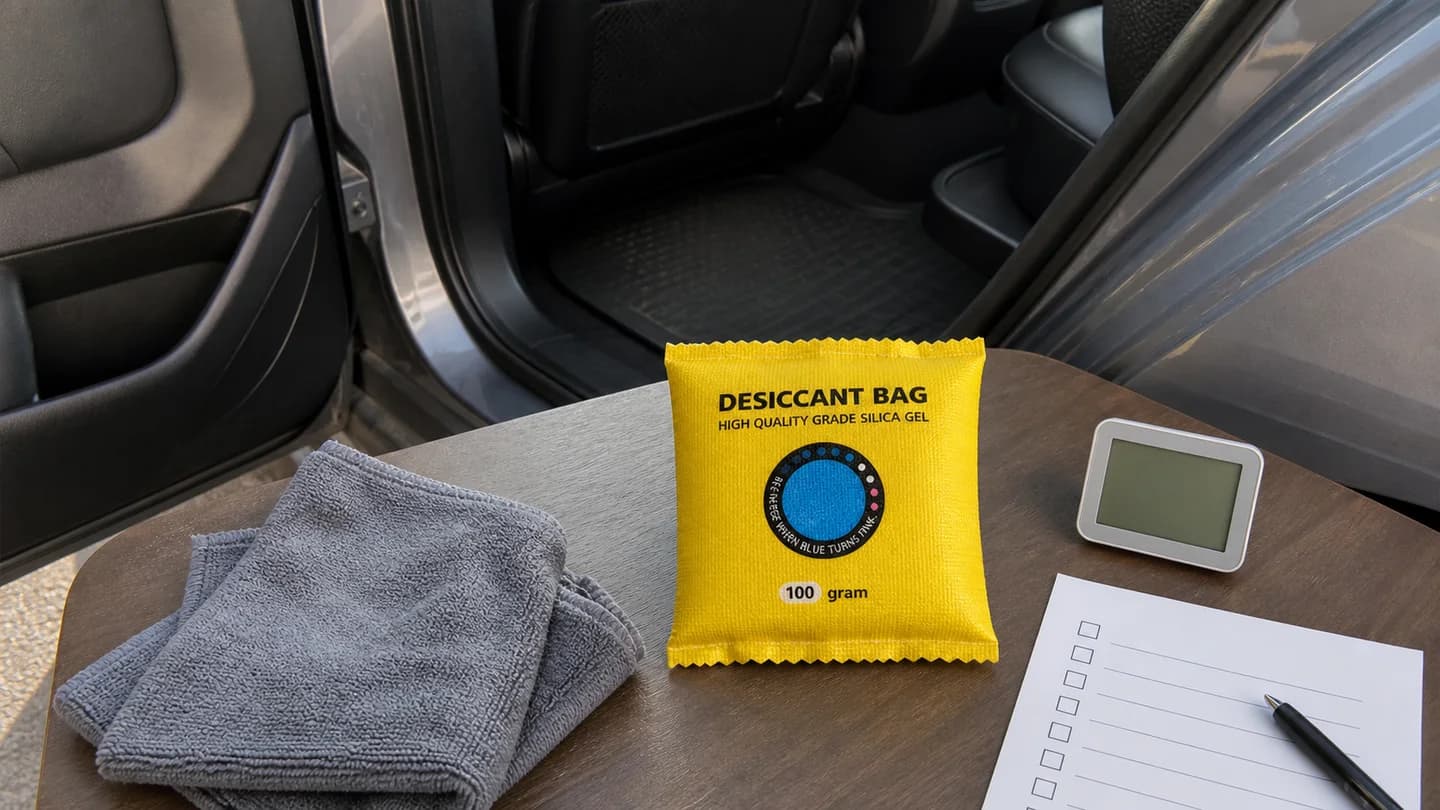
Begin with a dry cabin. Remove wet items, lift removable mats and check the luggage well. The EPA's advice on moisture source control is written for buildings, but its central lesson transfers well: dry wet materials and correct the water source instead of asking humidity control to hide it.
| Check point | What to look at | What the observation may mean | Appropriate response |
|---|---|---|---|
| Day 0 | Dryness under mats, bag indicator, chosen holder and weather | Establishes the starting condition | Photograph the setup and leave the location unchanged |
| Day 2 or after heavy rain | Glass, the same carpet points, wet cargo and bag position | Separates a weather event from movement or water entry | Remove wet items; inspect any local wet patch |
| Day 4 | Indicator trend and whether the bag is covered or displaced | Shows service demand and installation stability | Restore the safe position or follow approved care guidance |
| Day 7 | Pattern across several mornings or trips | Helps judge whether the setup is adequate for ordinary use | Keep, revise or escalate the setup based on the pattern |
The color window is a service cue, not a calibrated cabin-humidity measurement. If you use a hygrometer, keep it in a repeatable location and treat the trend cautiously because opening the car changes the reading quickly.
During finished-sample reviews, I look for a result that a customer can repeat: the same bag, the same location, a stated check interval and notes about unusual wet loads. A vague claim such as "works in every car" tells a retail team less than a modest observation record tied to an actual use case.
When should you recharge, move or remove the bag?
Recharge the bag when its approved indicator or care schedule calls for it, move it when the location is unstable or poorly ventilated, and remove it immediately if the pouch, seam, indicator window or holder is damaged.
Follow the instructions for the exact finished product. Silica gel may tolerate drying, but the outer fabric, seam construction, printing and indicator chemistry determine whether a particular microwave, oven or other method is approved. Our guide to recharging a dehumidifier bag explains why copied times and wattages are unreliable.
Move the bag if a passenger kicks it, cargo covers it, a seat rail approaches it or the holder shifts. Change one variable at a time so the next observation still means something.
Remove and replace the pouch if you see an open seam, escaping beads, scorched fabric, a loose indicator window or a permanent odor that is not resolved by approved care. Keep any damaged product away from children and animals, and follow the supplier's disposal information and local rules.
When does recurring moisture need a vehicle inspection?
Arrange further inspection when water returns in one place, carpet or padding stays wet, a sweet smell or oily film appears, drains overflow, or condensation remains severe after the cabin has been dried and normal ventilation practices are restored.
A bag cannot diagnose the source. Door and window seals, sunroof drains, body seams, heater components, air-conditioning drainage and hidden layers under the carpet can all contribute. The pattern matters more than the number of pouches already in the car.
The US EPA's basic moisture cleanup steps put moisture control before surface treatment. The setting is different, but the priority is sound: fix water problems and dry materials completely. Adding a second absorber to a wet footwell only delays the useful question.
Visibility is an immediate issue, not a seven-day experiment. Use the vehicle manufacturer's demist and climate-control instructions whenever glass fogging affects driving. A passive bag may support the parked cabin between trips, but it should never replace the controls intended to clear the windscreen.
What should a private-label use guide tell customers?
A useful retail guide should identify safe and unsuitable zones, explain how to secure the bag, define the indicator as a service cue, give validated care instructions and tell the customer when recurring dampness needs investigation.
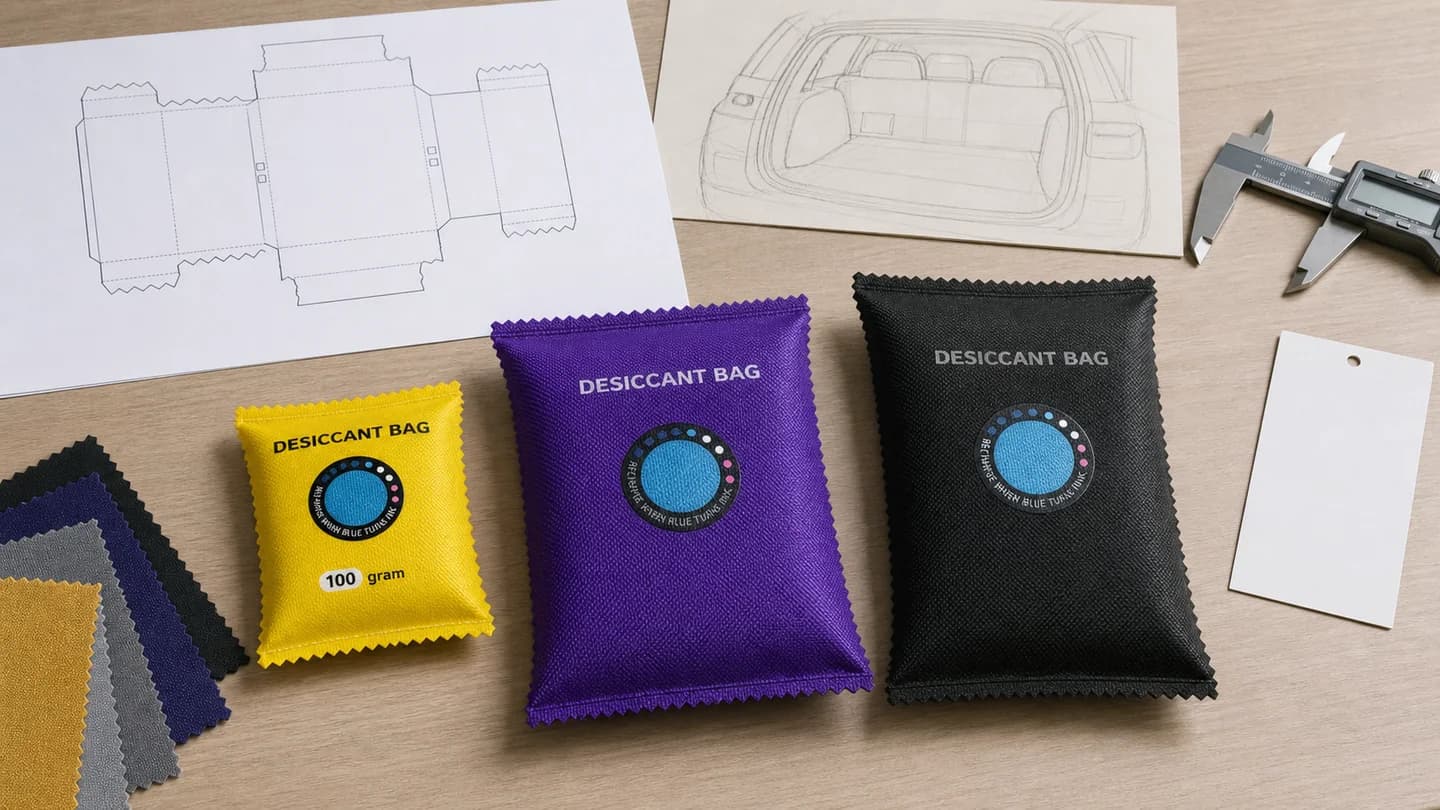
The placement claim must match the format. A protected pocket that accepts a compact 100g pouch may not accept a thicker 400g bag. If photography shows a holder, include it or state clearly that it is not supplied.
Before approving packaging, check these points on the finished sample:
- pouch dimensions, fill weight and normal finished thickness;
- breathable area that remains exposed in the recommended holder;
- indicator chemistry, dry reference color and service cue;
- approved regeneration method, cooling step and warnings;
- safe placement illustrations for both parked use and vehicle movement;
- damage, replacement, storage and disposal guidance;
- limits on leak repair, demisting speed and universal coverage claims.
The automotive interiors guide can help teams define the vehicle zone and retail use case before packaging artwork begins.
Planning a vehicle moisture-control line?
Send the intended vehicle, placement and pack format.
We can turn those details into a sample brief covering fill, dimensions, indicator, holder, care label and retail packaging.
How should the setup change for different vehicle routines?
Match the placement and check schedule to how moisture enters the vehicle. A daily commuter, a car carrying wet sports gear and a vehicle stored for several weeks expose the same silica gel pouch to very different moisture loads.
| Vehicle routine | Likely moisture pattern | Practical starting setup | Check point that matters most |
|---|---|---|---|
| Daily wet-weather commuting | Shoes, coats and passengers add small amounts repeatedly | One secured cabin placement after wet items are removed | Pouch position and the same carpet points |
| Sports, pets or outdoor work | Wet equipment creates a short, heavy cargo-area load | Dry the equipment first, then monitor a trunk-side position | Below the cargo liner and in the luggage well |
| Occasional or seasonal use | Temperature changes act on air left enclosed for longer periods | Store the car dry and set a dated inspection interval | Seals, carpet, indicator and any musty area |
| Large or divided vehicle | Cabin and cargo zones may receive different loads | Observe the zones separately before choosing a multipack | Whether one zone changes faster than the other |
Wet cargo should never rest on the pouch. Remove the item, inspect below the cargo liner and return the bag only when the holder is dry. For storage, use a calendar rather than adding unattended pouches. Check the same seals, mats and luggage-well points on every visit so a new pattern is visible.
What evidence tells you to keep, adjust or stop the setup?
Keep the setup when the holder remains secure, the cabin stays dry under normal use and the bag follows a manageable service cycle. Adjust it when airflow or access is poor. Stop the trial and investigate the vehicle when water returns to a specific material or location.
Use three decisions instead of asking whether the pouch worked in the abstract:
| Decision | Evidence you can observe | Next action |
|---|---|---|
| Keep | Bag stays secure; no local wet patch returns; indicator changes gradually | Continue the same placement and interval |
| Adjust | Bag is covered, displaced, hard to inspect or loads quickly after unusual wet use | Correct one installation variable, then repeat the observation |
| Stop and inspect | Carpet is wet again, water trails appear or one area remains consistently damp | Arrange source inspection or direct drying |
Do not add bags and change placement at the same time. That makes the next result hard to interpret. Correct the holder or zone first, then observe the same routine again. A changing indicator confirms that the sorbent is taking up moisture; it does not prove that a seal is sound or hidden padding is dry.
These outcomes also give product teams more useful instruction copy than a universal coverage number. The customer receives a repeatable action while the product keeps the limits of a passive absorber clear.
Conclusion: use a placement routine, not a guess
A car dehumidifier bag has a narrow, useful role once wet materials and active water sources are under control. Put it in a dry, stable and ventilated zone, keep it away from driving equipment, then observe the same setup long enough to understand the moisture pattern.
Start with one practical configuration rather than an unsupported coverage promise. Record what changes after rain, wet cargo and normal trips. Recharge the approved finished bag when its service cue calls for it, and treat a returning local wet patch as an inspection signal.
For vehicle-care programs, placement belongs in the product specification. The bag size, holder, indicator, instructions and pack count should tell one consistent use story that a customer can follow without creating a safety problem or expecting the pouch to repair the car.