
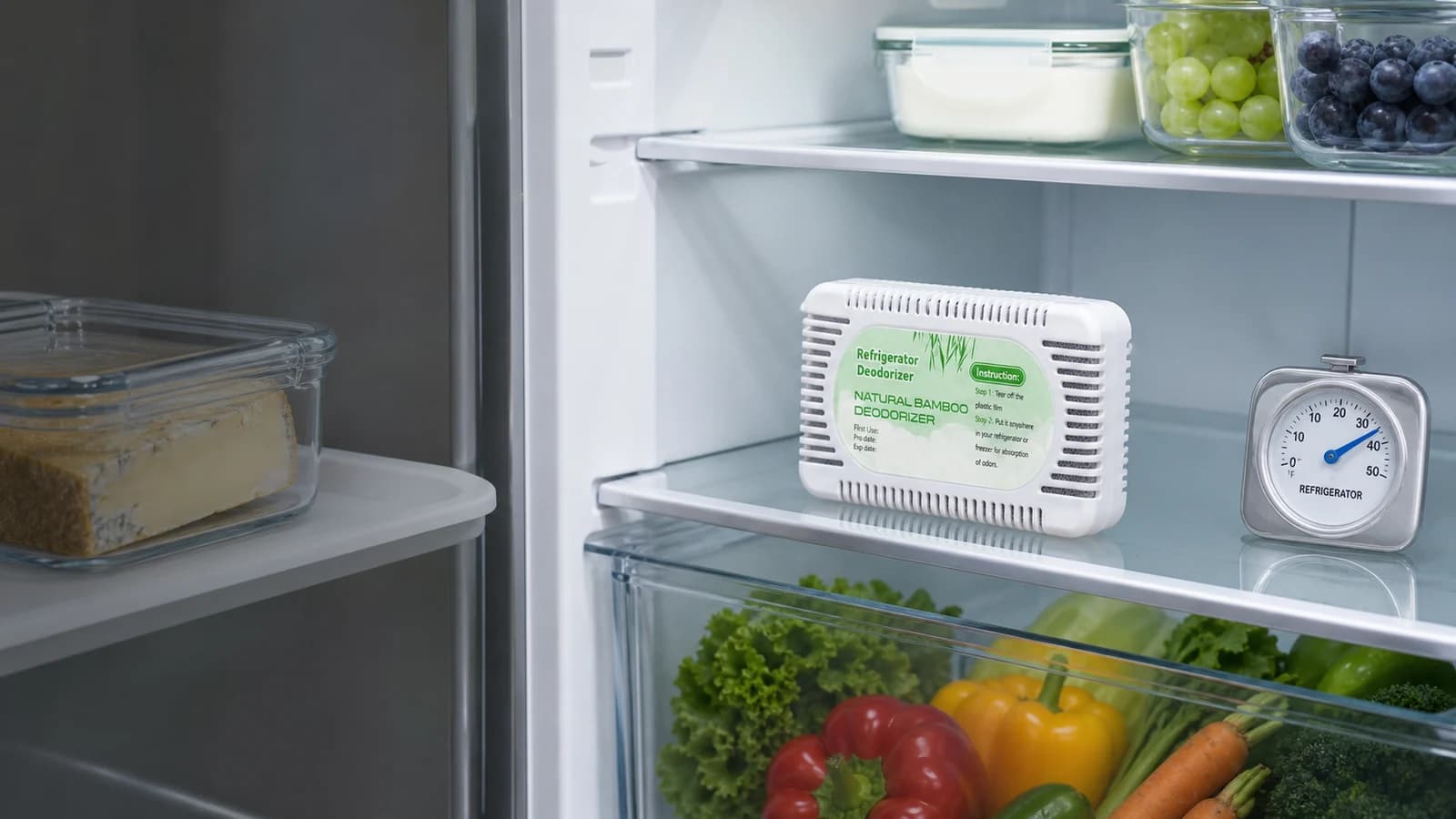
You open the refrigerator and smell yesterday's dinner, although every container appears closed. The problem may be an onion lid, a drip beneath a drawer, ageing leftovers or air that cannot circulate. Adding another scent only makes the source harder to identify.
To remove a bad fridge smell naturally, discard spoiled or questionable food, seal strong-smelling items, clean shelves, drawers, walls and the door gasket, then restore cold-air circulation. A passive deodorizer belongs after those steps, where it can support routine odor care rather than hide poor hygiene.
This guide uses a three-pass reset: find the source, clean the compartment, then maintain the result. It also explains when a bamboo charcoal fridge deodorizer is a sensible finishing step, where it should sit and what a reusable product still needs from its owner.
What should you do first when a fridge smells bad?
Start with food and temperature, not a deodorizer. Remove anything spoiled or doubtful, check for leaking packages and confirm that the refrigerator is holding 40°F (4°C) or below. An odor product cannot make unsafe food safe.
Smell is useful as a prompt to investigate, but it is not a food-safety test. Some harmful bacteria do not announce themselves with a strong odor. The FDA's refrigerator guidance recommends an appliance thermometer, covered containers, immediate spill cleanup and enough free space for cold air to move around stored food.
Before taking shelves apart, make four quick checks:
- Read the appliance thermometer, not just the control dial.
- Remove food that is spoiled, questionable or beyond a safe storage window.
- Put pungent but usable food into properly sealed containers or bags.
- Look for drips from raw meat, dairy, sauces and thawing food.
If you are unsure how long a particular item should remain refrigerated, the Cold Food Storage Chart gives item-specific time ranges. Treat that chart and the food label as decision tools. Do not keep an uncertain item merely because a deodorizer might make the compartment smell better.
Where is the refrigerator smell actually coming from?
The likely source depends on the character and timing of the odor. A sour note points toward dairy, produce or a spill; a sharp food smell often comes from an unsealed container; a musty odor calls for a close look at wet surfaces, the gasket and the drain area.
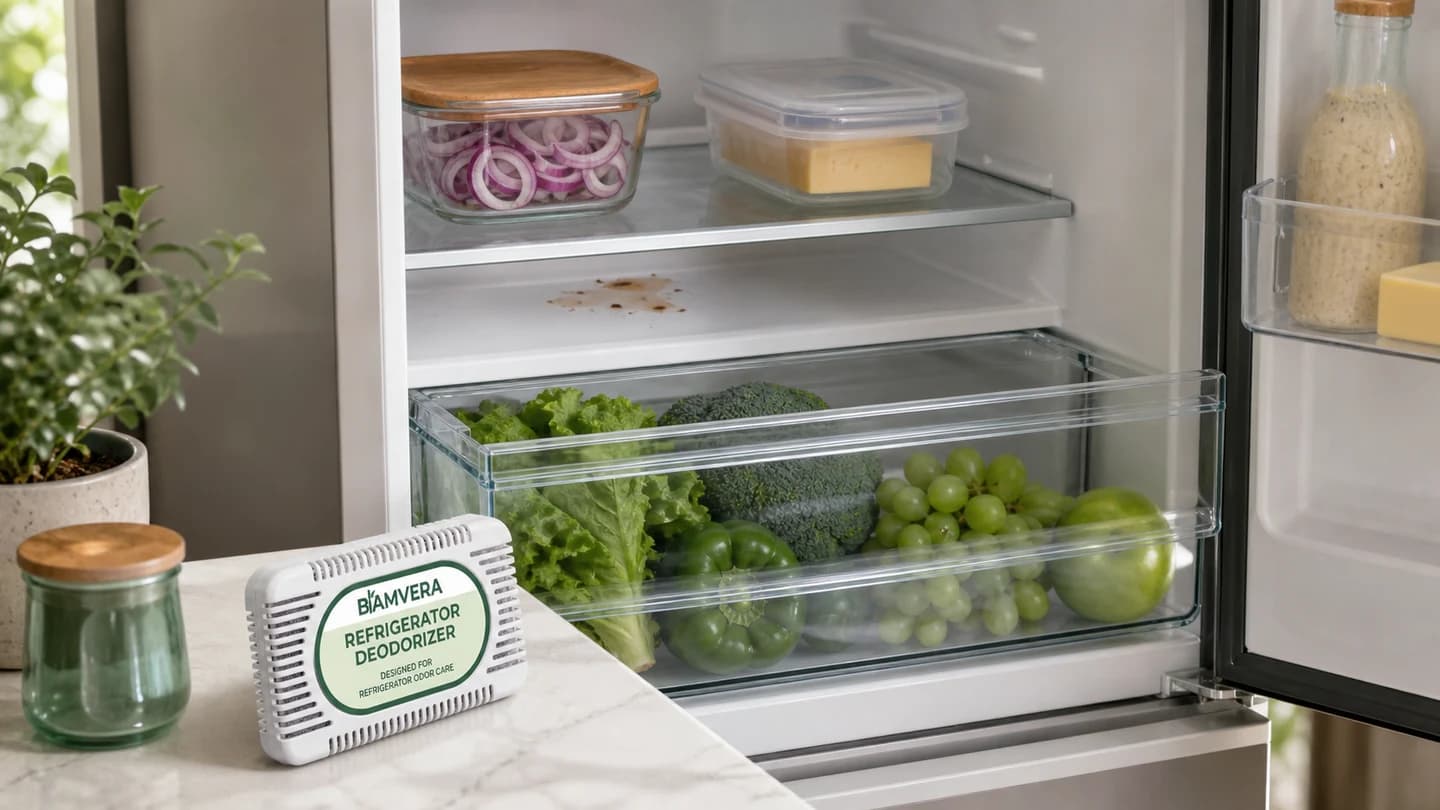
Move methodically from the most perishable items to the least visible surfaces. Take food out one shelf at a time and keep perishables cold while you inspect. Check beneath containers, inside drawer tracks, around the gasket folds and under removable glass. A dried teaspoon of sauce can smell far stronger than it looks.
| What you notice | Likely places to inspect | Best first response |
|---|---|---|
| Strong onion, cheese, fish or spice smell | Lids, storage bags, door shelves | Reseal or move the food into a suitable covered container |
| Sour or fermented note | Dairy, cut produce, leftovers, drawer corners | Check storage time, discard questionable food and wash the affected area |
| Odor appears after defrosting meat | Package seam, shelf edge, drawer below | Isolate the package and clean the drip path promptly |
| Musty smell with visible moisture | Gasket folds, drain area, wet drawer, standing condensation | Dry and clean the area, then check why moisture persists |
| Smell returns only when the fan runs | Hidden spill, air outlet, drain pan or appliance cavity | Consult the appliance manual; seek service if the source is inaccessible |
Do not dismantle an internal drain, panel or fan cover unless the appliance instructions permit it. If the odor appears electrical, burning or refrigerant-like, unplugging and qualified service take priority over any home deodorizing method.
How do you clean a refrigerator without just masking the odor?
Clean the source area and every surface the spill or spoiled food may have reached. Removable shelves and drawers need separate washing; the cabinet needs attention to walls, corners, door shelves and the gasket. Follow the appliance maker's cleaning instructions.
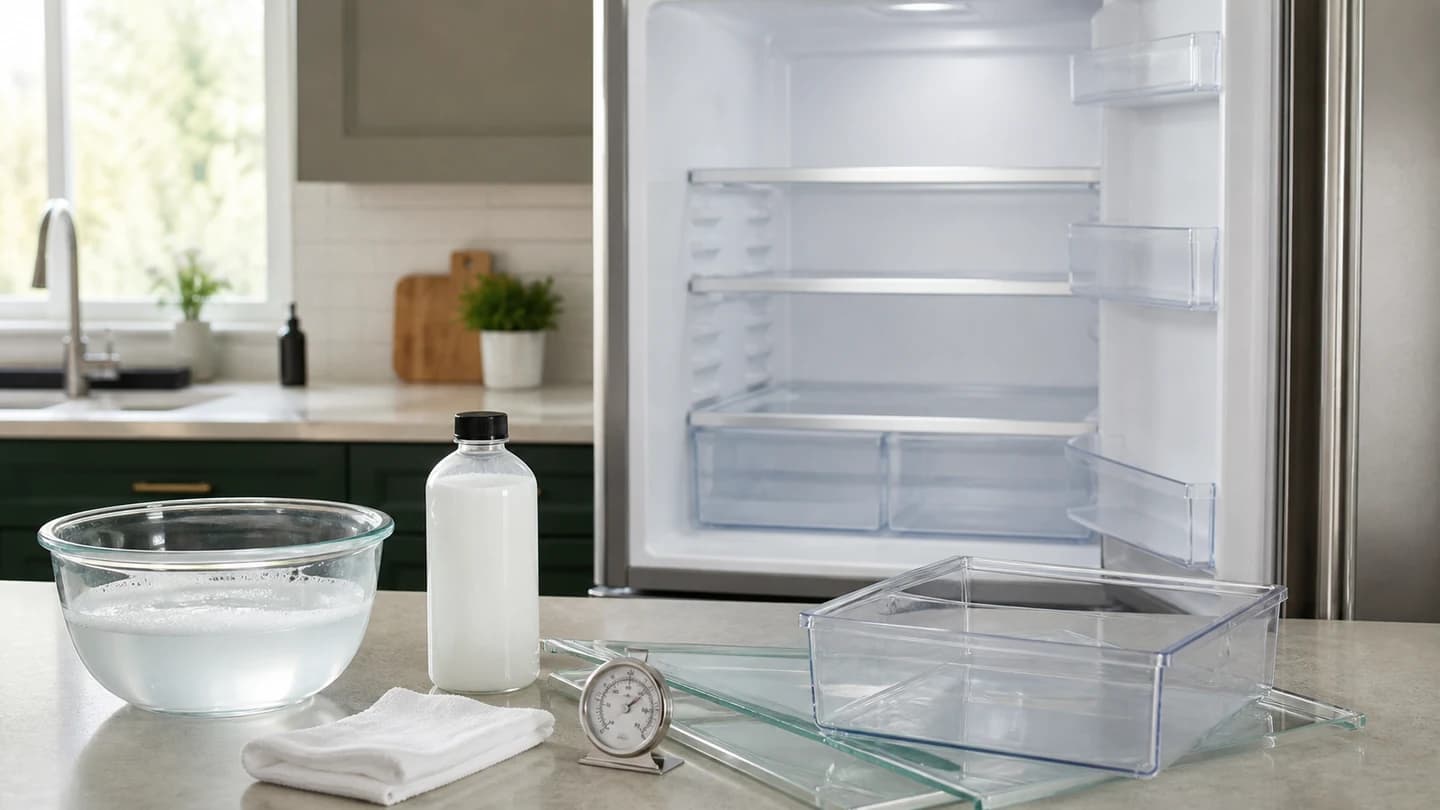
The USDA odor-removal procedure starts by discarding spoiled or questionable food. It then calls for removable parts to be washed, the interior and gasket to be cleaned, and the empty compartment to be allowed some air circulation. The agency notes that persistent spoilage odors may require the process to be repeated.
A practical reset looks like this:
Pass 1: empty and contain
Move refrigerated food to another cold space or an insulated cooler. Keep raw items separated from ready-to-eat food. As each item comes out, wipe its base and inspect its lid, seam or bag closure.
Pass 2: wash the removable parts and cabinet
Use the cleaning method specified by the refrigerator manufacturer. Wash and dry drawers, shelf frames and trays before reinstalling them. Clean from the highest affected surface downward so runoff does not contaminate an area you have already finished. Pay attention to gasket folds and drawer rails, where liquid can remain unseen.
Pass 3: dry, reassemble and restore circulation
Dry the interior and removable parts. Return food in covered containers, avoid packing the cabinet so tightly that cold air is blocked, and place the thermometer where it can be read easily. Recheck the smell only after the cleaned compartment has returned to its normal temperature.
Avoid using a strongly perfumed cleaner to make the refrigerator smell "clean." A fragrance can mix with food aromas and conceal whether the original source remains. Never combine cleaning chemicals, and follow both the appliance instructions and product label.
Why can a refrigerator still smell after cleaning?
A returning odor usually means the source was missed, the food was not fully contained, or residue reached a hidden area. It can also point to a temperature, drainage or airflow problem that a passive odor absorber cannot correct.
Wait until the refrigerator is cold again before judging the result. Warm plastic and an open door change how aromas travel. Then use a simple decision ladder:
- Same smell, same strength: inspect the original food and spill path again.
- Smell is weaker but returns: check lids, drawer rails, gasket folds and the space beneath removable components.
- Smell follows the fan cycle: review the appliance manual and accessible air paths.
- Smell is accompanied by pooled water: investigate the source of the moisture.
- Burning, chemical or mechanical odor: stop troubleshooting with household products and arrange service.
Severe spoilage after an extended power loss can penetrate insulation or inaccessible cavities. The USDA notes that some refrigerator and freezer odors may ultimately be impossible to remove. That is an appliance problem, not evidence that a stronger natural deodorizer is needed.
When can a bamboo charcoal fridge deodorizer help?
A bamboo charcoal deodorizer can support an already clean, properly cold refrigerator by giving certain airborne odor-causing compounds a porous surface on which to adsorb. It is a maintenance aid, not a cleaner, sanitizer, food preservative or repair.
Adsorption happens at a surface. In a ventilated unit, refrigerator air passes through slots and a breathable liner, bringing some compounds into contact with the charcoal. The effect depends on the charcoal specification, exposed surface area, airflow, humidity, odor source and product condition. It should not be translated into a promise that every odor will disappear on a fixed schedule.
An ITTO bamboo utilization manual describes refrigerator deodorization as an application for bamboo charcoal. That supports the material choice, but finished-product performance still depends on the housing, liner, fill, placement and care instructions.
The BamveraEco reference bamboo charcoal refrigerator deodorizer uses 50g of high-temperature bamboo charcoal granules inside a breathable nonwoven liner and a slotted housing. It uses carbonized bamboo charcoal, not a separate claim of activated carbon. For buyers, that distinction belongs in the specification and on the artwork.
See how adsorption, airflow and placement affect whether a bamboo charcoal fridge deodorizer works.
Developing a refrigerator-care range? Review the reference housing, 50g fill and private-label options on the refrigerator deodorizer product page, then share the target market and pack brief through the inquiry form.
Where should a natural fridge deodorizer be placed?
Place the unit upright on an open, dry shelf with its ventilation slots unobstructed. Keep it away from leaking packages, standing water and direct contact with unpackaged food.
The back corner is convenient only if cartons do not close off the slots. A crowded door shelf may expose the unit to spills, while a produce drawer can limit airflow and bring it too close to wet vegetables. The useful position is visible enough to inspect, open enough for air contact and stable enough not to fall when containers move.
A natural fridge deodorizer also needs space around it. The FDA advises against overpacking because cold air must circulate around refrigerated foods. The same practical constraint matters to a passive charcoal product: a fully blocked housing has less air contact than a correctly placed one.
Keep the product in its housing. Do not scatter charcoal granules inside the refrigerator or place loose material near food. If the case cracks, the liner opens or charcoal dust escapes, remove the unit and follow the supplier's replacement guidance.
How should a reusable fridge deodorizer be cared for?
Use the care method printed for the finished product. For the BamveraEco reference format, the packaging direction is “Reusable After Sun Drying,” so the unit is removed from the refrigerator and sun dried according to the approved instruction rather than heated by an improvised method.
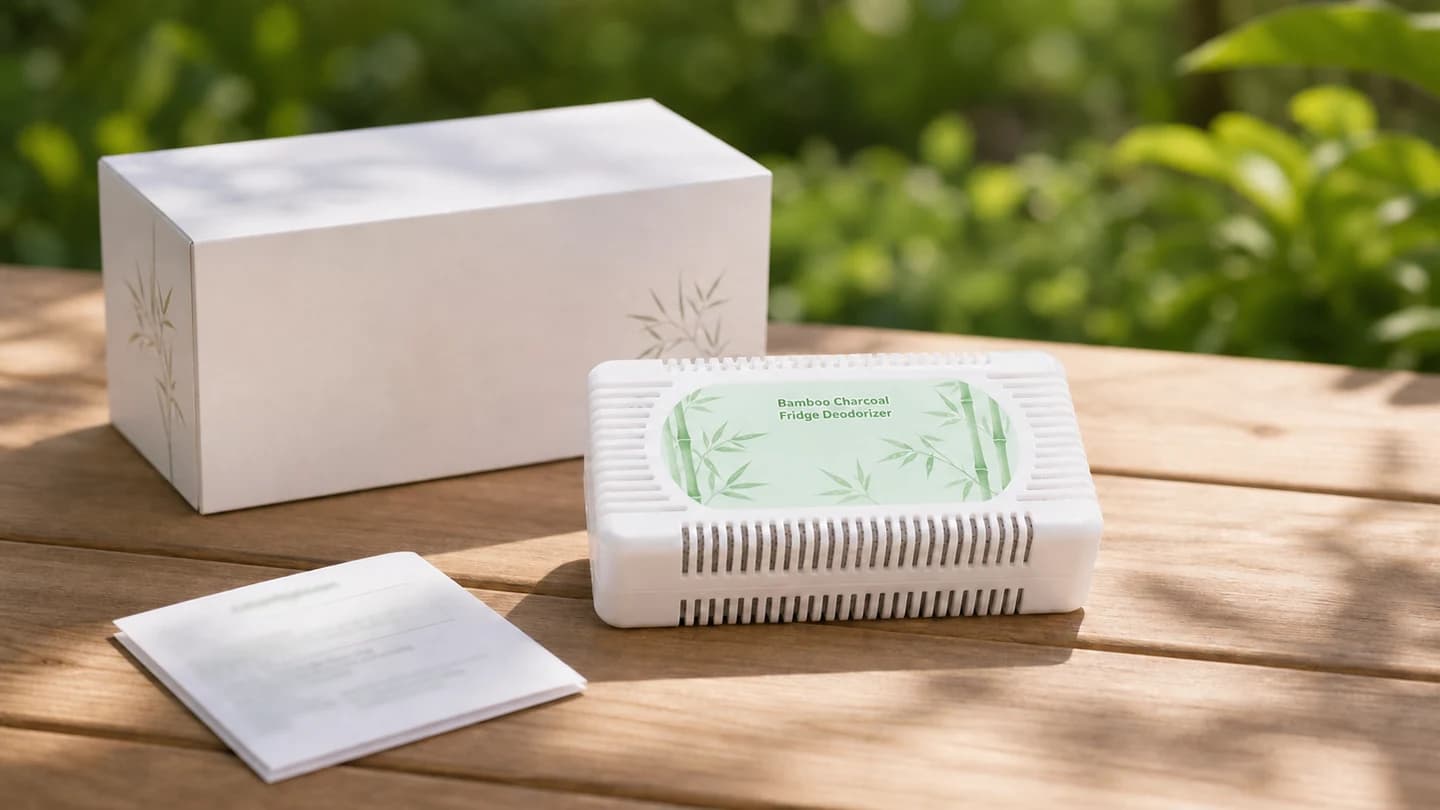
Sun drying does not mean unlimited life, complete regeneration or sterilization. A reusable fridge deodorizer still needs a clear first-use step, a care trigger, dry-weather guidance, a replacement rule and a warning against unsuitable heating. Those details should be validated for the actual housing, liner, adhesive and charcoal fill before printing.
When I review a refrigerator deodorizer sample, I start with the parts that make reuse practical: do the slots remain open, does the liner contain dust, does the label stay bonded, and can the instruction be followed without opening the housing? A reuse claim is only useful when the finished unit and its directions agree.
Do not put the product in an oven, microwave, dishwasher or direct water unless the approved instruction explicitly permits that treatment. Improvised heat can deform a plastic housing, damage an adhesive label or affect the inner liner.
What should a buyer verify before approving a refrigerator deodorizer?
Approve the complete unit, not just the charcoal. Housing airflow, liner containment, net fill, label language, care instructions and retail pack must work together in the sample that reaches the user.
For a reference 130 x 65 x 30 mm housing, a useful sample review covers:
| Control point | What to record | Why it matters to the user |
|---|---|---|
| Charcoal | Material description, particle format and 50g net-fill tolerance | Keeps the delivered product aligned with the approved specification |
| Inner liner | Breathability, seam integrity and dust containment | Allows air contact while keeping granules contained |
| Housing | Dimensions, closure, slot condition and stability | Protects the liner and supports suitable shelf placement |
| Label | Adhesion, product identity, lot/date fields and destination language | Makes the item traceable and understandable |
| Instructions | First use, placement, sun-drying care, damage and replacement guidance | Turns “reusable” into a procedure the owner can actually follow |
| Retail pack | Unit count, barcode area, carton fit and warnings | Protects the unit and keeps market information together |
Claims should remain narrower than the evidence. “Supports routine refrigerator odor care” is different from “eliminates all odors,” and “bamboo charcoal” is different from “activated carbon.” A physical sample, representative refrigerator trial and final artwork review are more useful than enlarging a claim that cannot be checked consistently.
Buyers comparing housings, labels and retail packs can also review the broader bamboo charcoal odor-care range and the customization process before requesting a sample.
What routine helps keep a fridge fresh smelling?
A fresh-smelling refrigerator is maintained by short, repeatable checks: control temperature, contain aromatic food, remove ageing items, wipe spills promptly and inspect the deodorizer without waiting for a major odor.
Use this rhythm instead of searching for a stronger product every time the door opens:
- After shopping: leave room for cold-air movement and separate raw packages from ready-to-eat food.
- After cooking: cool and store leftovers in suitable covered containers, following current food-safety guidance.
- When a spill happens: clean it promptly, including the shelf edge or drawer below the leak.
- Once a week: review leftovers and short-life foods against their storage windows.
- During the same check: inspect the deodorizer housing, slots, liner condition and care status.
- When an odor returns: repeat the source audit before changing products or adding fragrance.
This routine answers two different questions at once. “How do I make my fridge smell better?” begins with the source today. “How do I keep it fresh smelling?” depends on storage, cleaning and inspection habits over time.
Conclusion: remove the source, clean the compartment, then maintain
The natural way to remove a bad smell from a refrigerator is not to cover it with a more pleasant smell. Find questionable food and leaks, confirm safe temperature, clean the reachable surfaces, restore airflow and check whether the odor returns.
A bamboo charcoal refrigerator deodorizer can then play a limited but useful role. Its ventilated housing lets refrigerator air contact porous charcoal, while the case and liner keep the granules contained. Correct placement and product-specific care matter as much as the material name.
For a private-label program, the approval question is practical: can the user understand where to place the unit, when to remove it for labeled sun drying and when to replace a damaged or spent product? If you are developing that program, send your housing, label and pack requirements so the finished sample can be reviewed as one system.