
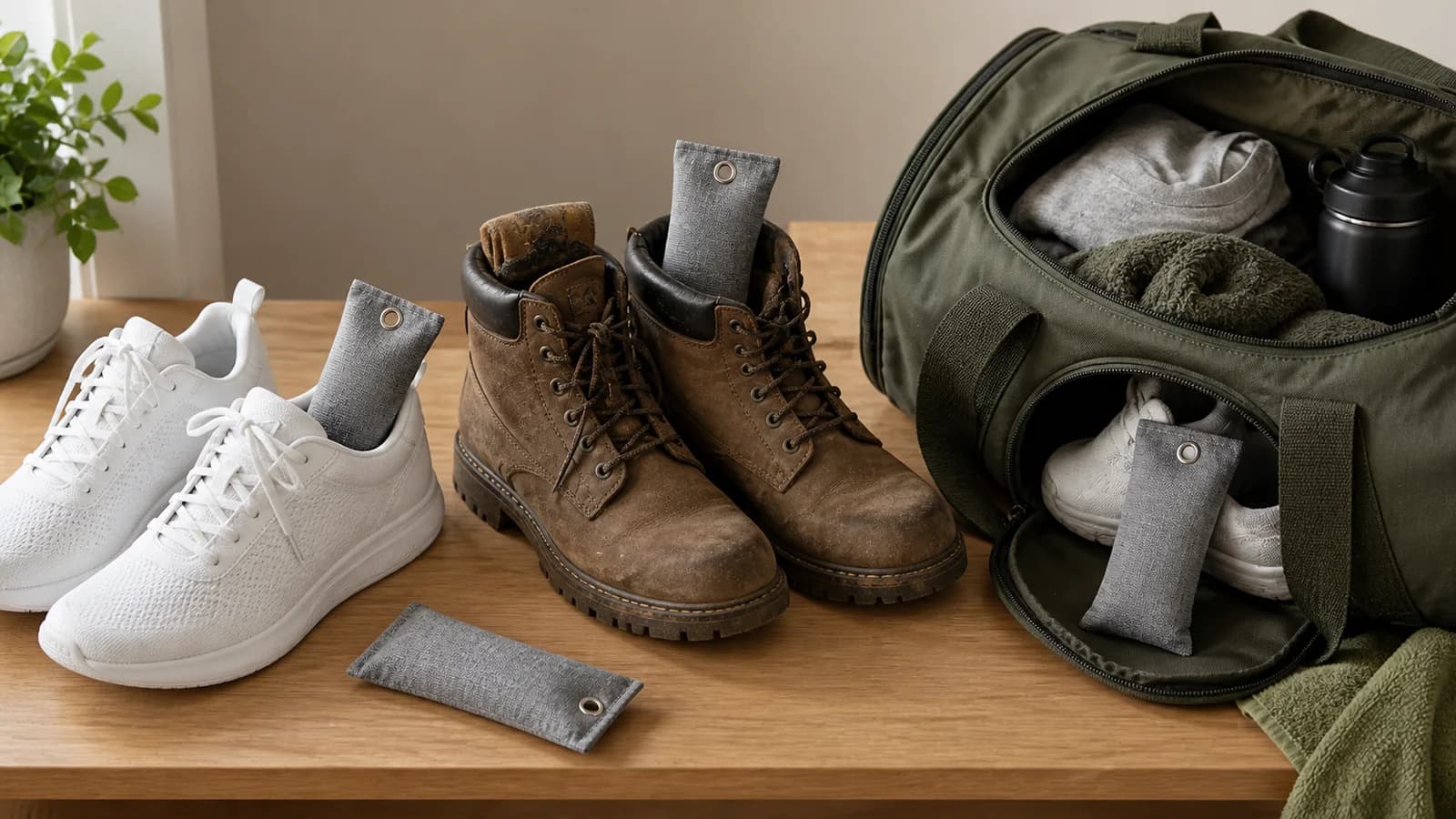
Open a gym bag the morning after a hard session and the pattern is familiar: the shoes are still damp, the towel is sealed inside, and a charcoal pouch is expected to handle all of it. The pouch has been given a job it cannot do well because cleaning, drying and airflow never had a chance.
The reliable routine is simpler: unpack first, clean away any residue, let the shoes and gear dry, then place the charcoal shoe deodorizer bags loosely inside for storage. Leave them there between uses and remove them before the shoes, boots or equipment go back into service.
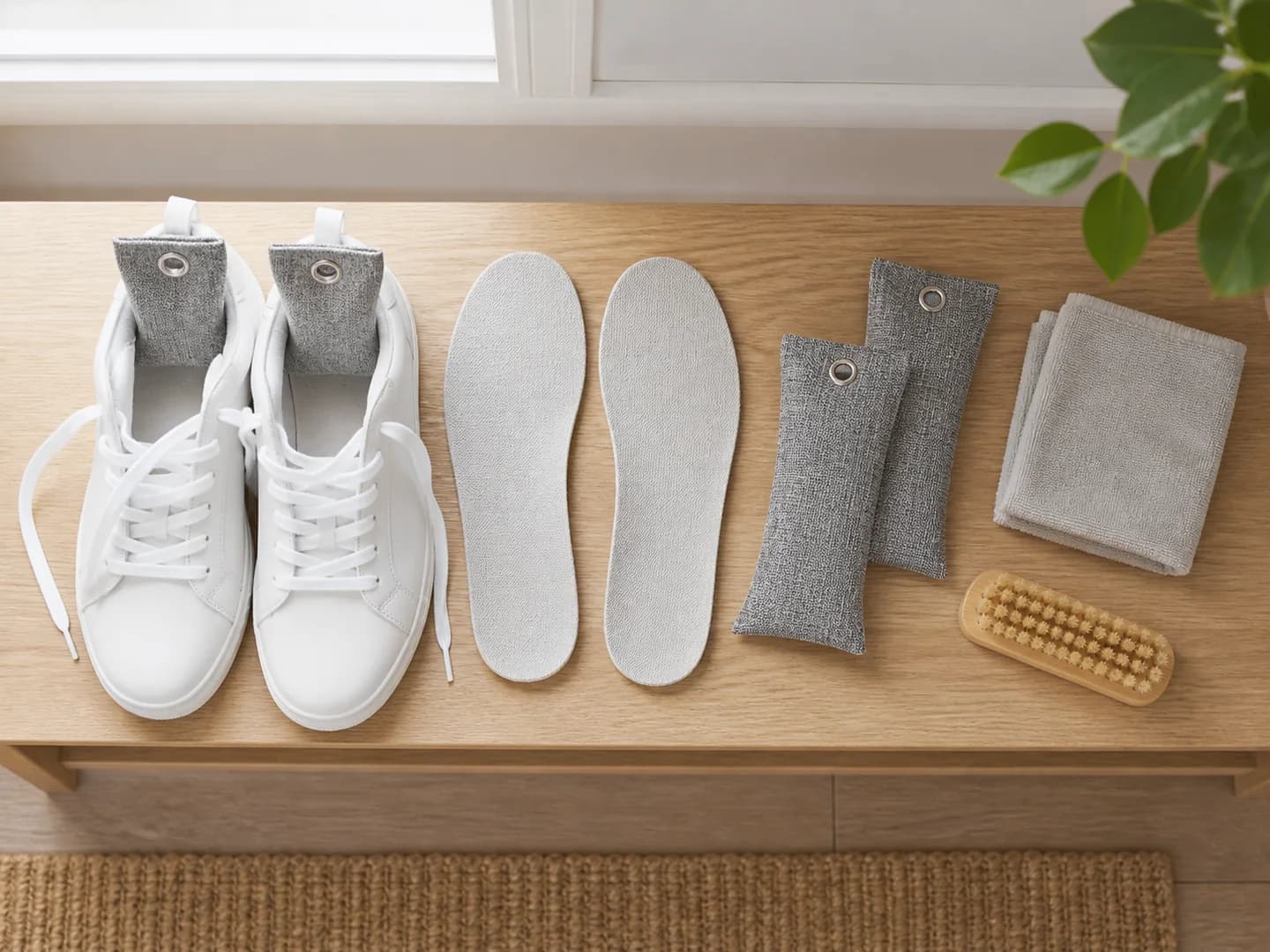
In finished-sample reviews, I rarely give the same placement advice for every item. A low-profile trainer, deep work boot and divided gym bag create different clearance, retrieval and airflow conditions. This guide explains how to adjust the routine without overpromising what a passive charcoal pouch can do.
How should you use charcoal shoe deodorizer bags after each wear?
Use them as the final step in an after-wear routine: unpack the item, inspect it, clean it when required, let it dry, then place the pouch loosely for storage. Remove the pouch and check both items before the next wear.
That order matters more than an impressive-sounding number of hours. A pouch placed promptly into a damp shoe does not stop the lining from holding moisture, and a pouch buried under wet gym clothes has very little chance of receiving the same air contact as one resting in an open, dry space.
Start by opening the item. Loosen sneaker laces, pull the tongue forward and remove a detachable insole if the footwear maker allows it. Unzip boot liners and bag compartments. Mud, a drink spill, dirty socks or a damp towel each calls for a different cleaning action before a passive odor-care accessory enters the routine.
Follow the product maker's cleaning instructions rather than choosing a method from the apparent toughness of the shoe. Adhesives, membranes, leather finishes, foam and printed components can all impose care limits. Once the relevant surfaces feel dry, place one appropriately sized pouch in each shoe or in the intended storage compartment without folding or compressing it.
| Routine stage | What to do | What to confirm before moving on |
|---|---|---|
| Unpack | Remove footwear and damp gear from the travel or gym bag | No wet item remains sealed in a closed compartment |
| Inspect | Check the lining, removable insole, seams and any visible residue | The problem is not dirt, a spill or damaged material |
| Clean | Follow the footwear or equipment maker's care instructions | Cleaner and loose residue have been removed as directed |
| Dry | Open the item and allow every relevant layer to dry | The lining, footbed and pouch contact area are dry |
| Place | Rest the pouch loosely in the shoe or clean storage space | The pouch is not folded, crushed or blocking closure hardware |
| Remove | Take it out before wearing or using the equipment | Pouch seams, eyelet and outer fabric remain intact |
The CDC foot-hygiene guidance supports keeping feet clean and dry and changing shoes and socks regularly. That guidance does not prove the performance of a charcoal pouch, but it explains why a storage accessory should sit behind basic hygiene and drying rather than in front of them.
Should shoes be dry before adding a charcoal deodorizer bag?
Yes. Wait until the footwear is dry before adding the pouch because a charcoal shoe deodorizer is not a shoe dryer. Dampness keeps the original problem active and makes it difficult to judge what the pouch contributes during storage.
A shoe can feel dry at the upper while the padded collar, foam footbed or removable insole still holds moisture. Press a clean dry cloth against those areas, inspect the underside of the insole and open the tongue far enough to see the interior. Thick work boots and lined winter footwear may need more time than a mesh trainer.
Do not solve slow drying with uncontrolled heat. Current NHS footwear-care guidance recommends letting footwear dry naturally and away from direct heat sources such as radiators. Adhesives, membranes and shaped components have their own care limits, so the footwear maker's instructions decide whether room-temperature airflow, paper, a purpose-designed dryer or another method is suitable. The NHS advice on sweaty feet also recommends rotating footwear and letting absorbed moisture dry before the same pair is worn again.
This distinction protects the customer from a common category mistake. Some product listings blur odor adsorption and moisture removal into one promise. Unless the finished pouch has been tested for a defined moisture claim, the safer instruction is to use it in clean, dry footwear for odor-care support. The separate shoe odor removal guide covers cleaning, drying and source checks in more detail.
Author insight: the dry surface is not always the dry shoe.
During a sample review, I pay attention to the insole underside and the padded area around the heel before calling the footwear dry. Those hidden layers are often more useful than touching the upper for two seconds.
Where should the pouch sit inside sneakers?
Place one pouch loosely inside each dry sneaker, normally along the open interior toward the forefoot, with the laces loosened and tongue lifted. The pouch should enter and leave without stretching the upper, folding sharply or pulling on its seam.
Low-profile training shoes have less free volume than they appear to have from the outside. The foot normally occupies that space, so a product shown standing high above the collar may look clear in a photograph but still be too thick for convenient customer handling. A slim pouch that lies naturally can be more usable than a heavier one that has to be wedged under the tongue.
Keep the pair together. One pouch in a shoe cabinet is not the same instruction as one pouch in each shoe because the air path and odor load are different. If the retail set contains a pair of pouches, the packaging should show the paired use clearly rather than leaving the user to guess whether one bag moves back and forth.
Remove both pouches before wearing the sneakers. They are storage accessories, not insoles, footbeds or products intended for skin contact during activity. If a child or hurried customer could mistake the pouch for a wearable insert, the front and instruction panels need clearer removal language.
Choosing a format for narrow trainers or wider footwear?
Compare the construction and private-label options for charcoal shoe deodorizer bags, then test the finished thickness in the actual shoe range before approving the pack.
How should placement change for work boots and hiking boots?
Boots usually offer more room but take longer to dry. Inspect the footbed, lining and any removable liner first, then place an appropriately sized pouch where it rests freely and can be removed without reaching blindly into the toe or pulling the product by its eyelet.
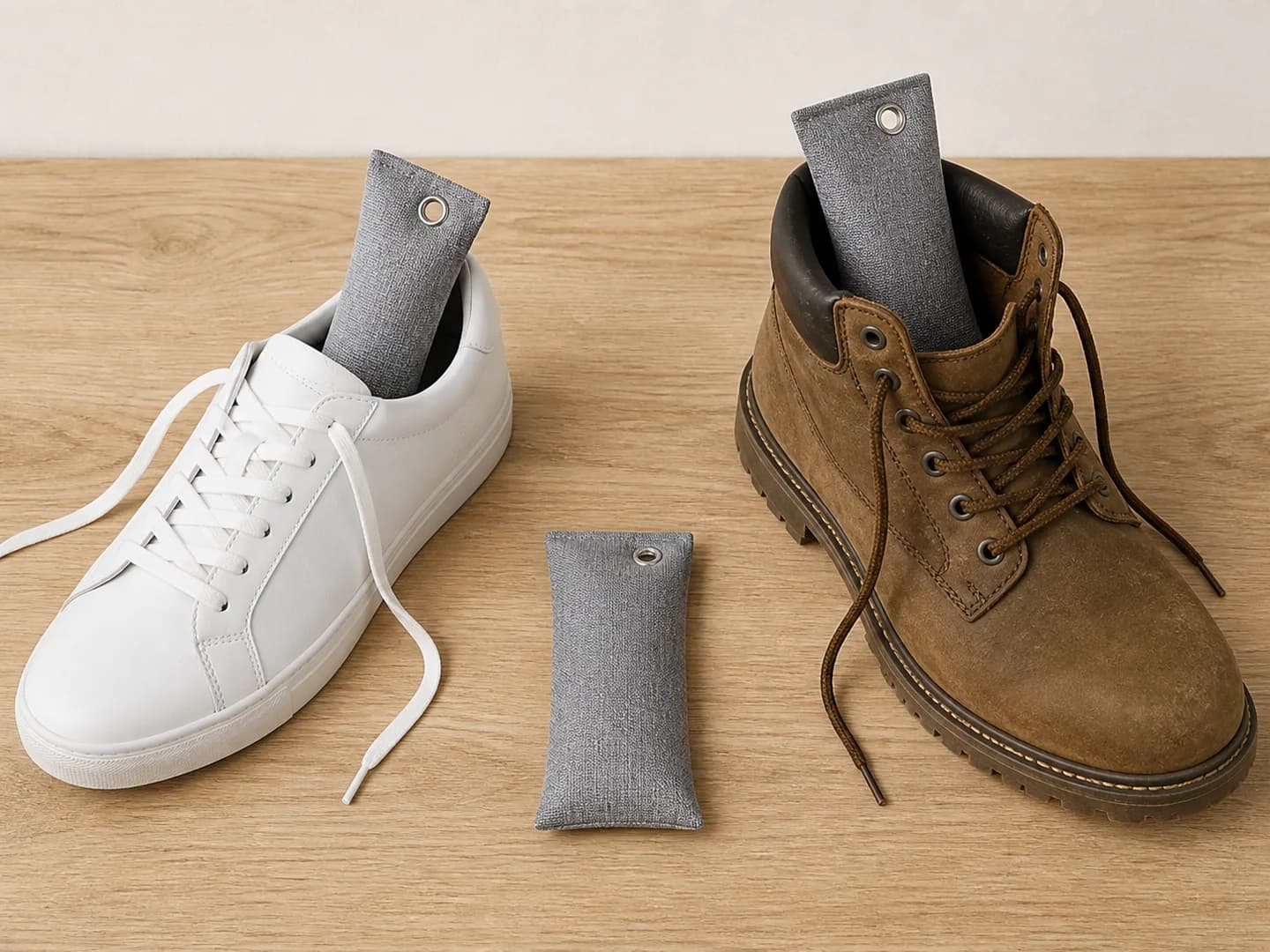
A roomy work boot can accept a different pouch profile from a running shoe, but more space does not make the largest available fill automatically correct. Finished thickness, charcoal density, particle movement, fabric breathability and seam construction still affect how the pouch sits. The target is usable exposure and repeatable handling, not the highest number on a quotation.
With tall boots, decide whether the instruction is for the foot area, the shaft during storage or both. A pouch hanging near the top may be easy to remove but far from the area being evaluated. A pouch pushed deep into the toe can be closer to the footbed yet awkward to retrieve. The finished sample should settle the compromise.
| Use context | Prepare the item | Practical pouch position | Remove or reassess when |
|---|---|---|---|
| Low-profile sneaker | Loosen laces, lift tongue and dry the footbed | One slim pouch resting freely in each shoe | The upper stretches or the pouch must be folded |
| Running or court shoe | Check foam collar and removable insole after activity | One pouch per dry shoe with the opening left relaxed | The lining is still damp or the pair returns to use immediately |
| Work boot | Inspect deep footbed, lining and any safety-related care limits | A suitable pouch in the open foot area, within easy reach | Retrieval requires pulling the seam or eyelet |
| Hiking boot | Remove mud as directed and dry the lining and insole | Loose placement that does not compress the membrane or tongue | The boot needs cleaning, repair or more drying time |
| Tall storage boot | Support the boot shape and define the target area | Foot area or shaft only as specified on the approved instruction | One position is being claimed to cover the whole boot without evaluation |
The AAD footwear guidance recommends alternating shoes so they are dry when worn again. That advice is particularly relevant to boots used on consecutive shifts. If the same pair returns to service before it dries, a passive storage pouch cannot correct the schedule.
How should charcoal bags be used in gym bags and sports gear?
Empty the gym bag first, clean equipment according to its instructions and dry every item that will return to the bag. Then place a pouch in a clean, open storage compartment with air space around it. Do not seal it under wet towels, socks or protective gear.
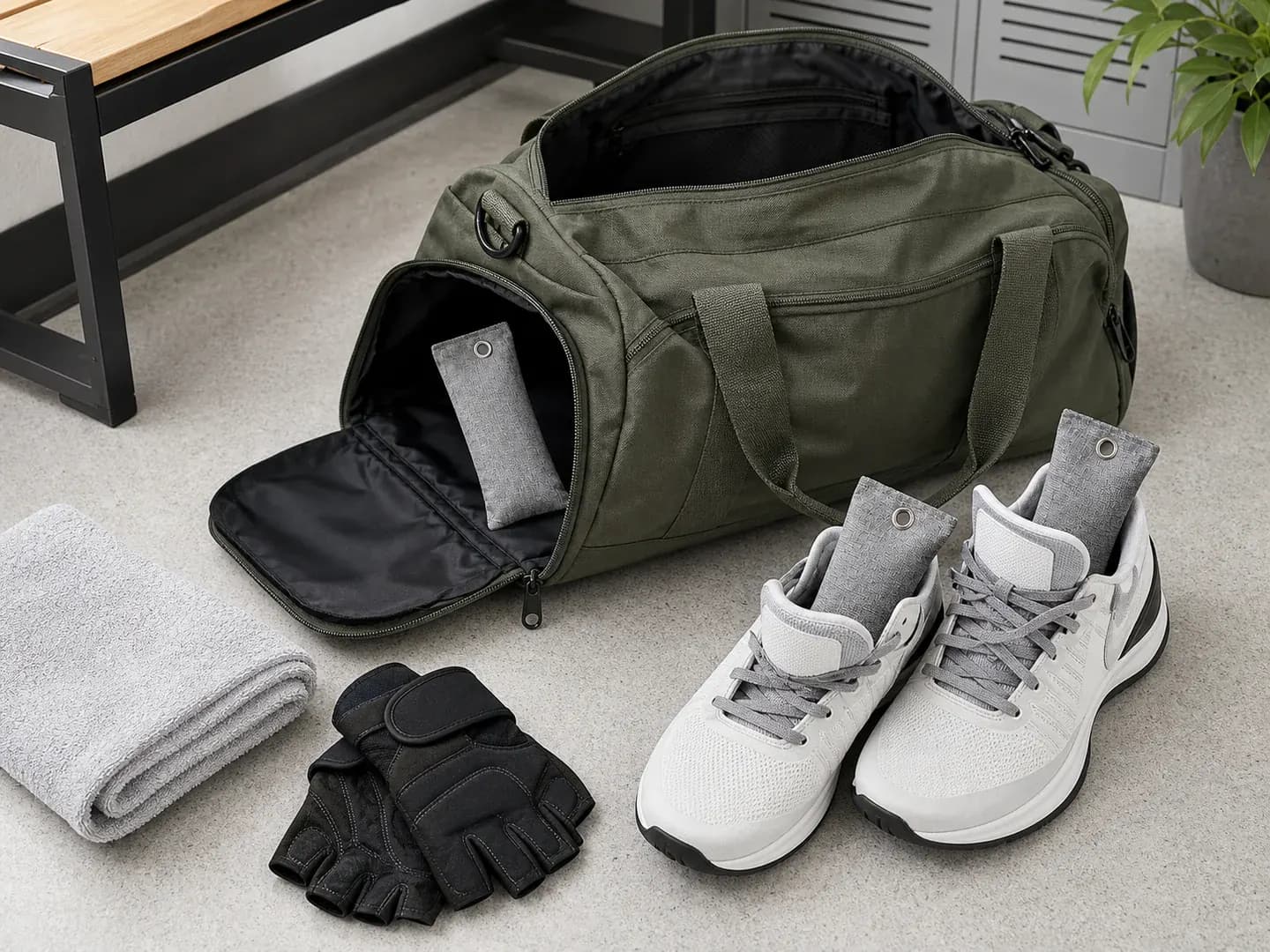
A divided duffel needs a deliberate location. If shoes sit in a separate ventilated compartment, a pouch can remain with the dry footwear between sessions. If the main compartment carries clean clothes, towels and food containers, dropping the pouch anywhere creates avoidable handling questions. Specify a dedicated pocket or shoe compartment in the consumer instructions.
Sports gloves, pads, helmets and braces should not be treated as interchangeable fabric objects. Their liners, foams, coatings and fastening systems may have different cleaning and drying rules. The CDC athletic-equipment guidance advises cleaning shared equipment after use, allowing it to dry and following the manufacturer's instructions so the cleaner does not damage it.
The charcoal pouch does not disinfect shared equipment. It should not become a reason to postpone washing a uniform, wiping approved surfaces or reporting skin symptoms. The CDC sports-gear hygiene advice specifically separates keeping gear clean from personal hygiene steps. Keep that same boundary in the product copy.
| Item | Sensible storage use | Poor use to avoid | Better instruction cue |
|---|---|---|---|
| Gym shoe compartment | Pouch placed with clean, dry shoes while the compartment is open or ventilated | Pouch buried under wet socks in a zipped compartment | "Unpack and dry shoes before storage" |
| Main duffel compartment | Pouch kept in a defined clean pocket between trips | Loose pouch mixed with food, toiletries and damp laundry | "Use in the designated dry-gear pocket" |
| Sports gloves or pads | Pouch stored beside dry equipment if fit and material care allow | Pouch used instead of cleaning shared contact surfaces | "Clean and dry gear according to its label first" |
| Locker | Pouch positioned in an open area near dry footwear | Pouch expected to manage an entire crowded locker indefinitely | "Keep airflow around the pouch and review the storage load" |
What changes on travel days, tournaments and back-to-back shifts?
When drying time is short, protect the sequence instead of pretending the pouch replaces it. Unpack footwear as soon as practical, open it for airflow, separate wet textiles and use the pouch only when the target storage space is dry enough for a fair odor-care job.
During a tournament, a shoe may travel from court to vehicle to hotel in a few hours. Leave it in a zipped duffel and the storage condition changes throughout the day. A mesh carry section, removable shoe bag or planned unpacking point can matter more than adding a second charcoal pouch to the same wet compartment.
For back-to-back work shifts, rotation is the stronger control when available. Mark the paired pouches so they stay with the same boots, inspect them before each storage cycle and avoid moving a damp pouch from one pair into another. If rotation is impossible, the instruction should admit that the product has limited storage time rather than promising an overnight reset.
Travel also raises a simple retrieval problem. A dark pouch pushed into a deep boot is easy to forget when someone dresses early or works in low light. Contrasting fabric, a clearly visible eyelet, a pull loop that has been approved for the construction, or a packing reminder can reduce misuse. Those are specification decisions, not decoration.
How long should the bags remain in shoes or gear?
Leave the pouches in place between uses and remove them before the footwear or equipment returns to service. Treat "overnight" as a practical observation period, not a universal performance guarantee, unless the finished product has been tested under defined conditions.
The result can vary with the starting odor load, shoe volume, temperature, humidity, airflow, pouch construction and charcoal condition. Eight hours in a dry everyday sneaker is not the same task as eight hours in a thick boot that was worn through a wet shift. A fixed time printed without those conditions creates a promise the sample may not support.
If the pack needs a time statement, define how it was evaluated and what the customer should notice. Otherwise, "place in clean, dry footwear between wears" is clearer and easier to follow. The guide to charcoal adsorption and performance limits explains why air contact and finished construction matter more than a copied duration.
Do not confuse service time with product life. How long the pouch stays in the shoe during one storage cycle is separate from how many cycles the finished pouch can complete. Care method, seam condition, exposure history and the approved replacement rule all belong in a reuse claim.
What should you check when the routine does not work?
Restart at the first broken step: confirm that the item is dry, clean, correctly loaded and paired with an undamaged pouch that fits without compression. If those checks pass and the odor remains strong, the problem may sit outside passive storage care.
Check 1: Is the item still damp?
Open the lining, removable insole or hidden compartment and inspect again. If moisture remains, return to drying. Adding more charcoal before this step is complete changes the product quantity without fixing the active condition.
Check 2: Is there a source that needs cleaning?
Look for mud, spills, dirty socks, residue in a footbed or a gym bag lining that has never been washed. Follow the relevant maker's instructions. A pouch can support the storage air after cleaning; it cannot lift contamination from a surface.
Check 3: Can air reach the pouch?
Unfold it, move it out from under a tight tongue and avoid stacking gear on top. In a bag or locker, reduce crowding around the pouch. If the product only fits when compressed, review the dimensions rather than training the customer to misuse it.
Check 4: Is the pouch still fit for use?
Inspect the outer fabric, seams, closure, eyelet and any sign of dust escape or wetness. Stop using a damaged pouch. Follow the care and replacement wording approved for that exact construction instead of copying sunlight or lifespan claims from another supplier's pack.
Check 5: Does the problem need another response?
Persistent odor after normal cleaning and drying can point to a worn material, a recurring foot-hygiene issue or a condition that a storage accessory cannot identify. Itching, redness, cracked skin, pain or nail changes belong with a pharmacist or healthcare professional, not a stronger product claim.
Author insight: complaints often expose instruction gaps.
If a user reports that the pouch "did nothing," I first ask where it was placed, whether the shoe was dry and whether the bag was removed before wear. Those answers are more useful than immediately increasing fill weight.
What usage instructions should footwear-care brands print?
Print the preparation, placement, removal, care and limitation steps in the order the customer performs them. The finished pouch, target footwear and retail pack should all support the same instruction without relying on assumptions hidden in a product photograph.
Short copy is useful only when it preserves the essential conditions. "Place in shoes" omits dryness, pair count, removal and the product boundary. A full paragraph squeezed into six languages can become unreadable. The better route is a short numbered sequence, supported by clear icons that are checked against the final artwork and product.
| Instruction field | Question the copy must answer | Example direction | Risk it reduces |
|---|---|---|---|
| Preparation | What condition must the item be in? | "Use in clean, dry footwear or dry storage spaces" | Pouch treated as a cleaner or dryer |
| Quantity | How many pouches go where? | "Place one pouch loosely in each shoe" | One pouch moved randomly between a pair and cabinet |
| Removal | When must the customer take it out? | "Remove before wearing or using the equipment" | Pouch mistaken for an insole or wearable insert |
| Handling | What physical misuse should stop? | "Do not force, fold or pull by the seam" | Seam strain, awkward fit and dust escape |
| Care | How is this construction inspected or refreshed? | Use only the approved care and replacement wording | Unsupported reuse or full-regeneration claim |
| Limitation | What job remains outside the product? | "Does not replace cleaning, drying or appropriate hygiene care" | Sanitizing, treatment or instant-result implication |
When I compare a finished pouch with its instruction copy, I check the sequence in the narrowest target shoe instead of relying on the roomy sample used for photography. If insertion distorts the upper or removal encourages someone to pull the eyelet, the specification or the wording needs another review.
Another overlooked risk is pack architecture. A two-pouch set should show paired use. A four-pouch set should explain whether it serves two pairs or supplies a rotation. If the brand offers sneakers, boots and gym accessories under one SKU, the instruction should identify where the same rule ends and application-specific judgment begins.
The footwear and sports-gear application guide helps buyers map dimensions, pair count, fabric, handling and pack format to the intended channel. Use the physical sample to confirm those decisions before artwork approval.
Conclusion: what is the simplest correct-use rule?
Dry first, place loosely and remove before use. That rule keeps the charcoal pouch in its proper role: supporting odor care during storage after cleaning and drying, without asking it to act as a dryer, disinfectant, insole or treatment.
For sneakers, protect internal clearance and paired use. For boots, allow extra drying time and keep the pouch within easy reach. For gym bags and sports gear, empty and clean the storage system before putting the pouch into a defined dry compartment.
Preparing a private-label footwear-care range?
Review your usage and packaging brief with the target shoe types, pouch dimensions, pair count, care wording and retail format before the instructions move into final artwork.