

You open the closet for a clean shirt, yet the stale smell seems to have settled into everything behind the door. A spray may improve the first few seconds, but the odor returns as soon as the fragrance fades and the wardrobe has been closed again.
The dependable fix is to trace the smell to dampness, soiled textiles, shoes, poor air movement or the closet structure, then clean and dry that source. A passive deodorizer can support the space afterward, but it cannot repair a leak, remove mold or dry wet fabric.
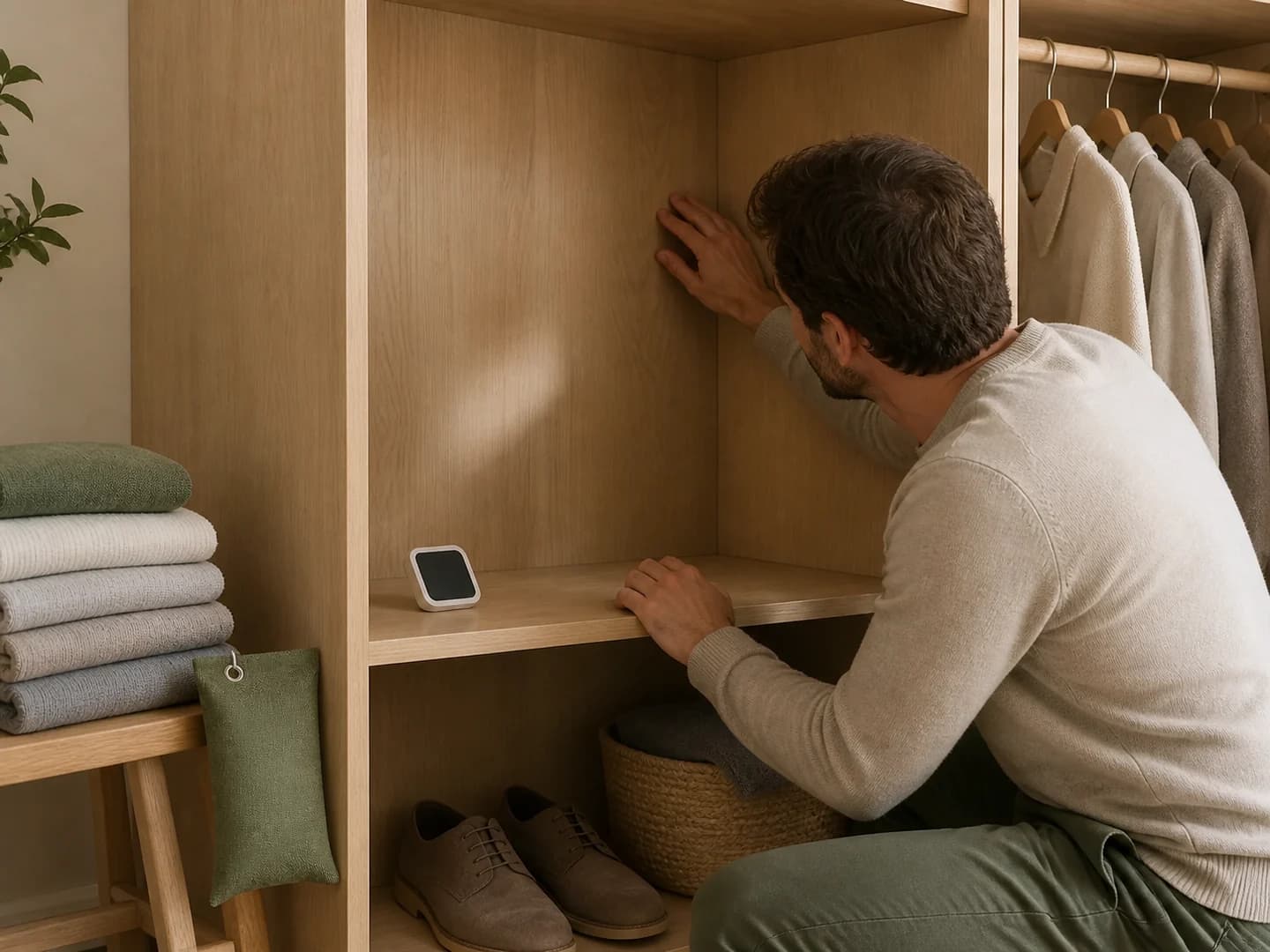
The useful part of a closet-product brief often appears before anyone discusses grams: a photo of the compartments, where shoes or laundry sit, and whether a pouch will remain exposed. Those details shape both the sample I review and the instructions a buyer can honestly print.
Why does a closet smell musty?
A closet usually smells musty because moisture and organic residue have remained in a poorly ventilated space long enough for odors to build up, and sometimes for microbial growth to begin. The source may be a damp garment, shoes, a laundry hamper, a cold exterior wall, a small leak or the closet materials themselves.
Start by treating "musty" as a clue, not a diagnosis. People use the same word for several different smells. Damp cotton, worn shoes, old cardboard, fragranced products and visible mold do not call for the same response. Empty enough of the closet to smell and inspect each zone separately.
Humidity matters because textiles respond to their environment. The Canadian Conservation Institute's textile guidance explains that high relative humidity permits mold growth and that a musty odor can accompany it. This is not a reason to assume every odor is mold. It is a reason to investigate moisture instead of covering the smell.
| What you notice | More likely source | First place to check | First sensible action |
|---|---|---|---|
| Smell is strongest after rain | Leak, wall dampness or humid air | Back wall, ceiling edge, floor and adjacent room | Find and correct the moisture source |
| Only a few clothes smell | Garments stored damp or with body oils | Collars, cuffs, dense folds and garment bags | Follow the care label, clean and dry fully |
| Lower section smells stronger | Shoes, hamper, carpet or floor-level dampness | Insoles, hamper base, skirting and carpet edge | Remove the item and clean the zone |
| Odor is woody or chemical | Cabinet board, finish, adhesive or packaging | Empty shelf and rear panels | Air the closet and identify the material source |
| Speckling, staining or fuzzy growth appears | Possible mold or mildew | Wall, textiles, leather and hidden corners | Stop routine deodorizing and seek suitable remediation |
| Smell fades with the door open, then returns | Stagnant air plus an unresolved source | Crowded rail, blocked vents and closed boxes | Create space, ventilate and repeat the source check |
A useful location test is simple. Move one suspect group, such as shoes or a hamper, into a clean, dry temporary area. Close the empty closet for a short observation period, then compare the odor in the closet with the removed items. This does not identify a microorganism or measure air quality, but it helps narrow the next inspection.
What should you check before adding any deodorizer?
Check for active water, visible growth, damp textiles, dirty items, blocked airflow and odor-emitting storage materials before adding any deodorizer. If one of those conditions remains, a fragrance or charcoal pouch may change the smell around the source without fixing the cause.
Use your eyes and hands before reaching for a product. Look along the back wall, ceiling corners, skirting, shelf joints and floor. Feel for cool or damp surfaces without touching visible growth. Check whether the closet backs onto a bathroom, kitchen, exterior wall or plumbing route. A moisture meter or hygrometer can add useful evidence when dampness is suspected, but one reading should be interpreted with location, weather and time.
Then inspect the contents. Clothes should be clean and completely dry before storage. The CCI basic textile-care advice recommends clean, dry storage with ventilation and warns that excess humidity, poor circulation and unsuitable storage can damage textiles. Everyday garments are not museum objects, but the source-control logic still applies.
| Inspection step | What to examine | Evidence that changes the plan | Continue when |
|---|---|---|---|
| 1. Structure | Wall, ceiling, pipe route, floor and cabinet back | Wet patch, staining, soft board or recurring condensation | Surfaces are dry and intact |
| 2. Textiles | Garments, linens, garment bags and folded stacks | Damp feel, isolated odor, stains or visible growth | Items are clean, dry and safe to store |
| 3. Footwear and laundry | Shoes, insoles, hamper and gym gear | Odor is concentrated in one item or container | Source items have been removed or treated |
| 4. Storage materials | Cardboard, liners, shelf paper and wood products | Odor remains on the empty material | Suspect materials are removed or aired |
| 5. Air path | Door gap, vents, rail density, shelves and drawers | Clothes touch walls or isolate compartments | Air can reach each occupied zone |
| 6. Baseline | Empty, cleaned closet after airing | Musty smell returns without contents | The structural source has been investigated |
Do not disturb visible mold casually. The appropriate response depends on the affected material, area and health risk. Isolate affected belongings where sensible and obtain qualified advice for extensive, recurring or building-related growth. A charcoal bag is not mold treatment.
How do you remove a musty closet smell without masking it?
Remove the odor by correcting moisture, taking out the affected contents, cleaning compatible surfaces and items, drying everything fully, and restoring air movement before the closet is refilled. The order matters because a deodorizer placed beside a continuing source is being asked to manage new odor faster than it can passively adsorb it.
First, correct active moisture. That may mean repairing a leak, moving furniture away from a cold wall, improving room ventilation, addressing condensation or using purpose-designed humidity control. The US EPA describes source control as the most effective strategy for many indoor air problems, with ventilation and filtration as supporting measures.
Second, remove the contents and sort them by condition. Follow garment and footwear care instructions rather than applying one cleaning recipe to every material. Wool, leather, coated fabrics and delicate textiles can be damaged by unsuitable water, heat or chemicals. If an item has visible growth, valuable construction or uncertain care requirements, professional advice is safer than improvised cleaning.
Third, clean the empty space using a method compatible with the closet finish. Remove dust and residue from shelves, corners, drawer runners and the floor. Avoid soaking composite board or leaving cleaner trapped in joints. Let the closet become fully dry before returning anything.
Fourth, rebuild the air path. Leave breathing room between the back wall and garments, avoid packing the rail solid, and do not seal damp-prone items inside non-breathable bags. If the room itself stays humid, closet organization alone will not solve the environmental problem.
| Stage | Goal | Evidence before moving on | Common shortcut that fails |
|---|---|---|---|
| Source control | Stop new water, residue or odor entering | Leak, damp item or dirty source is removed or corrected | Spraying fragrance into the closed closet |
| Cleaning | Remove soils that retain odor | Compatible surfaces and contents are visibly clean | Wiping only the front shelf |
| Drying | Prevent wet items from restarting the cycle | Garments, shoes, walls and shelves are dry | Returning clothes while seams or linings are damp |
| Airflow reset | Reduce stagnant pockets | Garments have clearance and compartments are not sealed off | Hanging a pouch behind a solid stack |
| Odor support | Manage residual odor in a dry space | Source is controlled and placement stays exposed | Expecting a passive bag to dry the wardrobe |
| Observation | Check whether the fix holds | Odor trend improves without new dampness | Adding more product without rechecking the source |
This sequence is slower than spraying a scent but gives you useful information. If the smell returns after the closet is empty, clean and dry, the structure or room environment needs more attention. If it returns only after a particular item comes back, that item becomes the next source to examine.
When can a bamboo charcoal bag help in a closet?
A bamboo charcoal bag can support odor care after the closet and its contents are dry, clean and free of an active moisture problem. It is most suitable as a passive, fragrance-free accessory for residual odors in a small storage zone, not as a substitute for cleaning, ventilation, leak repair or mold remediation.
Charcoal works by adsorption, which means some molecules adhere to available surfaces in the porous material. Adsorption is different from absorbing liquid water into the bulk of a desiccant. That distinction matters in a closet: an odor-care pouch should not be sold as though it were a dehumidifier unless the finished product has separate evidence for that claim.
The EPA guide to home air cleaners discusses powered activated-carbon filters rather than passive bamboo-charcoal pouches, so its ratings cannot be transferred to this product. It does, however, reinforce two relevant limits: gas removal depends on the material and airflow, and air cleaning does not resolve a mold and moisture problem. Our guide to how bamboo charcoal bags work explains the passive pouch in more detail.
| Closet condition | Is a charcoal bag the first action? | Appropriate supporting role | What it cannot replace |
|---|---|---|---|
| Clean, dry closet with mild residual odor | Possibly | Passive odor-care support | A verified performance guarantee |
| Clean closet with isolated shoe odor | No, treat the shoes first | Support the lower dry storage zone afterward | Footwear cleaning and drying |
| Damp wall or recurring condensation | No | None until moisture is controlled | Leak repair or humidity control |
| Visible mold or mildew | No | None during remediation | Mold assessment and cleanup |
| Crowded wardrobe with blocked air | Not yet | Support after the layout is opened | Ventilation and practical spacing |
| Strong odor from board or adhesive | Not as the main remedy | Limited residual-odor support after source review | Removal or airing of the emitting material |
For buyers, the honest category description is often stronger than an inflated claim: a bamboo charcoal odor-care pouch for dry wardrobe storage. It tells the customer where the product belongs while leaving moisture, mold and health claims outside the promise.
Where should a charcoal bag sit inside the wardrobe?
Place the bag in a dry, exposed position where closet air can reach its breathable surfaces, such as an open shelf or hanging rail, and keep it away from wet fabric. Do not bury it under folded clothes, squeeze it behind a solid box or let garments seal both sides of the pouch.

A small single-compartment wardrobe can begin with one exposed placement. A tall unit with separate shelves, drawers and a shoe zone should be treated as several air zones rather than one empty volume. Moving one pouch from the rail to a sealed lower drawer does not help the hanging section above it.
There is no responsible universal formula such as one 200 g bag for every closet. Internal volume matters, but so do fill density, door openings, compartment barriers, garment loading, source strength and the finished pouch construction. The practical approach is to select a starting format, record the placement and observe the same closet under normal use.
The closet charcoal bag range shows hanging and shelf formats used as 200 g and 250 g development starting points. Buyers should confirm finished dimensions, fill, fabric, hanging hardware and pack instructions on the physical sample. For broader room and storage planning, see the home storage application.
Planning a wardrobe-care range?
Why does the musty smell come back after cleaning?
A musty smell comes back when the source was missed, moisture returned, an affected item was reintroduced, or the closet was packed in a way that recreated stagnant pockets. Adding another deodorizer before checking those possibilities can hide the pattern that would identify the real problem.
Recheck the timeline. An odor that returns after rain points toward a different cause from one that returns after damp laundry is stored. A smell confined to the floor suggests different sources from one concentrated along a cold rear wall. Record what changed before the odor came back instead of relying on memory.
This is also the point to distinguish product disappointment from application mismatch. A pouch may remain unused because it was trapped behind clothing. It may be expected to manage an active shoe source, a wet wall or a whole room. Those are placement and scope problems, not evidence that another fragrance is needed.
| Return pattern | Most useful diagnosis | What to change next | When to stop self-troubleshooting |
|---|---|---|---|
| Returns after wet weather | Building or room moisture may be entering | Inspect wall, ceiling and adjacent spaces | Dampness or staining persists |
| Returns when one garment group is replaced | An item or garment bag still carries the source | Isolate and follow item-specific care | Visible growth or valuable material is involved |
| Strongest at the floor | Shoes, hamper, carpet or low-level moisture | Remove lower-zone contents and inspect | Floor or skirting remains wet |
| Returns only when tightly packed | Air movement is being blocked | Reduce loading and separate compartments | Room humidity remains uncontrolled |
| Pouch seems ineffective where hidden | Breathable faces lack air exposure | Move it to an open, dry position | The odor is strong or source-driven |
| Empty closet still smells after cleaning | Cabinet or building material may be the source | Air, inspect and identify the material | Chemical irritation or structural concern appears |
If odor is accompanied by visible growth, recurring water, respiratory irritation or a large affected area, treat that as an escalation signal. A blog cannot identify the hazard from a smell, and a passive closet product should never delay suitable building, cleaning or health advice.
How should brands diagnose specification ambiguity before approving a closet bag?
Brands should mark every phrase that two reasonable people could interpret differently, then replace it with a defined field, approved sample or documented acceptance check. This specification ambiguity diagnosis prevents a generic closet claim from becoming a mismatched product, inconsistent quotation or unsupported instruction.
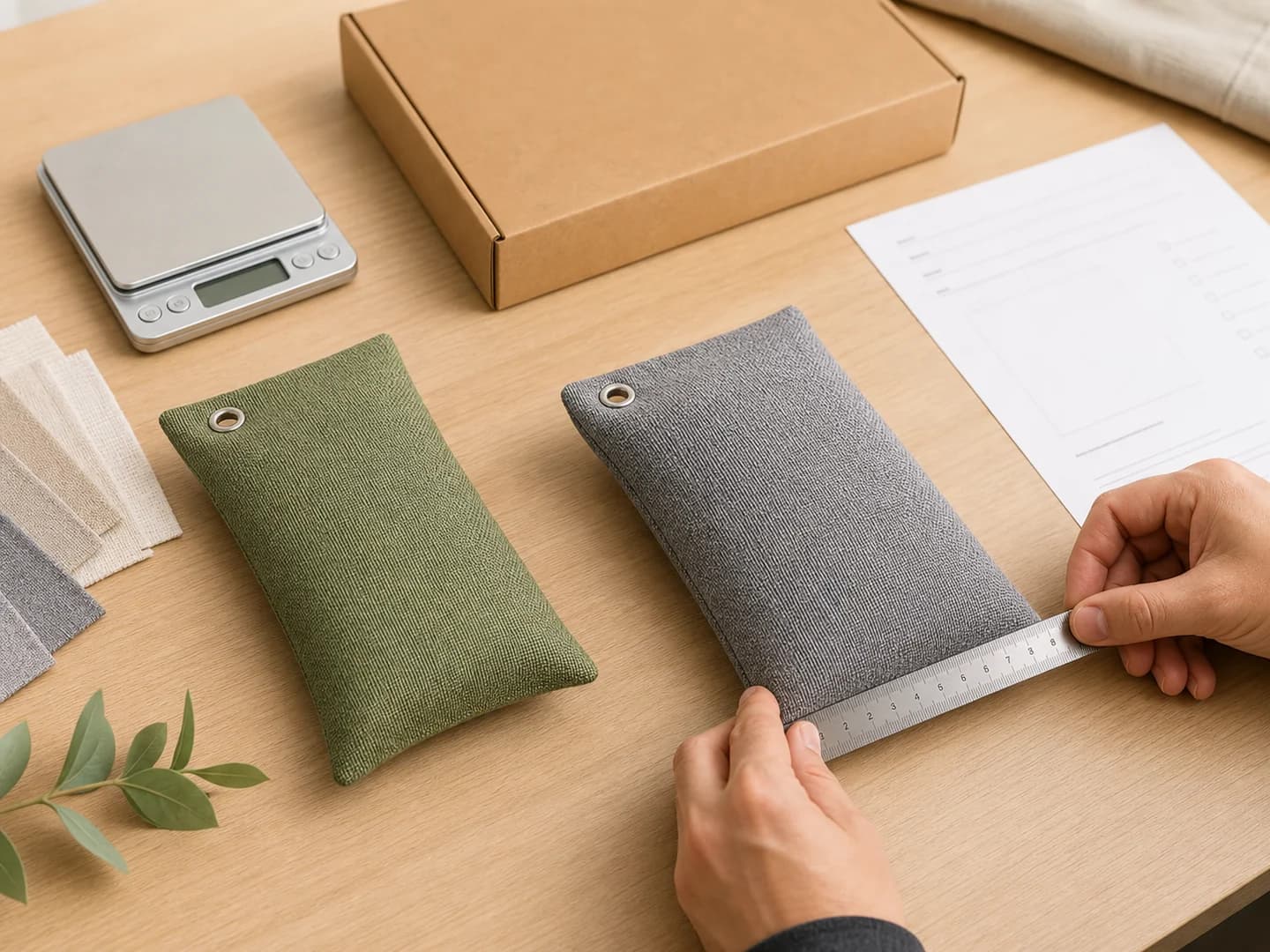
In sample reviews, I read the brief as if no one will be available to explain what its writer intended. That exposes risk quickly. "One bag per closet" sounds clear until the closet has three sealed compartments. "200 g bag" is incomplete until the document says whether 200 g is net charcoal fill or total finished weight. "Breathable fabric" is not a material specification.
| Ambiguous phrase | Questions the buyer should ask | What the specification should record | Approval evidence |
|---|---|---|---|
| "One bag per closet" | What closet volume, loading and compartment layout? | Starting placement by airflow zone | Placement photo and use trial |
| "200 g bag" | Net charcoal per pouch or total finished weight? | Net fill basis, unit and tolerance | Agreed weighing method |
| "Standard wardrobe" | Freestanding, fitted, single or divided? | Reference dimensions and compartment map | Target-use brief |
| "Breathable fabric" | Which outer textile and inner liner? | Material reference, construction and color | Swatch and sealed sample |
| "Reusable" | Reused how, for how long and until what condition? | Care method and end-of-use criteria | Finished-product evidence record |
| "Natural deodorizer" | Which material supports the wording? | Exact material identity and claim scope | Material file and artwork approval |
| "Prevents mold" | What evidence supports prevention? | Remove the claim unless substantiated | Legal and technical claim review |
| "Freshens a closet" | Against which odor, in what setup and for how long? | Intended dry-storage role and test conditions | Defined sample comparison |
Net quantity deserves particular care when it appears on packaging. The current NIST Handbook 133 provides procedures for checking packaged goods against labeled quantity requirements in the United States. Buyers should confirm the rules for their target market and keep charcoal net fill separate from finished pouch weight in both the specification and inspection sheet.
Broad environmental language needs the same discipline. The FTC Green Guides summary warns marketers against broad, unqualified environmental benefits and expects claims to be supported. Bamboo charcoal as one component does not automatically prove that the finished pouch, label and packaging are "eco-friendly" as a whole.
The practical output of this diagnosis is not a longer adjective list. It is a cleaner sample record: target closet, pouch dimensions, net fill, fabric, liner, seams, hanging method, logo, pack count, placement copy, care instructions, claim boundaries and inspection method. The size and fill guide can help connect format decisions before sampling.
What should closet deodorizer instructions tell the customer?
Instructions should tell the customer to correct active moisture and odor sources first, place the pouch dry and exposed, keep it away from wet materials, and follow the approved care and replacement criteria. They should also state what the product is not designed to do when misunderstanding could create risk.
Short copy can still be accurate. A practical instruction set might say to use the pouch in a clean, dry wardrobe, hang it or place it on an open shelf, avoid covering its breathable surfaces, inspect the area if mustiness returns, and follow the product-specific care directions. Do not copy a heating, sun-drying or lifespan instruction from another charcoal product unless it has been approved for the finished sample.
For a retail pack, review these five questions before artwork release:
- Does the product name describe a bamboo charcoal odor-care pouch rather than a dehumidifier or mold treatment?
- Are pouch count and net fill stated on the same piece, pair or pack basis used in the order?
- Can the customer see where to place the pouch and what not to block?
- Does the care instruction match the finished fabric, liner, charcoal and packaging?
- Are broad health, pollution, mold and environmental claims absent unless specifically substantiated?
Clear limits do not weaken the product. They direct it toward the condition where a customer can reasonably use it: a dry closet with the source already controlled. That is more useful than a long claim panel that promises to solve odor, moisture, mold and air quality at once.
Conclusion: what is the reliable order for fixing a musty closet?
The reliable order is source, clean, dry, airflow, support and observe. Find what is producing the smell, correct the moisture or residue, clean compatible surfaces and contents, let everything dry, reopen the air path, then consider a bamboo charcoal bag for residual odor care.
If the smell returns, do not automatically add more bags. Use the return pattern to check the wall, garments, shoes, floor, compartment layout and room humidity again. Visible growth, ongoing water or health concerns belong outside a passive-product routine and may require professional help.
For a private-label program, turn that same decision order into the specification. Define the intended dry closet, product format, net fill, placement zone, instruction wording, claim boundary and sample acceptance evidence. A clear use case makes both the product and its packaging easier to approve.
Need a closet pouch sample matched to your program?