
An automotive charcoal bag can look correct on a sample table and still fail once it is placed inside the vehicle. Poor clearance, unstable attachments, cabin heat, unclear installation copy or a retail pack that hides essential instructions can turn an approved sample into a rejected program.
The direct answer is to approve the bag as part of a vehicle-use system, not as an isolated pouch. The location, attachment, dimensions, fill, materials, claims, directions and retail packing should be reviewed together and converted into measurable requirements before bulk production begins.
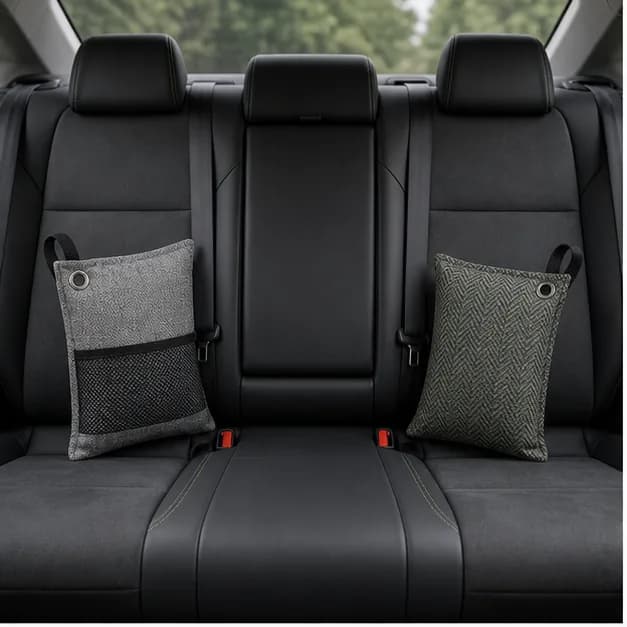
When an automotive buyer asks me to diagnose a rejected sample, I start inside the intended vehicle rather than with another studio photograph. This guide follows that practical review, showing where sample approvals usually break down and what evidence purchasing and quality teams should record.
Did the team define the exact vehicle placement?
"For the car" is not a placement specification. State where the bag will sit or hang, how it will be secured and what it must remain clear of.
A 500 gram seat pouch, a headrest cushion and a paired hanger are different products. Each creates different thickness, movement and user interaction. For a practical example, review the 360g car seat back charcoal odor absorber, which uses two straps on the two posts of one front-seat headrest. The approval brief should name the location, target vehicle class and installation method.
| Symptom | Likely gap | Evidence to approve |
|---|---|---|
| Bag slides during driving | No attachment or surface test | Vehicle trial and attachment photo |
| Strap is too short | Headrest dimensions not mapped | Strap length range and fitted sample |
| Product blocks a control | Placement treated as decoration | Clearance checklist in representative vehicle |
| Pouch looks undersized | Format selected from weight alone | Installed photos and finished dimensions |
Safety comes before styling. NHTSA's consumer guidance for vehicle adaptations emphasizes maintaining visibility and safe operation (NHTSA adapted vehicle guidance). Although a charcoal pouch is not an adaptive device, the principle is useful: accessories should not interfere with the driver's view, controls, belts, airbags or seat movement.
Our Automotive Interiors application page maps common rear-seat and headrest formats without treating them as universal fits.
Was the attachment approved with the filled pouch?
Test the strap, cord, eyelet or pocket with the final fill and fabric because weight and thickness change how the attachment loads and moves.
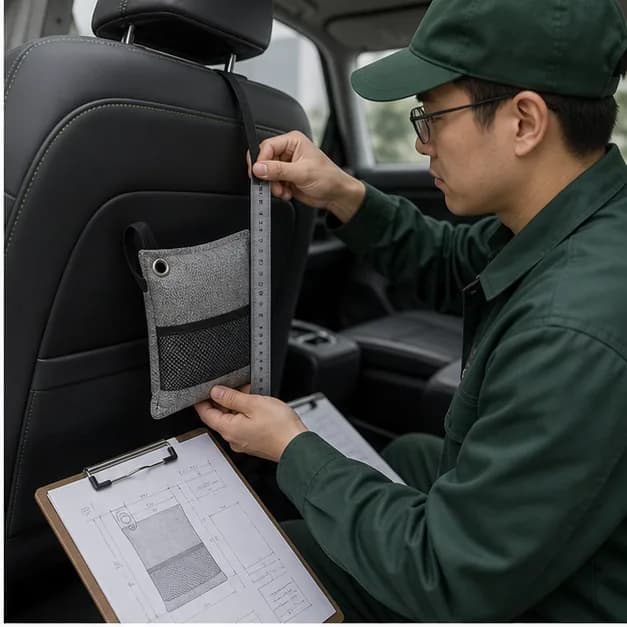
An empty sewn shell can make any strap look secure. The same shell at final net fill may pull the seam, rotate on the headrest or hang lower than expected. I ask the sample team to fit the finished product, move the seat and repeat installation several times.
Check attachment width, stitch reinforcement, eyelet position and the path of any cord. If a paired hanger is sold as a set, both pieces should be evaluated together. Record the approved method in diagrams and photographs so production inspectors know what matters.
Have a vehicle format to validate? Send your placement, dimensions, attachment and target quantity.
Did the sample lock fill, liner and finished thickness?
Nominal fill alone is not enough. Approve net fill, tolerance, liner construction, particle format, finished dimensions and thickness as one reference.
Two pouches can both contain 500 grams and still feel different if their cut size or charcoal particle format changes. Overfilled corners can become hard. Loose fill may shift and make printed artwork look uneven.
For US net-contents control, NIST Handbook 133 explains procedures for checking packaged goods and distinguishes average lot requirements from limits for individual packages (NIST Handbook 133). Buyers should confirm applicable market rules with their own compliance team and put the agreed factory checks in writing.
Dust containment also needs a physical acceptance method. A reference 65 gsm SMS liner may be used in selected BamveraEco programs, but the final result depends on the liner, closure seam, outer seam and handling together. Check the completed sample, not a swatch alone.
Were materials reviewed for parked-cabin conditions?
Automotive samples should be reviewed for the temperatures and storage conditions reasonably expected in a parked vehicle, especially fabrics, print, cords, eyelets, labels and packaging.
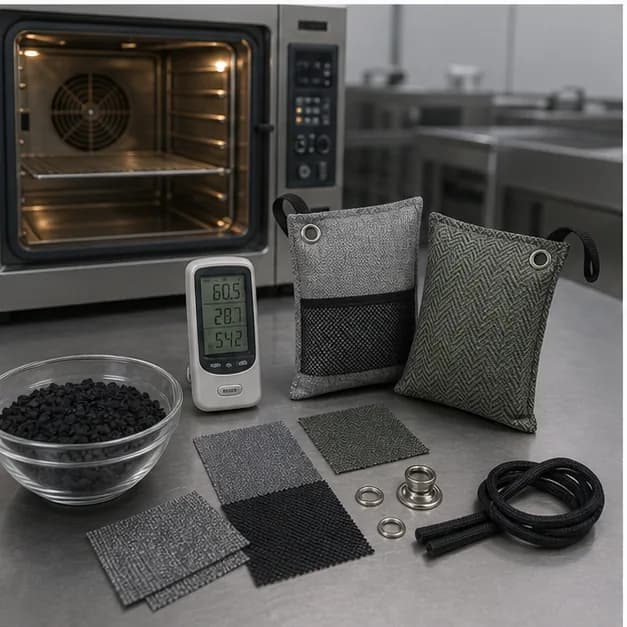
Cabin conditions vary by climate, color, ventilation and exposure. Avoid claiming one universal temperature limit unless it has been established for the actual construction. Instead, define the buyer's expected range and test the finished materials against an agreed protocol.
During a review, I look for print transfer, adhesive movement, cord deformation, color change, odor from non-charcoal components and changes in seam appearance. The objective is not to simulate every vehicle in every country. It is to reveal whether the chosen material set remains appropriate for the target program.
This is also where fragrance-free positioning matters. A buyer choosing charcoal adsorption should not receive a fabric, ink or packaging component with an unintended strong scent.
Are the odor-care claims technically supportable?
Use narrow, product-specific language because adsorption capacity is finite and in-vehicle results depend on airflow, temperature, humidity, placement and the odor source.
The EPA describes adsorption as pollutants accumulating on a solid surface and notes that carbon capacity and operating conditions affect performance (EPA activated-carbon overview). That supports a fragrance-free odor-care position, but it does not justify promising complete removal of every vehicle contaminant.
Avoid broad phrases such as "removes all toxins" or "works for years" unless the exact finished product and claim have suitable evidence. The FTC expects objective advertising claims to be truthful, non-misleading and supported before publication (FTC advertising substantiation policy).
A practical approval set includes intended placement, instructions, care conditions, replacement guidance and claim limitations. Packaging should not turn cautious sample notes into absolute marketing promises.
Did artwork and retail packaging reflect the actual installation?
Show the approved product in the approved location, and make the set count, installation and warnings easy to understand before the pack is opened.
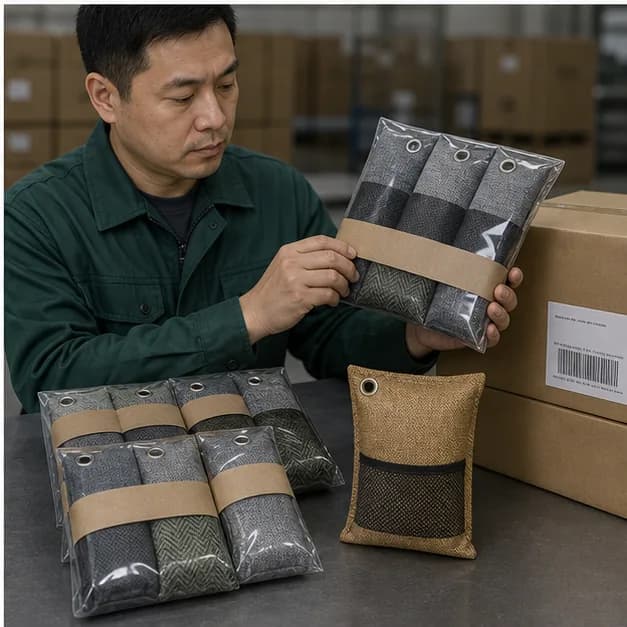
If a pouch is designed for a seat-back pocket, do not show it hanging from a mirror. If a headrest strap is required, include the installation path. Misleading imagery creates customer complaints even when the pouch itself is correctly manufactured.
Barcode position should be checked on the assembled package. GS1 recommends avoiding folds, edges and obscured areas and considering the full packaging process (GS1 barcode placement steps). Export cartons should then be packed with the final retail unit so counts and measurements are real.
The Bamboo Charcoal Car Odor Absorber Bags page provides examples of compact, headrest and paired automotive formats that can be sampled separately.
Was the golden sample translated into production controls?
A signed sample is useful only when the factory converts it into measurable checks for materials, cutting, filling, sewing, printing and packing.
This is the handoff point where many programs fail. The buyer approves one sample, but the bulk team receives only a photo. I prefer a controlled specification that links each approval to a production or inspection step.
| Approval | Production control |
|---|---|
| Fabric and color | Approved swatch and incoming check |
| Cut dimensions | Pattern and measurement method |
| Net fill | Weighing record and agreed tolerance |
| Attachment | Stitch path, reinforcement and position |
| Artwork | File version, method and placement range |
| Finished product | Dimensions, thickness, dust and appearance check |
| Retail unit | Set count, insert, barcode and pack sequence |
| Export carton | Count, dimensions, marks and order reference |
Inspectors also need a rejection boundary. "Looks good" is not repeatable. A short list of critical defects, major defects and appearance limits gives both sides a clearer basis for decisions.
Frequently Asked Questions About Automotive Sample Approval
Describe the failure in the real use context, identify the missing specification and request one controlled correction instead of asking the supplier to "improve quality."
What should buyers check if the bag moves or hangs poorly?
Send installed photos and measurements. Change the attachment or format, then repeat the same vehicle trial.
What should buyers check if charcoal dust appears?
Locate where it escaped. Review charcoal format, liner closure, outer seam and hardware penetration before changing materials at random.
What should buyers do if bulk color differs from the sample?
Confirm whether the approved standard was a physical swatch, printed proof or screen image. Establish a physical reference and an agreed production range.
What should buyers do if the retail pack does not fit?
Rebuild the dieline around the filled golden sample and final set count. Do not resize only the artwork.
Conclusion: how can buyers prevent sample-to-bulk surprises?
Treat the vehicle, pouch and package as one approval system, then translate that system into measurable production checks.
The most useful sample is not the prettiest one. It is the one that has been installed, handled, measured, opened, packed and documented. That work gives the factory a repeatable reference and gives the buyer evidence for a clearer launch decision.
Preparing an automotive private-label brief? Send your vehicle use case and request a sample review.