

A stale cupboard smell can make the half-used bag of grilling charcoal in the garage look like a quick solution. The idea sounds reasonable: if charcoal is used in odor filters and deodorizer bags, perhaps any black charcoal will do.
It will not. Some porous carbon materials can adsorb certain odor compounds, but barbecue briquettes, lump fuel charcoal, bamboo charcoal and activated carbon are not interchangeable products. For a home, use a contained odor-control product with a defined material and instructions, not loose or instant-light cooking fuel.
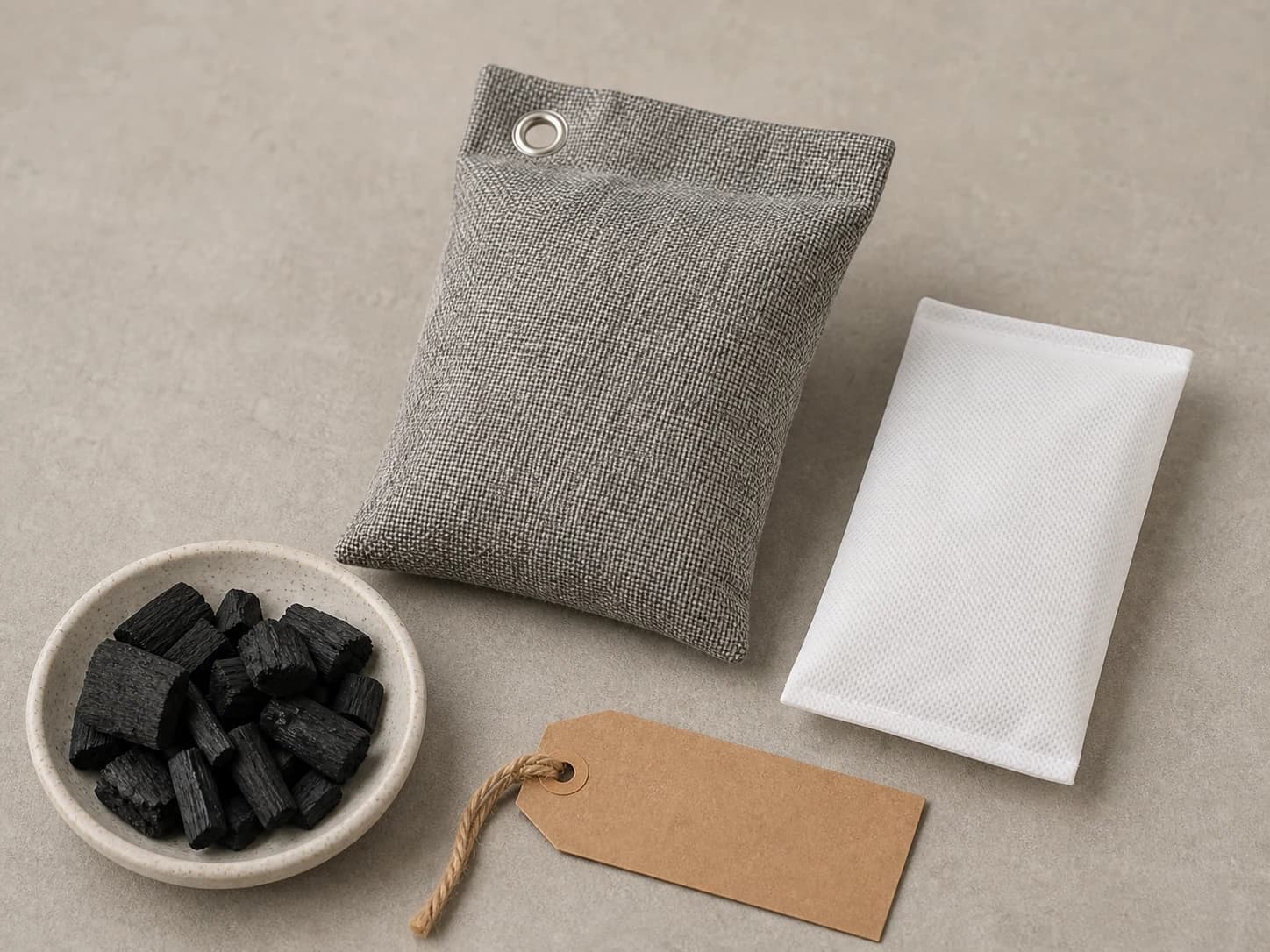
The shortest material brief I receive is sometimes one word: "charcoal." That is where my questions begin. Before a sample can mean anything, I need to know whether the word describes the feedstock, an activation process, a fuel product, a particle specification or only the front label. This guide shows consumers and private-label buyers how to make the same distinction.
Can charcoal briquettes absorb odors?
Charcoal briquettes may expose some carbon surface, but they are fuel products and should not be treated as a household deodorizer specification. Their ingredients, binders, ignition aids, ash behavior and intended use can differ from a contained odor-control medium.
The practical issue is not whether one briquette can interact with one odor molecule. The issue is whether the product was made, documented and packaged for passive use beside clothing, household goods or other stored contents. A bag sold for grilling answers a cooking-fuel brief. It does not automatically answer questions about dust, additives, contact surfaces, customer handling or odor-claim evidence.
Instant-light briquettes are an especially poor shortcut because easy ignition is part of their design. Even plain briquettes can crumble and leave residue on shelves. Do not place them loose in a wardrobe, drawer, refrigerator or vehicle. Never burn charcoal indoors to address an odor. The CPSC charcoal warning explains that indoor charcoal burning can produce deadly carbon monoxide.
Lump charcoal is not a finished deodorizer either. A bag marked "natural lump charcoal" may contain fewer formulated ingredients than a briquette, but that label still does not define particle dust, source consistency, prior contamination, containment or suitability for the intended household placement. The safe purchasing decision rests on the finished product and its documented use, not on color or appearance.
How are bamboo charcoal, activated carbon and fuel charcoal different?
Bamboo charcoal describes carbonized bamboo feedstock, activated carbon describes carbon processed to develop adsorption properties, and fuel charcoal is made and sold primarily for combustion. These categories can overlap in feedstock, but the names do not establish the same processing, performance or finished-product controls.
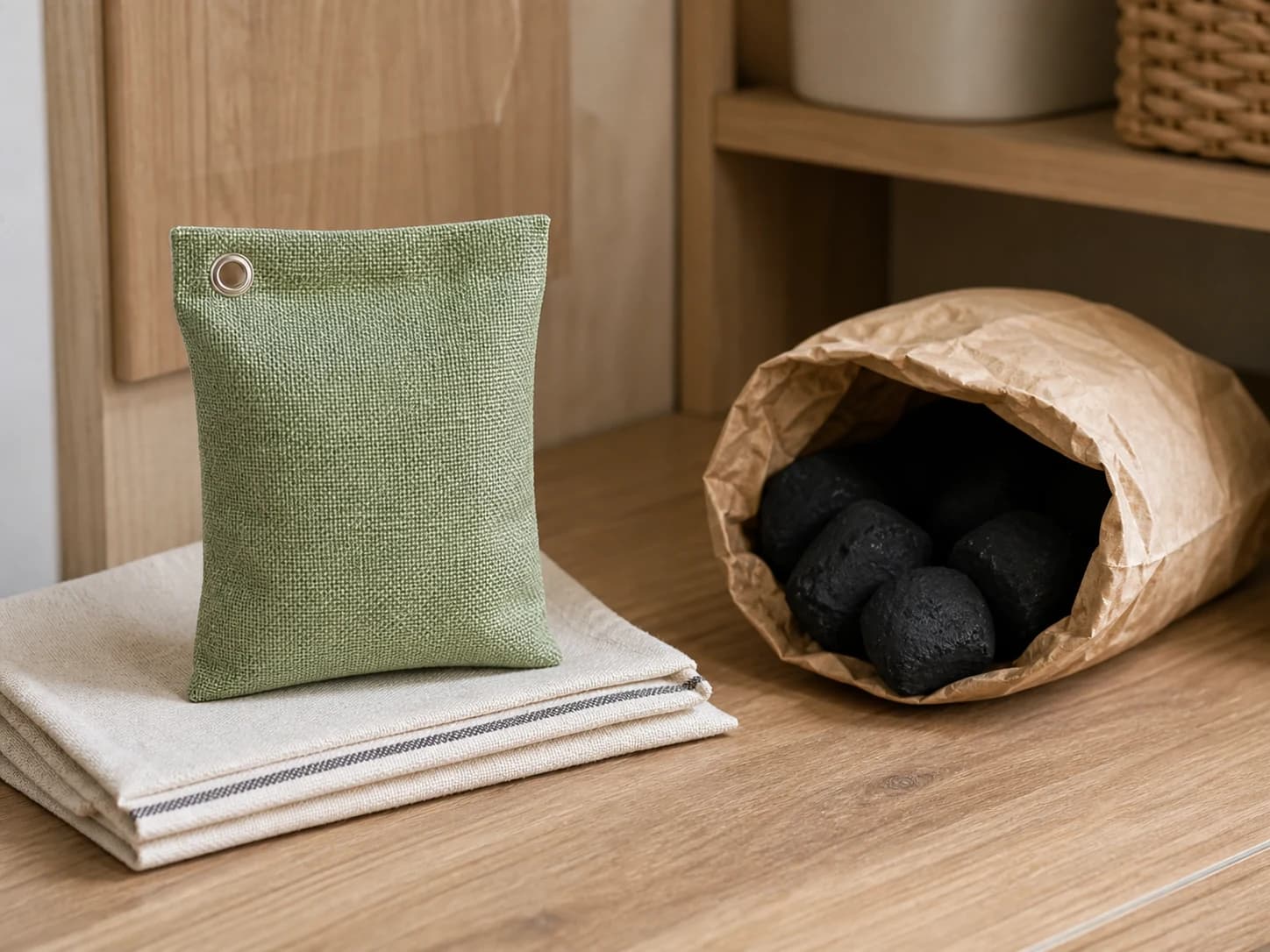
Adsorption occurs at a surface. The IUPAC definition of adsorption describes an increase in concentration at an interface due to surface forces. In ordinary language, certain gas or vapor molecules are held at available surfaces within a porous material. That is different from absorption into the bulk of a sponge, and it is different again from destroying every odor-causing substance.
The comparison below is a category check, not a ranking. A well-defined material can be evaluated for a stated job. A vague material name cannot.
| Material category | What the name tells you | What it does not tell you | Responsible household decision |
|---|---|---|---|
| Bamboo charcoal | Bamboo was the carbon feedstock | Activation status, pore distribution, dust, net fill or odor capacity | Use only in a purpose-designed, intact pouch with approved instructions |
| Activated carbon | An activation step is claimed or documented | Feedstock, activation method, target compounds, quantity or finished format | Request the material specification and evidence for the actual application |
| Lump fuel charcoal | The product is a carbonized fuel, often sold for grilling | Household cleanliness, consistency, dust control or deodorizer suitability | Keep it for its labeled fuel use rather than placing it loose indoors |
| Charcoal briquettes | Pieces are formed as a cooking or heating fuel | Binder system, ignition aids, residue and indoor placement suitability | Do not substitute them for a household odor pouch |
| Instant-light charcoal | The fuel is designed to light more readily | Suitability near fabrics, food storage or enclosed household contents | Do not use it as an odor absorber and never burn it indoors |
Two labels deserve special care. First, bamboo charcoal is not automatically activated carbon. If activation matters to the claim or quotation, the supplier file should identify it. Second, activated carbon is not one universal grade. Feedstock, processing and pore structure vary, and different gases do not behave identically at the carbon surface.
This is why changing "bamboo charcoal" to "activated bamboo carbon" on artwork is not a harmless copy edit. The revised name can imply a processing claim that the purchase file does not support.
Does activated carbon remove every household odor better?
No. Activated carbon can be useful for some gases and odors, but no carbon medium removes every compound under every household condition. Performance depends on the target compound, carbon quantity, available surface, air contact, humidity, temperature and how much the material has already adsorbed.
The EPA home air-cleaner guide notes that gas-phase filters use sorbents such as activated carbon and that these filters are usually intended for one or a limited group of gaseous pollutants. The same guide says no air cleaner or filter removes all pollutants in a home. That limitation matters even more for a passive pouch, which has no fan forcing room air through a carbon bed.
More activation language on a package does not answer four basic questions:
- Which odor or gas was the finished product evaluated against?
- How much carbon does the consumer receive per pouch and per retail pack?
- How does air reach the material through the liner and outer cover?
- What observation or test defines the end of useful service?
The Canadian Conservation Institute's guidance on pollutant sorbents makes the same principle visible in a controlled setting. Sorbent quantity, type, surface exposure, enclosure conditions and pollutant source all affect performance, and exhausted material needs replacement or controlled regeneration. A household wardrobe is not a museum display case, so its numerical examples should not be copied onto retail packaging. The decision variables are still useful.
Which odor situations suit a passive charcoal pouch?
A passive bamboo charcoal pouch is best considered for residual odor care in a clean, dry, limited air zone. It is not the first response to a spill, active mold, sewage, combustion gas, a dead pest or another continuing source.
Before adding any odor product, ask what is still producing the smell. Remove spoiled material, clean residue, dry damp contents and correct leaks or unsafe appliance conditions. A pouch can then sit in the remaining air zone with its breathable faces exposed. The bamboo charcoal effectiveness guide explains why source strength, airflow and contact time change the result.
| Situation | First action | Possible role for a finished charcoal pouch | Stop or escalate when |
|---|---|---|---|
| Closed wardrobe smells stale after clean clothes are stored | Air the space and inspect textiles, shoes and the back wall | Support residual odor care on an open shelf or rail | Dampness, visible growth or a leak remains |
| Storage bin has a light packaging or textile odor | Remove affected contents, clean if appropriate and dry fully | Trial a contained pouch without burying it under contents | Odor points to contamination, pests or wet materials |
| Entry cabinet holds dry everyday footwear | Clean and dry the shoes, then improve cabinet ventilation | Add a pouch as secondary odor support | Shoes remain wet or need material-specific cleaning |
| Strong chemical, smoke or fuel odor enters a room | Identify the source and follow appropriate safety guidance | Do not rely on a passive pouch as the safety control | Symptoms, combustion, a spill or an unknown source is present |
| Musty odor returns after every rainy period | Check humidity, condensation and hidden surfaces | Use only after the moisture cause is corrected | Visible mold, wet building material or recurring water entry appears |
Room-size claims are often misleading in this product category. A pouch placed in a drawer has a different air-contact path from the same pouch in an open bedroom. Start with the actual enclosure and placement rather than assuming that one gram value maps neatly to a floor area.
For consumers, that means judging one defined space at a time. For buyers, it means building instructions around recognizable uses such as a wardrobe shelf, cabinet or storage box instead of printing a universal "covers the whole home" promise.
Why does pouch construction matter as much as the charcoal?
The charcoal cannot contact surrounding air effectively if the finished pouch is sealed behind the wrong barrier, but an overly open or weak construction can release dust. A useful product balances air access, particle containment, seam integrity and normal handling.
A typical finished bag combines charcoal fill, an inner containment layer, breathable outer fabric, stitching, a closure or hanging feature, and retail packaging. The charcoal bag construction guide explains those layers in detail. Each layer changes the commercial product that the customer actually touches.
This is where loose briquettes and a finished pouch separate most clearly. The pouch gives the brand a controlled unit that can be weighed, inspected, labeled and placed. It also creates new responsibilities: the liner must contain the selected particle presentation, the seam must survive normal handling, the loop or eyelet must suit the intended placement, and the retail pack must explain which layer to remove before use.
In sample review, I set the front artwork aside for a moment. I check the back seam, corners, liner closure and dust marks on a clean contrasting surface. A strong material story cannot rescue a pouch that leaks, and a neat pouch cannot prove an undefined charcoal grade. Both have to pass the same brief.
What should a private-label buyer verify before approving a charcoal pouch?
Private-label buyers should verify the material identity, net fill, particle presentation, containment, breathable construction, intended placement, claim scope and bulk acceptance criteria as one connected specification. A supplier price cannot be compared fairly until those fields match.
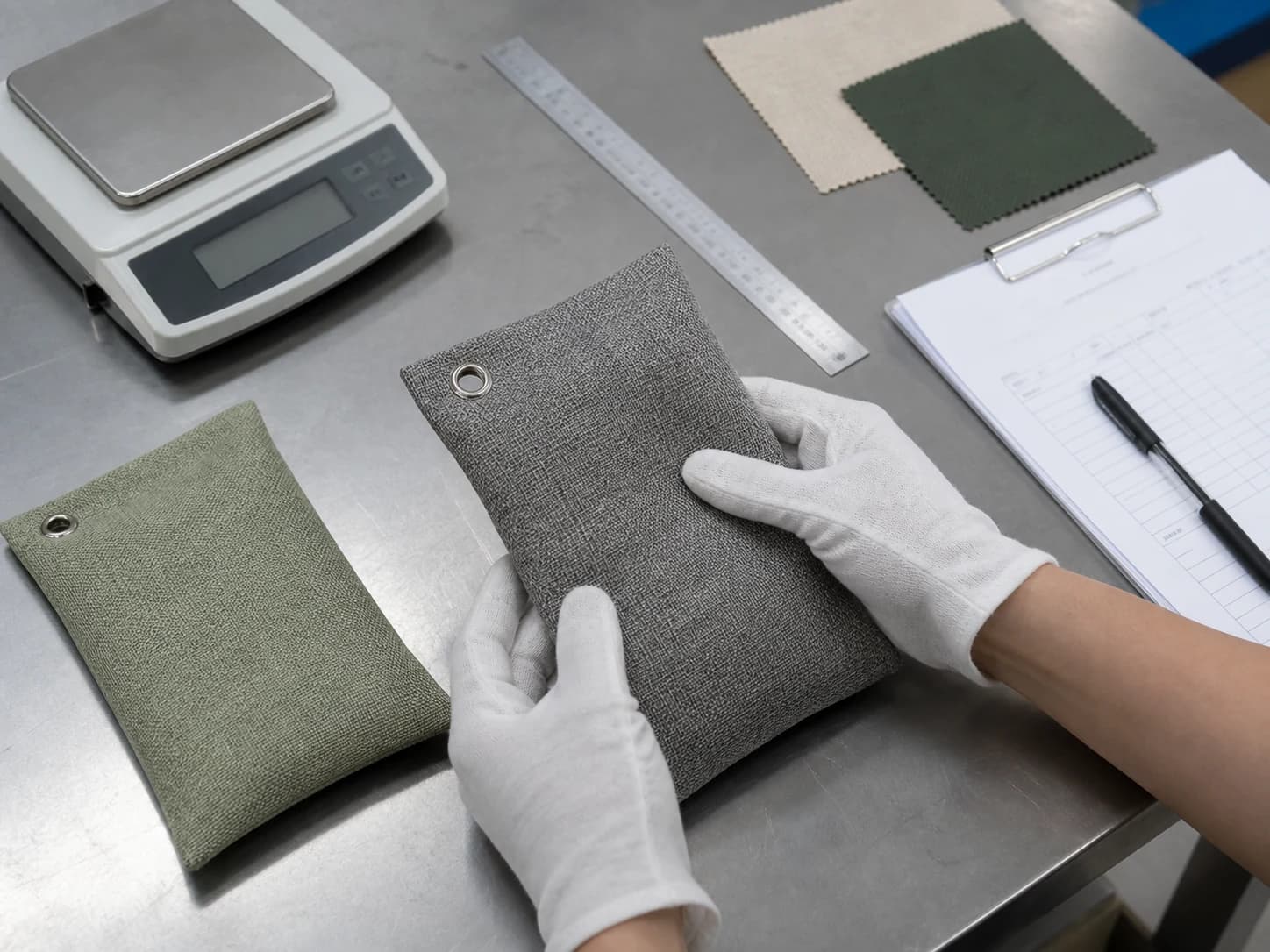
Begin with the commercial unit. Is the quotation for one pouch, one pair, a multipack or a display carton? Then lock the net fill per pouch and the finished dimensions. The size and fill-weight guide shows why a larger outer bag does not automatically contain more charcoal and why nominal weight needs its own check.
Next, request records that answer the material claim. "Bamboo charcoal" should connect to the declared feedstock and processing description. "Activated carbon" should connect to documented activation and the supplied grade. Neither term should be approved from a sales message alone.
The finished-sample review should cover:
- charcoal identity and the exact wording permitted on the artwork;
- nominal net fill, agreed tolerance and a documented check method;
- particle form or size presentation and an agreed dust acceptance rule;
- inner liner material, basis weight, closure and compatibility with the fill;
- outer textile composition, breathability, color and print version;
- seam, loop, eyelet, button or other attachment details;
- unit pack, pack count, batch traceability and customer instructions;
- destination-market evidence for objective safety, performance or environmental claims.
The EPA technical summary identifies airflow, contaminant concentration, other gases, available sorbent surface and humidity among the variables that affect carbon adsorption. A passive household pouch is not an HVAC filter, but the source helps buyers see why a material name cannot replace a finished-product trial in the intended enclosure.
For a representative trial, record the enclosure, source condition, placement, pouch quantity, sample version, start time and observation method. Compare the finished sample with a control under the same conditions. A simple odor panel can guide product development, but it should not be presented as instrumental proof of a broad chemical-removal claim.
How can buyers diagnose specification ambiguity before quotation?
Translate every broad charcoal phrase into a material field, a finished-product field and an evidence request. If the supplier or brand cannot agree on what the phrase means, the quotation and artwork are not ready for approval.
This diagnosis prevents a common sequence: the buyer approves a price for "charcoal bags," the sample uses one fill presentation, the artwork later says "activated bamboo carbon," and bulk production is judged against expectations that never entered the purchase specification.
| Ambiguous phrase | What may be missing | Better specification question | Evidence or approval record |
|---|---|---|---|
| "Activated charcoal" | Activation status, grade, feedstock and target use | Which supplied material is activated, by what documented process, and what name appears on the purchase order? | Material specification and lot-linked supplier record |
| "100% bamboo charcoal" | Scope of 100%, particle presentation and non-charcoal pouch components | Does 100% refer only to the fill feedstock, and how are liner, fabric, thread and hardware declared? | Component bill and approved artwork wording |
| "Natural odor remover" | Meaning of natural, target odor and test boundary | Which material attribute and finished-product benefit are being claimed? | Claim rationale and market review |
| "Chemical-free" | Undefined and scientifically misleading scope | Which restricted substances or intentionally added ingredients are actually in question? | Named requirement, applicable test scope and pass criteria |
| "Works in any room" | Enclosure size, source strength, airflow, quantity and duration | Which placement and observation conditions support the statement? | Representative finished-product trial record |
| "Reusable" | Care step, cycle count, performance threshold and retirement rule | What does the instruction ask the user to do, and what evidence supports repeat use? | Approved care instruction and cycle record |
Broad environmental wording deserves the same discipline. The FTC Green Guides summary advises marketers not to make broad, unqualified environmental benefit claims and says objective claims need appropriate support. A bamboo feedstock may be relevant to material positioning, but it does not turn every component, process and disposal outcome into one universal "eco-friendly" conclusion.
The point is not to fill the carton with legal text. It is to make each claim narrow enough that the consumer understands it and the buyer can trace it to the approved SKU.
How should a buyer choose between bamboo charcoal and activated carbon?
Choose the material by the intended product format, target odor, evidence available, claim language and representative finished-product result. Do not choose from a generic hierarchy in which the word activated always wins.
For a breathable household pouch positioned around bamboo feedstock, low-complexity passive use and custom textile presentation, a documented bamboo charcoal program may fit the brief. If a buyer needs a defined activated-carbon grade for a specific gas-phase application, that is a different material and evidence discussion. It may also require different containment, dosage, testing and artwork.
Ask suppliers to quote the same brief before comparing cost. If one quotation uses ordinary bamboo charcoal, another uses a documented activated grade and a third does not identify the fill, the prices do not describe equivalent products. The cheapest line may simply leave the most decisions unresolved.
My practical decision rule is to approve the narrowest claim that the supplied material and finished sample can support. That usually produces clearer artwork and fewer surprises than choosing a bold claim first and trying to build evidence around it later.
Conclusion: which charcoal belongs in an odor-control product?
A purpose-designed, contained charcoal product belongs in household odor care. Leftover grilling charcoal, instant-light fuel and unknown loose carbon do not become suitable deodorizer products simply because some carbon surfaces can adsorb molecules.
Consumers should clean and dry the odor source first, follow the finished product's instructions and keep fuel charcoal for its labeled outdoor use. Buyers should define the charcoal, liner, outer fabric, seam, net fill, placement, care and claim evidence before approving a sample or comparing quotations.
Explore the bamboo charcoal air-purifying bag range to compare current pouch formats made for household placement. For a project review, send the target enclosure, material wording, pouch size, net fill, packaging, destination market and claims. Those details are enough to begin a useful sample discussion.
Compare the material and finished pouch together
Send your intended placement, charcoal wording, pouch format, net fill, pack count and market. We will help turn the request into a sample brief with reviewable material and construction fields.