

A bamboo charcoal bag can sit quietly in a closet or storage box for months, which makes it easy to forget until the space smells different again. Then the date on the calendar seems important, but it still does not tell you whether the pouch is exhausted, poorly placed, damp, contaminated or simply beside a new odor source.
There is no dependable universal lifespan for every bamboo charcoal bag. Its useful service period changes with the charcoal, net fill, pouch construction, air exposure, humidity, source strength and care history. A printed promise such as “lasts two years” is not a substitute for checking the actual finished product under its intended conditions.

When I review a private-label care brief, I look for the decision behind the date. What should the customer inspect, what does the approved sun-drying step actually do, and what makes the pouch ready to return or ready to replace? Those questions produce better instructions than copying a lifespan from another bag.
Quick lifespan decision
- Check whether the odor source has been removed.
- Inspect the pouch, seams and charcoal condition.
- Follow only the care method approved for that finished product.
- Replace the bag when odor control does not improve after proper source, placement and care checks.
How long do bamboo charcoal bags actually last?
A bamboo charcoal bag lasts only as long as the finished pouch remains intact and its charcoal provides useful odor support in the intended setting; no single number applies to every product or home. A mild, dry storage enclosure with an occasional odor load is different from a crowded shoe cabinet, a humid utility cupboard or a room with an active source.
Adsorption is a surface process. Certain molecules in the surrounding air can adhere to accessible surfaces within a porous carbon material. As those sites become occupied, the available capacity changes. The result also depends on whether enclosure air reaches the pouch. A bag hidden beneath folded textiles may appear to have “stopped working” even when placement, rather than age, is the main problem.
The material name matters too. Ordinary bamboo charcoal should not be treated as interchangeable with a documented activated-carbon grade. Activated carbon is manufactured and characterized for particular adsorption applications, while a consumer bamboo charcoal pouch can differ in feedstock, carbonization, particle size, dust content, liner, fill and breathable area. A lifespan borrowed from an activated-carbon filter or museum sorbent does not establish the lifespan of a storage pouch.
The Canadian Conservation Institute notes that pollutant sorbents become exhausted and require replacement or regeneration according to the source emission rate and outside infiltration. Its guidance on pollutant sorbents concerns controlled museum enclosures and specified activated charcoal, not BamveraEco household pouches. The transferable principle is limited but useful: service life follows the material, pollutant load and use environment, not a calendar alone.
| Factor | Why it changes the service period | What a customer can check | What a buyer should define |
|---|---|---|---|
| Odor source | A continuing source releases new compounds faster than residual odor | Whether the source was cleaned, dried or removed | Intended source-controlled use and exclusions |
| Air exposure | Covered surfaces receive less enclosure air | Whether both pouch faces remain open | Placement diagram and minimum clearance |
| Humidity and water | Moisture can compete for pore space and damage a finished pouch | Dampness, condensation or direct wetting | Dry-use boundary and care warning |
| Net fill and construction | Material quantity, liner and geometry affect the finished format | Product code and physical condition | Net fill, dimensions, liner, fabric and tolerances |
| Care history | Unrecorded care makes age difficult to interpret | First-use and care dates | Approved interval as a check, not an automatic reset |
| Contamination | Oil, cleaners, spills and soil can make a pouch unsuitable | Staining, odor transfer or surface damage | Replace-after-contamination instruction |
A useful consumer answer is therefore conditional: inspect the source, placement and pouch at regular intervals, follow the exact product instructions, and replace the unit when it is damaged, contaminated or no longer gives a repeatable benefit after those checks. A useful buyer answer goes one step further by defining how those decisions were validated on the finished sample.
Do bamboo charcoal bags need to be activated before first use?
Do not assume a new bamboo charcoal bag needs sunlight, heating or another “activation” step unless the approved instructions for that exact finished product require it. Open the retail barrier packaging at the point of use, inspect the pouch, and place it dry and exposed according to its directions.
The word “activate” causes avoidable confusion. In carbon manufacturing, activation can describe a controlled process that develops pore structure. In consumer copy, the same word is sometimes used casually for opening a package, airing a pouch or putting it in sunlight. Those are not equivalent operations.
If the pouch arrived in sealed protective packaging, the practical first step is normally to remove that outer packaging and inspect for transit damage. Do not cut the inner pouch, wash it, microwave it or put it in an oven unless the product-specific instructions explicitly approve that method. Fabrics, liners, eyelets, cords, inks and adhesives can have different temperature limits from the charcoal itself.
For a private-label program, replace “activate before use” with an observable instruction. For example: remove the pouch from its individual protective bag, keep it dry, and place it with both breathable faces uncovered. If a pre-use sunlight step is part of the approved product, state its purpose, position, duration range and weather limitations using evidence from the finished sample.
What can sun-drying do, and what can it not prove?
Sun-drying may be a practical care step for an approved finished pouch, especially for removing incidental moisture from its outer materials, but sunlight alone does not prove complete regeneration or restoration of original adsorption capacity. The instruction must stay within what the bag and its cycle record actually support.

Drying, desorption, regeneration and reactivation are different ideas. Drying removes water. Desorption releases a previously adsorbed substance. Regeneration aims to recover useful adsorption performance. Reactivation can involve much more demanding controlled treatment of spent carbon. A consumer instruction should not collapse all four into the phrase “recharge in the sun.”
The CCI source above describes a controlled heating condition for a particular activated charcoal used in heat-resistant conservation pouches. That procedure cannot be copied to an ordinary bamboo-charcoal consumer bag. It does, however, show why a sunny windowsill is not the same as a specified regeneration process: the bag temperature, exposure time, contaminants and construction are not controlled in the same way.
Sun exposure also creates practical questions. Is the pouch indoors behind glass or outside? Is the weather dry? Are both faces exposed? Can rain, dust, insects or outdoor odors reach it? Could prolonged light fade the fabric or printed logo? Will a dark surface become too hot for the liner, trim or adhesive? The approved instruction needs to answer the conditions that materially affect safe use.
| Care phrase | What it can reasonably mean | What it does not establish by itself | Evidence to approve before printing |
|---|---|---|---|
| “Air in a dry place” | Let the finished pouch and fabric return to a dry condition | Restored odor capacity | Drying observation and construction check |
| “Place in sunlight” | Expose the pouch under stated dry conditions | Complete desorption of all compounds | Finished-pouch cycle with position and duration recorded |
| “Recharge” | A consumer-friendly care claim only if defined | A technical activation process | Definition of the claimed benefit and repeat-cycle evidence |
| “Reusable” | The same unit can be used again under stated conditions | Unlimited life or unchanged performance | Repeated-use protocol and retirement rule |
| “Lasts for years” | A quantified durability or service-life claim | Suitability in every environment | Defined endpoint, sample population and substantiation |
This is why responsible care copy says what the customer should do rather than promising what the sun will accomplish inside every pore. If the program has not measured recovery, use language such as “follow the approved periodic care step” rather than “fully restores adsorption.”
How should you care for a bamboo charcoal bag between uses?
Keep the pouch dry, exposed to clean air during use, away from spills and chemicals, and inspect it on a repeatable schedule before following its approved airing or sun-drying instruction. Care should preserve the finished pouch and generate a useful decision, not create a ritual that hides a continuing odor source.
Start with the space. Remove damp textiles, food residue, dirty footwear or leaking containers before caring for the pouch. The US EPA's mold and moisture guidance emphasizes moisture control because mold cannot be solved by an air-cleaning accessory. If a closet or bin is wet, moving the charcoal bag into sunlight does not correct that condition.
Next, inspect the bag without opening it. Look at seams, eyelet, cord, liner containment and the outer surface. Gently handle it over a clean surface and check for visible dust leakage. If it has absorbed a spill, smells of a chemical cleaner, shows growth or has a torn liner, replacement is usually safer than trying to rescue it with sunlight.
Then follow the exact care method for that product. Use the stated position and duration, keep it away from rain and contamination, and do not improvise with an oven, microwave or other heating appliance. Let the pouch return to room conditions before it goes back beside textiles or inside a closed container.
Finally, return it to the same documented placement and observe the same enclosure under normal use. The companion guide on using bamboo charcoal bags in storage explains why separate drawers, shelves and boxes need separate air-path decisions.
| Care step | Action | Record or observe | Stop condition |
|---|---|---|---|
| 1. Source check | Inspect the enclosure and contents | New spill, dampness, dirty item or stronger odor | Correct the source before product care |
| 2. Pouch check | Inspect fabric, seam, liner and hardware | Tears, leakage, staining, wetness or contamination | Remove the pouch from service |
| 3. Approved care | Follow the finished-product instruction | Date, weather or indoor condition, position and duration | Stop if the pouch becomes wet, overheated or damaged |
| 4. Return | Restore the approved exposed placement | Same enclosure and normal loading | Reposition if both faces are covered |
| 5. Compare | Recheck after a consistent period | Directional odor change and product condition | Replace or investigate if no repeatable benefit appears |
For household use, this record can be as simple as a date on the package. For a brand approval, it should include the sample code, environment, starting condition, care action, post-care condition and decision. That distinction keeps a user instruction short while preserving the evidence behind it.
Reviewing pouch formats and care-copy space?
When should you replace a bamboo charcoal odor absorber?
Replace the pouch when it is torn, leaking, wet beyond its approved care scope, contaminated, structurally degraded, or no longer provides a repeatable benefit after source and placement checks. Do not wait for a severe odor if the physical pouch has already failed.
Replacement is sometimes a safety and cleanliness decision before it is an adsorption decision. A damaged eyelet can cause the bag to fall. A split inner liner can release dust. Oil, fragrance concentrate, cleaning chemicals or unknown spills can make continued handling inappropriate. A care claim should never encourage the customer to keep using a compromised unit just to reach a printed year count.
Performance is harder to judge because the nose is not a calibrated instrument. People adapt to smells, different compounds have different odor thresholds, and a new source can appear. Use a short diagnostic sequence: remove or correct the source, clean and dry the enclosure, expose the pouch properly, follow the approved care step, then compare under the same normal conditions. If the result remains poor, replacement becomes a reasonable next action.
| What you observe | Likely interpretation | Next check | Practical decision |
|---|---|---|---|
| Odor changed after a damp garment was added | New source, not proven pouch exhaustion | Remove, clean and dry the garment | Keep the pouch only if it remains clean and dry |
| Pouch is buried under stored items | Air path is blocked | Restore exposed placement | Recheck before replacing |
| Outer fabric is stained by an unknown liquid | Contamination risk | Do not rely on sun-drying | Remove from service |
| Charcoal dust appears outside the pouch | Liner or seam failure | Inspect over a clean surface | Replace and investigate construction |
| Eyelet, cord or seam is failing | Mechanical end of life | Check hanging load and handling | Replace regardless of odor result |
| No repeatable benefit after source, placement and approved care checks | Capacity or product-use mismatch is possible | Compare a fresh approved unit in the same setup | Replace or revise the format and instruction |
| Mustiness returns with condensation or visible growth | Moisture problem outside product scope | Investigate water and ventilation | Correct the environment, not the calendar |
For closets, the closet charcoal bag range shows hanging and shelf formats that make physical inspection easier than a pouch hidden behind garments. The product format should support the intended care routine, not work against it.
Why does the same bag seem to last longer in one place than another?
The same bag can appear to last longer in one enclosure because the odor load, humidity, temperature, opening pattern, air path and contamination risk are different. Service history should be attached to the use condition rather than transferred from one space to another.
A seasonal clothing bin may remain closed for months with clean, dry textiles and a mild residual smell. A shoe cabinet receives repeated fresh odor and moisture loads. A utility cupboard may contain chemicals that make a consumer charcoal pouch inappropriate. A bathroom cabinet can experience humidity cycles that are absent from a bedroom drawer.
The US EPA's guide to home air cleaners discusses powered gas-phase filters, not passive bamboo charcoal bags. It still reinforces a useful boundary: gas removal depends on the amount and type of sorbent, airflow, and replacement before the material becomes overloaded. A small passive pouch has no fan and cannot inherit a powered filter's performance rating.
Brands should therefore resist one care schedule for every SKU. A closet hanging pouch, compact drawer unit and shoe deodorizer may share a charcoal family but differ in net fill, construction, exposure and source. The better instruction names the intended application and gives inspection triggers that remain useful when the environment varies.
How should buyers validate a reusable or lifespan claim?
Validate the claim on the exact finished pouch through repeated representative use and care cycles, with a defined endpoint, control or comparison, inspection criteria and retained records. A raw-charcoal certificate or a supplier's general statement cannot prove how the complete retail unit behaves.
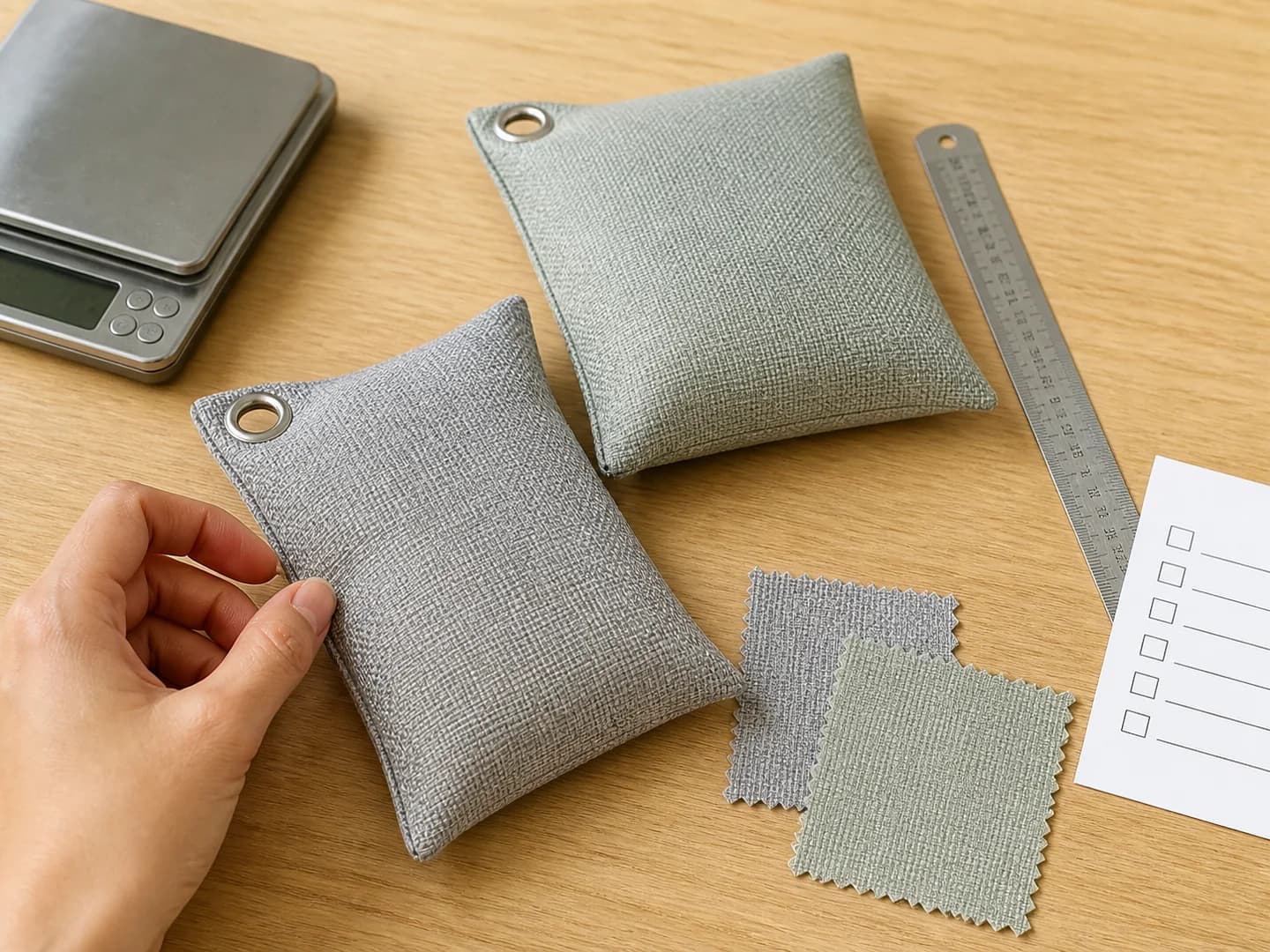
Begin with claim interpretation. “Reusable” may tell a consumer that the same bag can go back into service after care. “Rechargeable” may imply restored capacity. “Lasts 24 months” implies a measured time. “Use for up to two years” still needs conditions and a basis. Write down the reasonable interpretations before choosing a test.
Next, test the finished construction. Use production-intent fabric, liner, fill, seams, eyelet or cord, printing and packaging. Cycle it in a representative enclosure with a defined source and placement. Record the care step exactly. Inspect both odor-support performance and physical durability after each cycle. If the claim spans several climates or applications, one dry office sample is not enough.
The FTC Green Guides focus on environmental marketing claims and do not create a test method for charcoal bags. Their general lesson is relevant: marketers should understand how consumers may interpret a claim and possess substantiation for express and implied meanings. Calling a pouch reusable or eco-friendly can imply more than the writer intended.
For weight declarations, the NIST net-contents handbook is a US compliance reference rather than a global charcoal specification. It illustrates why “200 g” needs a declared basis and a checking procedure. The care-cycle record should identify the same approved product whose net fill and construction are controlled in production.
| Validation field | Minimum decision to define | Why it matters | Approval evidence |
|---|---|---|---|
| Finished sample | Product code, net fill, materials and construction | Prevents raw material data from standing in for the retail unit | Signed golden sample and specification |
| Intended enclosure | Dimensions, contents, loading and opening pattern | Establishes the use condition | Photos and enclosure record |
| Odor challenge | Source, baseline and safe handling | Keeps cycles comparable | Written protocol and baseline notes |
| Care cycle | Position, duration, condition and interval | Defines what “sun-dry” or “air” means | Cycle log and photographs |
| Endpoint | Physical failure, loss of repeatable benefit or time limit | Makes “lasts” measurable | Predefined pass, review and retire rules |
| Sample count | Number of units and production lots | Avoids approval based on one favorable pouch | Sample register and lot IDs |
| Claim wording | Exact front, back and online language | Captures implied as well as explicit meaning | Approved artwork proof |
| Market review | Destination rules and language | A claim suitable in one market may need qualification in another | Regulatory and native-language review |
In sample work, I find the most revealing record is not a dramatic before-and-after photograph. It is the cycle where the pouch still looks acceptable but the seam, print or result begins to vary between units. That is where a defined retirement rule protects both the customer and the brand.
How should buyers diagnose lifespan and care specification ambiguity?
Mark every lifecycle phrase that two reasonable people could interpret differently, then replace it with a defined field, finished-sample instruction or acceptance check. This specification ambiguity diagnosis prevents a care slogan from becoming an untestable manufacturing requirement.
Read the brief as if the salesperson, factory merchandiser, inspector and customer cannot ask the writer what was intended. “Reusable,” “sun-dry monthly,” “works for two years,” “200 g bag” and “natural charcoal” all leave material decisions unresolved. The goal is not to add more adjectives. It is to make the product and the claim refer to the same evidence.
| Ambiguous phrase | Missing question | Field to add | Evidence before approval |
|---|---|---|---|
| “Reusable” | Reused after which care step, for what retained benefit? | Cycle method, endpoint and retirement rule | Finished-pouch repeat-cycle record |
| “Recharge in sunlight” | Indoors or outdoors, which side, how long and under what weather? | Position, duration range, dry condition and warnings | Approved instruction trial |
| “Lasts two years” | In which enclosure, with what source and endpoint? | Intended use, claim period and pass criterion | Substantiation covering the reasonable claim meaning |
| “Use every month” | Is the interval mandatory or an inspection reminder? | Trigger, interval and action | Care log linked to the sample |
| “200 g bag” | Net charcoal fill or total finished weight? | Net fill basis, unit and tolerance | Weight-control record |
| “Bamboo activated charcoal” | Is activation documented for the supplied grade? | Material identity and relevant specification | Supplier documentation and test basis |
| “Absorbs moisture” | Is the product being sold as a desiccant? | Odor-care boundary and excluded moisture claims | Finished-product moisture evidence if claimed |
| “Eco-friendly and reusable” | Which specific environmental benefit is supported? | Qualified attribute and market wording | Claim review and supporting records |
This diagnosis should end with a compact approval pack: product code, intended enclosure, net fill, finished dimensions, outer fabric, liner, seams, hardware, material identity, first-use instruction, care method, inspection triggers, replacement rule, claim wording, pack count and test record. The guide on how bamboo charcoal bags work helps keep adsorption claims separate from source control and ventilation.
What should the final customer instruction say?
The instruction should explain where the bag belongs, how to keep it exposed and dry, the exact approved care step, what damage or contamination requires replacement, and which problems the product cannot solve. It should be short enough to follow and precise enough not to overpromise.
A practical sequence can be written in plain language:
- Remove the pouch from its protective packaging without cutting the inner bag.
- Use it in the intended clean, dry closet, drawer or storage enclosure.
- Keep both breathable faces uncovered and away from spills, children and pets as required by the product assessment.
- Inspect the space and the pouch at the stated interval.
- Follow only the approved airing or sun-drying step for that product.
- Replace the pouch if it is torn, leaking, wet outside its care scope, contaminated or no longer useful after the stated checks.
- Correct leaks, dampness, mold, spoiled material and strong sources separately.
Do not copy a heating temperature from activated carbon, a regeneration method from silica gel or a lifespan from another supplier's packaging. The customer instruction belongs to the approved finished pouch and the market where it will be sold.
Conclusion: what is the honest answer to bamboo charcoal bag lifespan?
The honest answer is that bamboo charcoal bags do not have one universal lifespan; useful service ends when the finished pouch fails physically, becomes contaminated, or no longer gives a repeatable benefit after source, placement and approved care checks. Sun-drying can be a defined care step, but it should not be presented as proof of complete regeneration unless the finished product has evidence for that claim.
For a household, the reliable routine is simple: keep the space clean and dry, leave the pouch exposed, inspect it periodically, follow its exact care directions and replace it when condition or results justify the decision. For a private-label buyer, turn that routine into a cycle protocol before the words “reusable” or “lasts” reach the package.
Need a care-cycle plan for a private-label pouch?