

A charcoal pouch is easy to forget once it has been placed on a shelf. The safety question usually appears later: a child reaches for the loop, a pet starts chewing the corner, or black dust appears where the bag was stored.
For ordinary household use, an intact bamboo charcoal bag can be a suitable passive odor-care product when it is correctly specified, kept dry, left unopened and placed away from chewing or ingestion. That answer does not make every charcoal pouch, material claim or placement automatically safe.
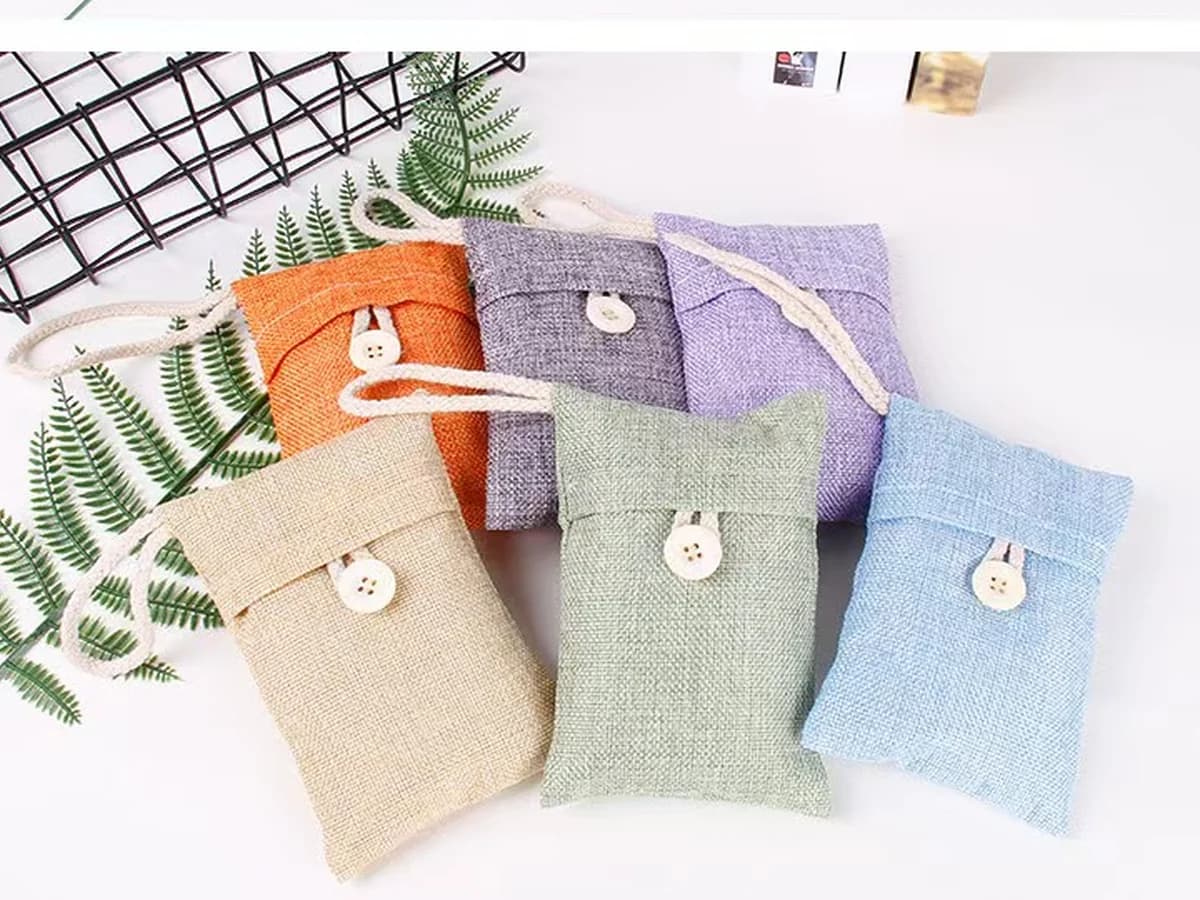
When I review a private-label sample, I do not start with the word "natural" on the artwork. I follow the possible failure path from charcoal identity and dust level through the liner, seam, button or eyelet, placement and customer instruction. This guide applies the same review to household use and bulk approval.
Are bamboo charcoal bags safe for normal household use?
An intact, correctly made bamboo charcoal pouch is generally intended for passive placement in dry household storage, but suitability depends on the finished product, the user and the placement. Keep the pouch closed, follow its instructions and remove it if it tears, leaks, becomes wet or is contaminated.
The product is not simply a pile of charcoal. It is a system made from fill, an inner containment layer, outer fabric, seams, closure or hanging hardware, packaging and instructions. A reasonable safety answer must cover that entire system. A sound charcoal specification cannot compensate for a weak seam, and strong fabric cannot make an unsupported "non-toxic" claim true.
The following decision table separates normal placement from situations that need a different action.
| What you observe | Is this normal-use scope? | Sensible action | Why it matters |
|---|---|---|---|
| Intact dry pouch on an open wardrobe shelf | Yes, if the approved instructions allow it | Leave breathable faces exposed and inspect periodically | This matches passive household placement |
| Pouch still inside sealed retail overpack | No useful air-contact path | Remove only the approved overpack before use | A sealed pack blocks the intended air contact |
| Loose charcoal, black dust trail or open seam | No | Isolate and replace the pouch; clean according to the surface instructions | Containment has failed |
| Pouch soaked by a spill or condensation | No | Remove it and correct the moisture source | Wet conditions can affect materials, handling and odor |
| Child or pet repeatedly handles or chews it | No | Move it out of reach and reassess the placement | Foreseeable misuse changes the risk path |
| Pouch placed against unpackaged food | Not unless that exact use is documented | Move it to a separate, appropriate location | Food-contact suitability cannot be assumed |
A charcoal pouch is also not a powered room purifier. A passive pouch has no fan and should be described within its smaller, placement-dependent role. Material quantity, exposed surface and air movement still affect how much contact occurs around the pouch.
What is actually inside a bamboo charcoal bag?
A finished bamboo charcoal bag normally combines carbonized bamboo charcoal with a particle-containing inner pouch and a breathable outer cover. Buyers should identify every layer and attachment rather than approving the product from an exterior photograph.
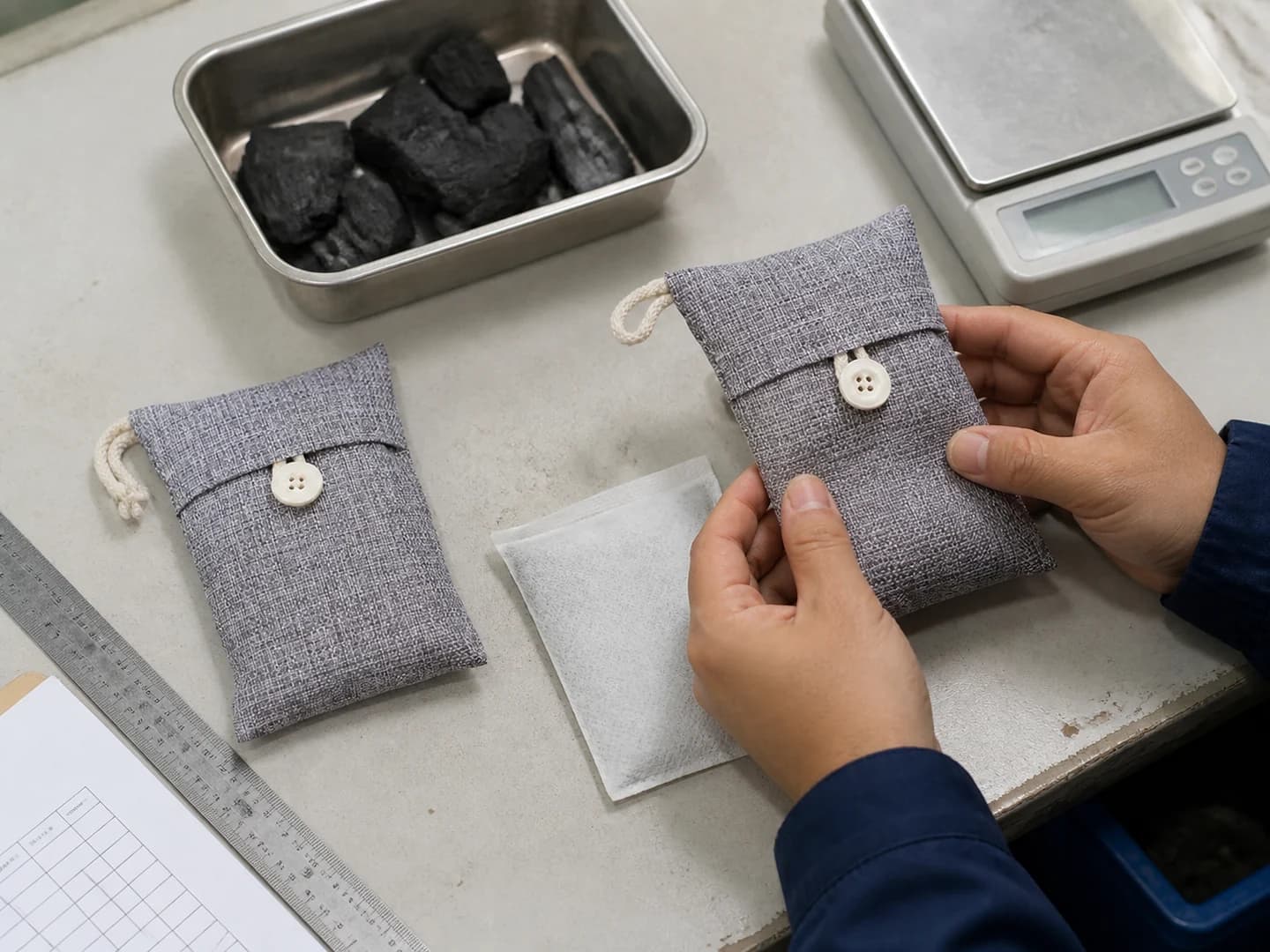
Our reference construction for selected pouch programs uses a white 65 gsm SMS nonwoven inner liner, with the final liner, charcoal, outer fabric and seam locked through the approved sample. That is a starting specification, not a universal safety certificate. Different fabric colors, printing systems, buttons, cords or eyelets can introduce different materials and failure points.
The bamboo charcoal bag construction guide gives a fuller component-by-component explanation. For a safety review, each component needs an identity, a foreseeable failure and evidence that matches the destination market.
| Finished-product component | What must be defined | Possible failure path | Approval evidence |
|---|---|---|---|
| Charcoal fill | Feedstock, processing description, particle presentation and dust acceptance | Misidentified material, excessive fines or contamination | Material record, reference sample and agreed incoming check |
| Inner liner | Material, basis weight, seam and closure | Particles migrate through weak fabric or an open seam | Liner specification and finished-pouch inspection |
| Outer fabric | Fiber composition, colorant, finish, print and breathability | Tear, color transfer, restricted air contact or unsuitable chemistry | Supplier declaration, applicable chemical review and sample |
| Button, cord or eyelet | Material, size, attachment and pull resistance | Detachment, sharp edge or accessible small component | Attachment check and intended-user risk review |
| Finished seam | Stitch type, density, allowance and closure | Split seam or gradual dust leakage | Golden sample and bulk acceptance criteria |
| Retail pack | Barrier, pack count, traceability and warning area | Contamination, missing instruction or untraceable lot | Approved artwork and packing standard |
The distinction between bamboo charcoal and activated carbon matters here too. "Bamboo charcoal" identifies a carbonized bamboo feedstock. "Activated carbon" describes additional activation processing. Unless the supplied fill has documented activation, buyers should not change the material name for marketing convenience.
What can go wrong when a charcoal pouch is damaged?
Once the inner liner or outer construction fails, the product is outside its intended closed-pouch condition. Stop using it, keep loose material away from mouths and food, and follow the brand's approved cleanup and disposal instructions.
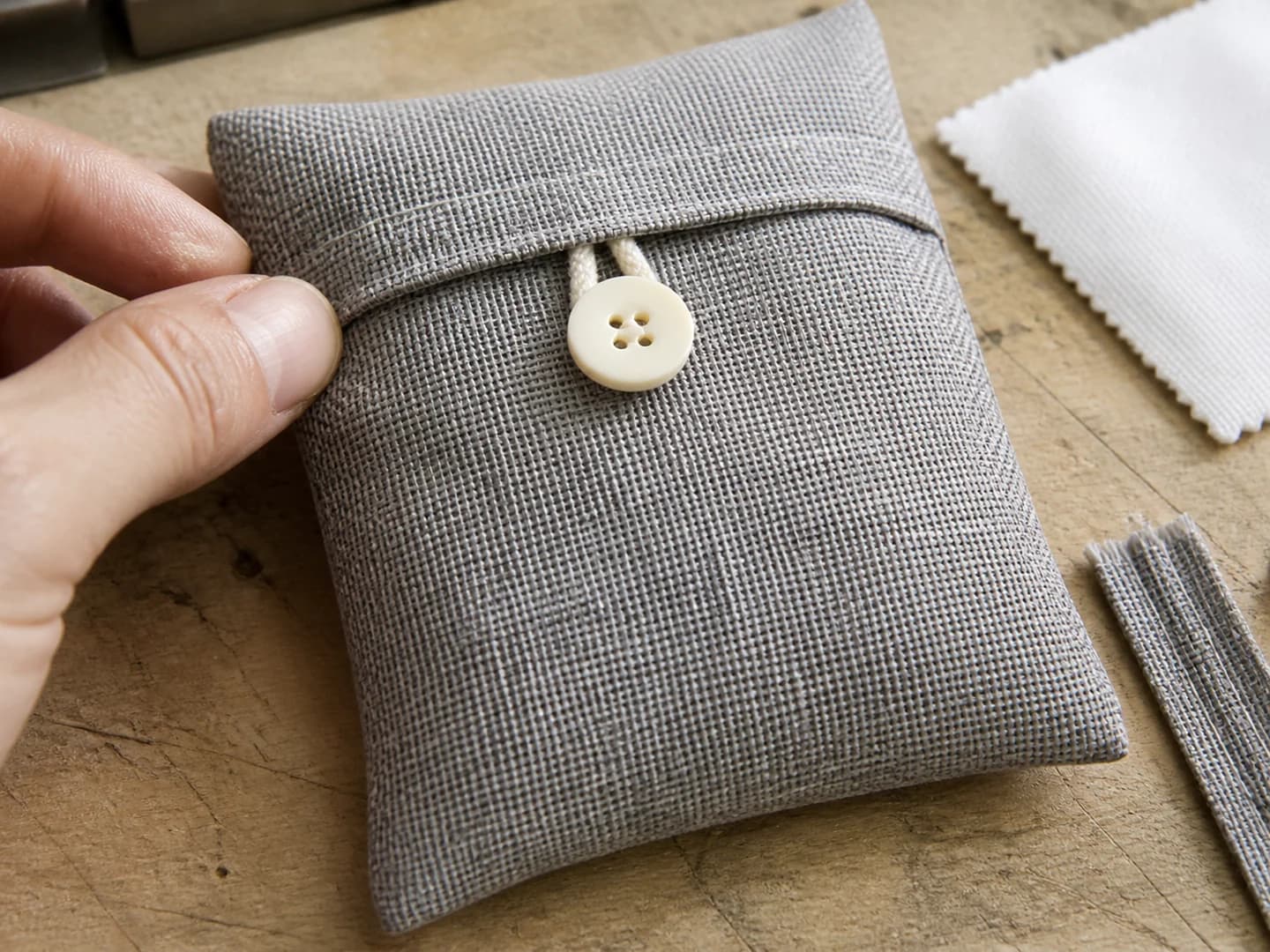
Damage rarely begins as a dramatic burst. It may appear as a dark mark along one seam, an eyelet pulling through the fabric, a loose button, a loop separating from its anchor or fine particles collecting under the pouch. Those details are why bulk inspection needs a defined dust and seam acceptance rule rather than a vague instruction to check "good workmanship."
Do not open a consumer pouch to see whether the charcoal looks genuine. Material identity should be confirmed through the supplier file and controlled reference samples, not by asking customers to handle loose fill. If an intact bag is dirty from ordinary shelf dust, follow the approved surface-care instruction. If liquid, pests, chemicals or biological contamination are involved, retire it rather than improvising a recovery method.
In sample review, I turn the pouch over before I study the front artwork. The back seam, corners, loop anchor and liner closure usually tell me more about foreseeable leakage than the logo area does. I then compare the same points after packing, transport simulation and normal handling because a clean pre-production sample is only the starting condition.
Are bamboo charcoal bags safe around children and pets?
Do not present a household charcoal pouch as a toy, chew item or pet accessory unless it has been specifically designed and assessed for that use. Place it where children and animals cannot pull, mouth, tear or swallow the pouch, its fill or detachable components.
This is a placement rule as much as a materials rule. A loop that is useful on a high wardrobe rail may become a tempting handle at floor level. A compact pouch that fits a drawer may also fit inside a pet's mouth. Household users should move the product when a child or animal shows interest rather than relying on a warning after repeated access.
The CPSC small-parts guidance applies to products intended for children and explains how detachable components can create choking concerns in that category. It does not automatically classify an ordinary household pouch as a children's product. It does show why intended users, foreseeable access and detachable parts must be settled before marketing.
If the pouch is opened or swallowed: Move the remaining product out of reach and keep the packaging. Note whether the exposure involved loose fill, fabric, cord, a button or the whole pouch.
Do not induce vomiting. For a child or adult, follow local poison-centre advice; the Poison Control first-aid guidance explains the initial steps for swallowed substances.
For a pet, contact a veterinarian or animal poison service before giving anything; the ASPCA pet-poison guidance follows the same approach. The next action depends on the finished product and the exposure, not on the word "natural."
For pet-owning homes, "pet-friendly" and "pet-safe" should not be casual label decoration. A finished product may contain charcoal, textile fibers, dyes, printing inks, a liner, thread and hardware. If a pet damages or ingests any part, contact a veterinarian or animal poison service with the packaging and material information instead of assuming that the word bamboo makes ingestion harmless.
Does natural bamboo charcoal mean non-toxic or chemical-free?
No. A plant-derived feedstock does not prove that a complete consumer product is non-toxic, chemical-free or safe for every person, animal, surface and disposal route. Those claims require a defined scope and evidence for the finished product.
The FTC guidance on environmental claims says marketers making a non-toxic claim need competent and reliable scientific evidence that the product is safe for people and the environment. A supplier declaration that the fill is bamboo charcoal does not by itself cover dyes, ink, adhesive, metal hardware, packaging or foreseeable exposure.
"Chemical-free" is also a poor specification. Charcoal, cotton, polyester, pigments and metal are all materials with chemical composition. Buyers obtain more useful answers by naming restricted substances, test scope, material version, test date and pass criteria. For products sold in the EU, ECHA's Candidate List guidance for articles explains that Candidate List substances can trigger communication and notification duties. The exact obligation depends on the article, concentration and supply-chain role.
A safety file should therefore connect evidence to the exact SKU. If the green fabric uses a different dye system from the grey fabric, or an embroidered version adds backing material, the earlier report may not cover the changed product. "Same bag, different color" is a commercial description, not a technical conclusion.
Can bamboo charcoal bags sit near clothing, bedding or food?
They can be developed for dry closets, drawers, cabinets and storage boxes, but the pouch should remain intact, exposed to air and separated from wet or unpackaged contents. Direct food contact, bedding for infants or any specialized use needs its own assessment and cannot be inferred from a general home-storage claim.
For clothing and adult bedding storage, check colorfastness, surface cleanliness, fabric finish and whether the pouch could be compressed hard enough to stress seams. A charcoal pouch buried below a heavy stack gets less air contact and is harder to inspect. The storage placement guide explains why each drawer, shelf and box should be treated as its own air zone.
Near food storage, distinguish "placed in the same cabinet" from "approved for direct food contact." Keep the finished pouch away from liquids, grease and unpackaged food unless the product and all relevant materials have been evaluated for that intended contact. A refrigerator deodorizer housing, a loose household pouch and food-contact packaging are different product formats.
Users with fragrance sensitivity may prefer a no-added-fragrance format, but "fragrance-free" should describe the formulation accurately. It should not imply allergen-free, hypoallergenic or universally irritation-free. Buyers should check the entire material set and use market-appropriate language.
How should private-label buyers review safety before placing an order?
Start with intended use and foreseeable misuse, then create a product-model risk record that links every identified hazard to a design control, instruction, verification method and responsible party. Do this before artwork turns an assumption into a printed promise.
The European Commission's GPSR business guidance explains that manufacturers should conduct an internal risk analysis and prepare technical documentation for each product model before market placement. For a pouch program, that review should cover the design, composition, packaging, instructions, warnings and intended consumer group.
This does not mean one generic certificate solves every market. The importer or brand should map the actual intended country, user, sales channel and claims to the applicable rules, then obtain qualified compliance advice where needed. The factory file supports that work by keeping materials, construction, samples and production records traceable.
| Review stage | Decision to record | Evidence to retain | Typical owner |
|---|---|---|---|
| Intended use | Space, user group, placement, access and excluded uses | Product brief and risk assumptions | Brand or importer |
| Material selection | Fill, liner, fabric, ink, thread, hardware and pack | Bills of material, declarations and applicable reports | Supplier and buyer |
| Finished construction | Seam, closure, dust containment and attachment | Coded samples, inspection record and photos | Factory and buyer QA |
| Claim approval | Natural, reusable, fragrance-free, non-toxic or other statements | Claim-specific substantiation and legal review | Brand or importer |
| Instruction approval | Placement, damage, wetting, children, pets, care and disposal | Market-language artwork and readability check | Brand and local reviewer |
| Bulk release | Lot identity, change control and agreed acceptance limits | Production and final-inspection records | Factory QA and buyer QA |
Review the Finished-Pouch Safety Brief
Share the target market, user, pouch format, materials, placement, claims and pack. We can identify the sample fields that need to be fixed before artwork and bulk approval.
How should buyers diagnose specification ambiguity before sample approval?
Treat every broad safety phrase as an unresolved field until the specification states the material, exposure, user, failure limit, evidence and responsible approval owner. If two suppliers can meet the same sentence with visibly different products, it is not an acceptance criterion.
The most common ambiguity is not a missing number. It is a missing boundary. "Safe for home" does not say whether the product may touch food, sit in a nursery, remain within a pet's reach or be used after its seam is damaged. "Dust-free" does not say what inspection method or visible-particle limit applies.
| Ambiguous phrase | What remains unknown | Safer specification rewrite | Evidence before approval |
|---|---|---|---|
| Natural bamboo charcoal | Fill identity, processing and other components | Carbonized bamboo charcoal fill; all other materials listed in the bill of materials | Material description and finished SKU record |
| Non-toxic | Population, exposure route, environment and test scope | Do not print unless the finished-product claim is substantiated for its stated scope | Qualified claim review and supporting evidence |
| Dust-free | Inspection surface, handling cycle and allowable residue | No visible charcoal escape from intact seams after the agreed handling check | Coded sample, method and acceptance photos |
| Child-safe | Intended age, detachable parts and foreseeable access | Not a toy; place out of children's reach, unless a child-use product is separately assessed | Intended-use decision and applicable market review |
| Pet-safe | Species, chewing, ingestion and material scope | Keep away from chewing and ingestion; replace if damaged | Finished-material file and instruction review |
| Food-safe | Direct or indirect contact, food type and conditions | No direct food contact unless the specified finished product is approved for it | Contact-specific compliance evidence |
| Reusable for years | Care method, cycle count, integrity and retirement rule | Reuse only while dry and intact, following the approved care and replacement instruction | Finished-pouch cycle record |
I also ask the buyer to define what happens after a failed check. If the only instruction is "contact supplier," production staff cannot separate a repairable packaging issue from a product that must be rejected. A good specification names quarantine, reinspection and disposition paths before the first bulk lot arrives.
What should the final warning and instruction panel say?
The panel should tell the user what the product is, where it belongs, how to place it, what to avoid, when to stop using it and who supplied it. The exact language and mandatory details must be reviewed for the destination market.
Do not overload a small insert with generic legal phrases while omitting the action a customer needs. Short, specific instructions are more useful: keep the pouch closed and dry; allow air around it; keep away from children and animals that may chew it; do not ingest; do not place against unpackaged food; discontinue use if torn, leaking, wet or contaminated.
Traceability matters too. Product identification, batch or lot coding, manufacturer or responsible economic operator information, and a contact route help connect a complaint to the correct material and production record. The required format varies by market and product role, so the buyer should approve it alongside the commercial artwork.
| Instruction field | Question the copy must answer | Weak wording to avoid |
|---|---|---|
| Identity | What is this finished product and fill? | Natural purifier |
| Placement | Where may it be used and what must stay clear? | Put anywhere |
| User boundary | Who or what should not mouth, open or play with it? | Completely safe |
| Damage rule | Which condition requires removal or replacement? | Use with care |
| Care rule | What approved dry-care step applies to this SKU? | Recharge forever |
| Contact and traceability | Who supplied it and how is the lot identified? | No batch reference |
For reusable programs, keep the care instruction aligned with the tested construction. The lifespan and replacement guide explains why sun-drying, reuse and full regeneration are not interchangeable promises.
What should be checked on samples and bulk production?
Check the complete pouch before and after realistic packing and handling, then translate observations into measurable bulk criteria. A supplier sample that merely looks clean on a desk is not yet an approved safety reference.
Start with the coded sample and bill of materials. Confirm dimensions, net fill, charcoal presentation, inner liner, outer fabric, seam, loop or hardware, print, unit pack and instruction version. Photograph both sides and record any approved variation. If a component changes, determine whether the risk and evidence review also needs updating.
Then inspect the failure paths that matter for the intended use:
- Handle and lightly flex the finished pouch using the agreed method, then examine seams and corners on a clean contrasting surface.
- Check the loop, button or eyelet attachment without turning an undefined hand pull into a fake laboratory result.
- Confirm that the unit pack protects the pouch and that the customer can identify which pack must be removed before use.
- Compare the printed instruction, warning, batch identification and product version with the approved artwork.
- Repeat the agreed checks on a documented bulk sample rather than one hand-selected piece.
The acceptance record should state the sampling plan and defect categories. A wrong warning panel, open inner seam or leaking charcoal may need a different disposition from a minor cosmetic thread. Buyers should agree those decisions before production, especially when several colors or pack counts share one listing.
Conclusion: what is the responsible answer to bamboo charcoal bag safety?
Bamboo charcoal bags can suit ordinary dry household storage when the finished pouch is intact, correctly specified, used as instructed and placed away from chewing, opening and ingestion. The word bamboo does not replace product-level evidence, safe construction or sensible placement.
For a consumer, the practical rule is simple: keep the bag closed, dry and out of inappropriate reach, and stop using it if containment fails. For a private-label buyer, approve the whole system, including charcoal identity, liner, fabric, seam, hardware, pack, warnings, traceability and market evidence.
Review the bamboo charcoal air-purifying bag range to compare finished formats, then send the intended market, placement, user group, construction, claims, packaging and order quantity. A safety review is most useful before the final artwork is treated as fixed.
Build the safety file around the finished SKU
Send the intended use, materials, pouch format, user boundary, market, claims and packaging. We will help turn the brief into a sample and inspection record that your compliance reviewer can assess.