
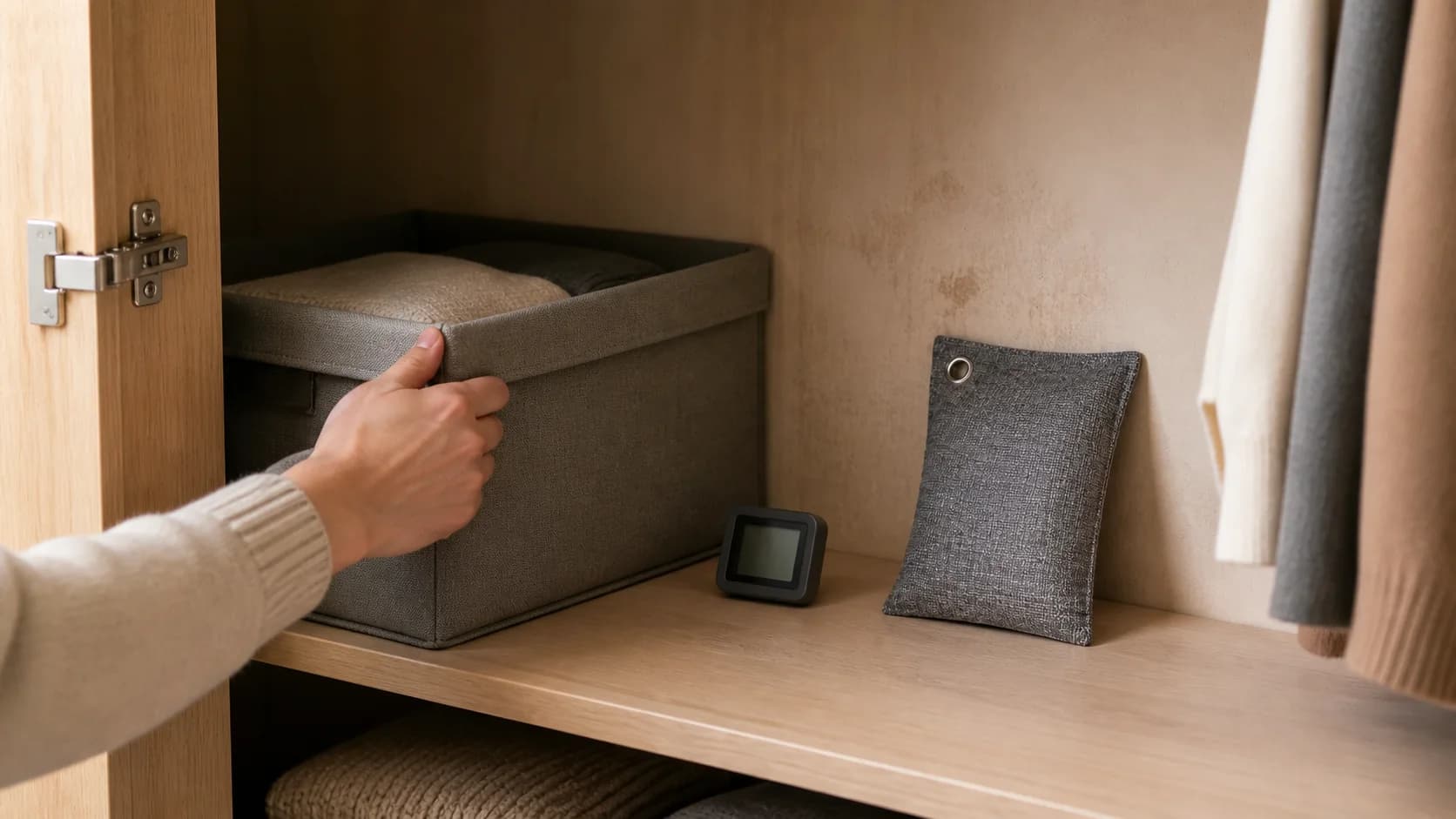
A musty smell can appear before anyone finds the damp corner behind a wardrobe, so a charcoal bag feels like a sensible first move. If the smell fades, the room seems better. The difficult part is knowing whether the odor changed while the moisture problem stayed active.
Charcoal bags do not remove mold growth, repair a leak or reliably capture airborne mold spores. A suitable pouch may support residual odor care in a clean, dry space after the moisture source and contaminated materials are addressed. It cannot prove that a mold problem is gone.
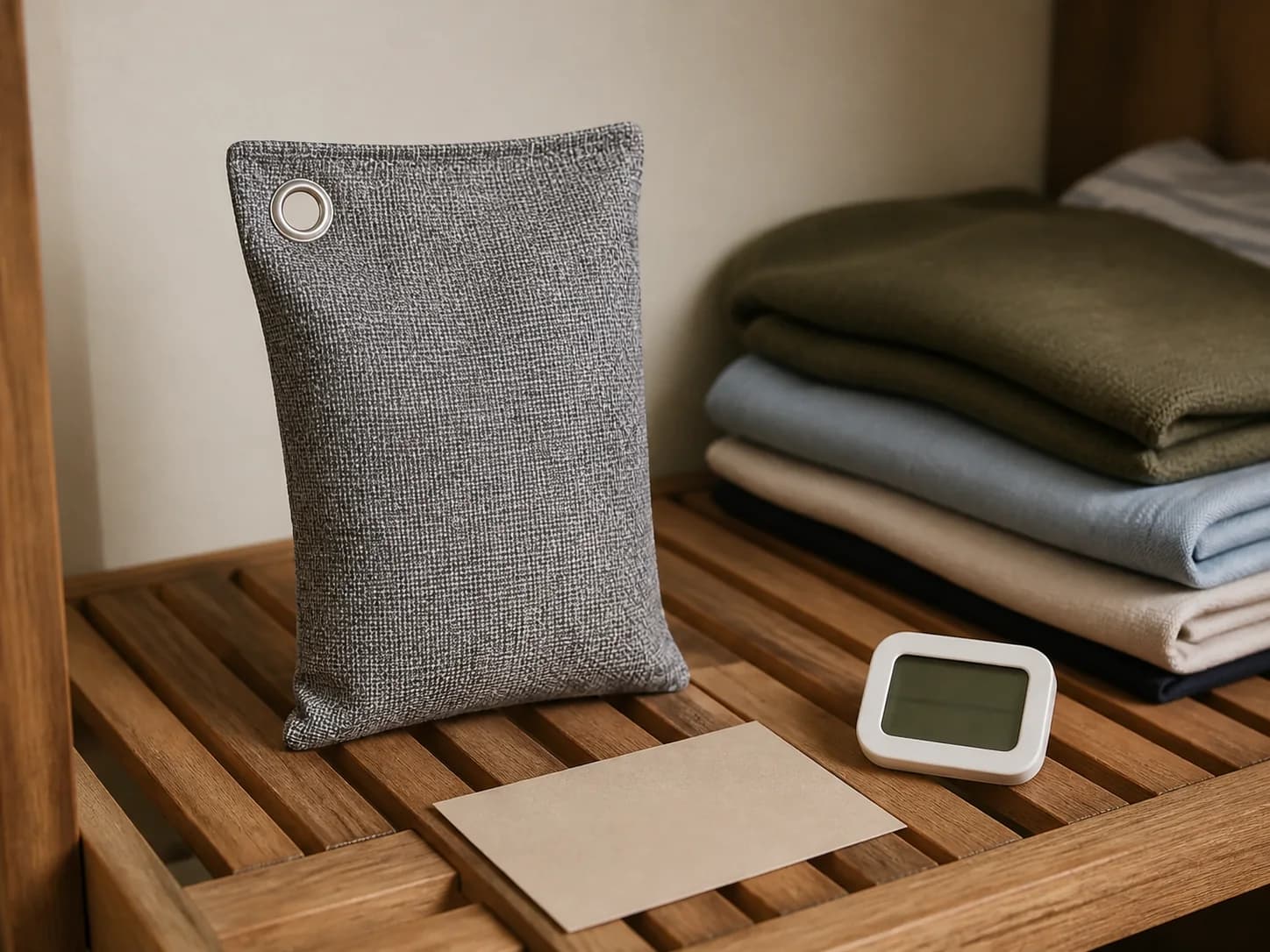
In product briefs, I often see "anti-mold," "moisture control" and "odor absorber" treated as if they describe one job. They do not. Separating those claims before sample approval protects the household user, keeps the instructions honest and gives the buyer a testable role for the finished pouch.
The 30-second decision
- Visible growth, wet material, a leak or recurring condensation: correct the moisture problem and follow appropriate cleanup guidance.
- Strong or returning mustiness with no visible source: inspect hidden surfaces and stored contents before adding an odor product.
- A clean, dry enclosure with a mild residual odor: a contained charcoal pouch may be tested as secondary odor support.
- A claim that the bag "kills mold," "captures spores" or "prevents mold": require product-specific evidence and market review before approval.
Do charcoal bags work for mold?
Charcoal bags can interact with some odor-causing gases that reach the carbon surface, but they do not clean mold from a wall, remove damp building material or control the water that lets mold grow. Treat them as a limited odor-care accessory, not a mold-remediation method.
Mold is living fungal growth on a suitable moist surface. It reproduces through small spores and fragments. A musty odor can accompany that growth, but the odor is only one signal. Removing or reducing the odor does not establish that the growth, spores or moisture have been removed.
The US Environmental Protection Agency states that the key to mold control is moisture control. Its home mold and moisture guide advises cleaning mold promptly, fixing the water problem and drying wet areas quickly. A passive charcoal pouch cannot perform any of those physical tasks.
Charcoal works through surface contact. Certain vapor molecules can adhere to accessible surfaces in a porous carbon material. The result depends on the compound, charcoal specification, quantity, pouch construction, humidity, temperature and air movement around the bag. A passive pouch has no fan, so only the air that reaches its breathable surfaces can contact the fill. Our guide to how bamboo charcoal bags work explains that passive air-contact mechanism in more detail.
This creates a narrow but useful role. After a cupboard has been emptied, the source corrected, cleanable surfaces cleaned and the space dried, a pouch can be evaluated for lingering enclosed-space odor. It cannot certify the space as mold-free, and it should not delay investigation of a returning smell.
What are you actually trying to remove: mold, spores, musty odor or dampness?
These are four different problems, and each needs a different control. Mold growth needs source correction and cleanup, airborne particles need suitable particle control, musty odor starts with source investigation, and excess humidity needs ventilation or mechanical moisture control.
| What you notice | What it may represent | First control | Possible charcoal-bag role |
|---|---|---|---|
| Visible spots or fuzzy growth | Active or historic fungal growth on a material | Stop water entry, assess the extent and clean or remove affected material safely | None during active cleanup |
| Water stain, wet wall or condensation | A moisture source that can support future growth | Repair, dry, ventilate or dehumidify as appropriate | None as the moisture control |
| Airborne spores or fragments | Particles released from indoor or outdoor mold | Source correction, containment or particle filtration selected for the situation | A passive carbon pouch is not a particle filter |
| Mild musty odor after the space is clean and dry | Residual odor compounds, a missed source or odor retained by contents | Reinspect first, then air and clean suitable items | Secondary odor trial if no active source remains |
| Strong or returning mustiness | Hidden dampness, contaminated porous material or incomplete cleanup | Investigate behind contents and building surfaces; seek qualified help when needed | Do not use odor reduction to close the investigation |
This distinction matters because carbon media and particle filters solve different air-cleaning jobs. The EPA's guide to air cleaners separates filters used for particles from activated-carbon media intended for certain gases. A small passive bag should not inherit the claims of a powered cleaner with measured airflow, a particle filter and a substantial carbon bed.
The same rule applies to the word "absorb." A pouch may be marketed casually as an odor absorber, but the technical process associated with carbon is usually adsorption at a surface. That language does not mean the bag consumes mold, sterilizes stored goods or pulls meaningful quantities of water from an entire room.
Why can a room smell better while mold remains?
Odor intensity and mold condition can change independently. Ventilation, cleaning, drier weather or contact with a sorbent may reduce what you smell even though hidden damp material, spores or a leak still require attention.
Human odor perception is not a mold clearance test. A wardrobe may smell less musty after its doors stay open for a day because the odor compounds have been diluted. A charcoal pouch may also alter some local vapor concentrations. Neither observation shows what is behind the back panel or under a damp box.
NIOSH advises that visual inspection and musty-odor detection are often more useful than routine short-term air sampling for locating building dampness problems. Its mold testing and remediation guidance still puts drying, repairs and proper remediation ahead of odor control. In other words, smell can prompt an investigation, but the absence of smell cannot close it.
Carbon also has finite available surface, while a wet source can keep releasing compounds. If the bag is buried or sealed inside retail film, little enclosure air reaches it. Returning odor may indicate a continuing source, blocked airflow, limited capacity or high humidity, not simply that "the charcoal stopped working."
What should you do when mustiness appears in a closet or storage area?
Empty enough of the space to inspect it, identify wet or affected materials, correct the moisture source, clean or remove items according to suitable guidance, and dry the enclosure before deciding whether an odor pouch belongs there.
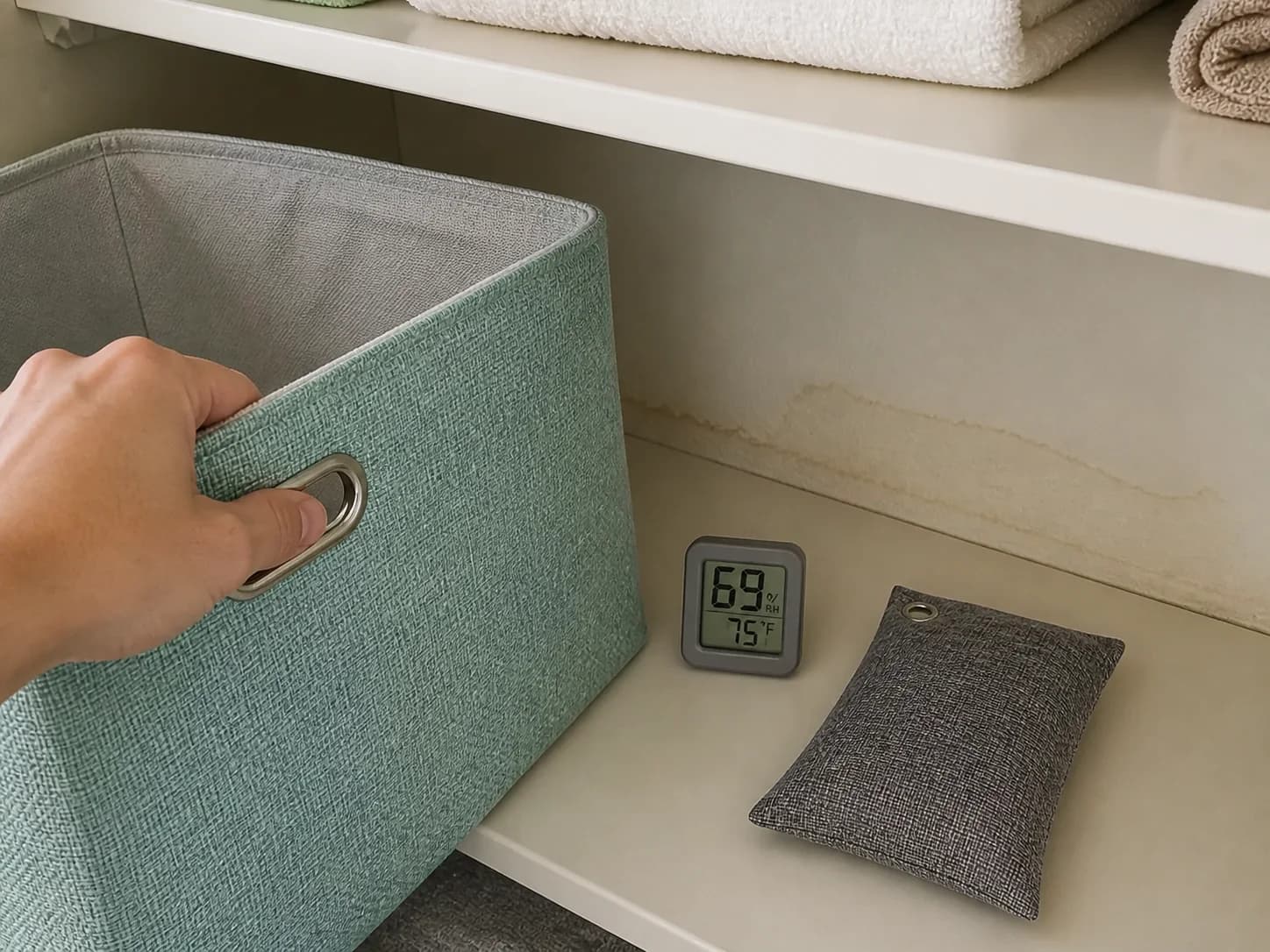
| Observation during the check | Immediate action | Recheck before adding a pouch | Escalation signal |
|---|---|---|---|
| Condensation on an outside wall or window | Dry the surface and improve humidity or airflow control | Confirm the condensation is not returning | Repeated wetting, damaged finishes or an unclear cause |
| Damp cardboard or textiles | Remove them from the enclosure and dry, clean or discard as appropriate | Inspect the shelf, wall and adjacent items | Mold growth, staining or odor remains in porous contents |
| Small visible patch on a cleanable surface | Follow authoritative cleanup and personal-protection guidance | Confirm the surface and surrounding materials are fully dry | A larger area, recurring growth or vulnerable occupants |
| Musty odor but no visible source | Inspect the back, floor, wall junctions, pipes and stored goods | Keep looking until dampness and affected contents are reasonably excluded | Strong odor, water damage or a source inside a wall |
| Clean and dry enclosure with a faint retained odor | Air the space and clean suitable contents first | Establish a simple baseline before a pouch trial | Odor strengthens, dampness returns or symptoms occur |
Health Canada recommends controlling indoor relative humidity and fixing the moisture source so mold does not return. Its moisture and mould guide also notes that porous materials affected by mold may need to be discarded, while washable surfaces require suitable cleaning and quick drying.
Stop the odor trial and get qualified help when: visible growth is extensive or recurring; water entry or damp building materials remain; strong mustiness persists with a hidden source; or occupants have health concerns or may be more susceptible. Follow local public-health guidance instead of using odor reduction to delay assessment or cleanup.
Do not put a new charcoal bag against a damp wall or directly on a recently cleaned wet surface. Keep the finished pouch dry and intact. If the bag itself becomes wet, stained or contaminated during cleanup, remove it from service rather than treating sunlight as a universal reset.
The musty closet diagnosis guide provides a more detailed source-first sequence for wardrobes. The important handoff is that a charcoal pouch enters only after the enclosure and contents are clean, dry and stable enough for an odor trial.
When can a charcoal bag fit after cleanup?
A charcoal bag fits best as secondary support in a dry, source-controlled enclosure with mild residual odor and enough open air around both faces of the pouch. Its purpose, placement and replacement rule should be visible in the instructions.
Suitable spaces include a ventilated wardrobe or dry storage cupboard after the odor source has been handled. Keep the bag away from water, food contact, children's play and pet chewing unless the finished product was assessed for that use.
Record the date, enclosure, cleanup, dry condition and pouch position, then recheck the same conditions. If mustiness returns with condensation or staining, stop the trial and investigate moisture again.
Pouch construction still matters. The charcoal needs a breathable path while the liner and seams contain particles. Net fill, particle presentation, exposed pouch area and placement influence air contact. The bamboo charcoal air purifying bag range shows the product formats that can be developed for closets and household storage, but the final format still needs a representative sample and claim review.
For a private-label program, avoid printing one broad room-size promise across every weight and pouch shape. A 100 g flat pouch in a drawer and a larger hanging pouch in a wardrobe do not have the same geometry or use pattern. Define the intended enclosure and trial conditions before setting copy.
Planning a dry-storage odor-care program?
Share the enclosure, pouch format, net fill, placement, warning language and intended claim. We can turn them into a finished-sample review brief.
Can charcoal bags absorb enough moisture to prevent mold?
Do not rely on a household charcoal bag to control room humidity or prevent mold. Mold prevention depends on stopping water entry, drying wet materials, controlling condensation and using ventilation, air conditioning or a dehumidifier when the conditions require it.
Porous carbon can interact with water vapor, but that fact does not establish practical moisture capacity for a finished consumer pouch. The bag lacks a drain, a humidity control setting and a published water-uptake curve for the room. Its fabric, liner and charcoal can also be affected by prolonged dampness.
The World Health Organization's dampness and mould guidelines identify prevention or minimization of persistent dampness and microbial growth as the main public-health control. A product labeled "moisture control" needs evidence that matches the claimed space, humidity range, duration and endpoint. A generic statement about charcoal porosity is not enough.
This is a recurring specification trap. "Helps with damp smells" can describe a limited odor role after the area is dry. "Reduces room humidity" is a moisture-performance claim. "Prevents mold" implies a biological outcome. Those statements need different evidence, and the last two should not be inferred from a basic odor pouch.
If a household really needs measurable water removal, use an appropriate dehumidification method and monitor relative humidity with a suitable meter. Keep the charcoal pouch in its honest lane: passive odor support under defined dry conditions.
How should product teams phrase mold and musty-odor claims?
Product teams should describe the intended dry enclosure, source-first use and limited odor-support role. Avoid mold-removal, mold-killing, spore-capture, dehumidification or prevention claims unless the exact finished product and wording have suitable evidence for the destination market.
| Proposed wording | Main problem | More responsible direction | Evidence needed before stronger wording |
|---|---|---|---|
| "Kills mold naturally" | Implies a biocidal result | Do not use for a passive charcoal pouch | Product-specific biological efficacy and regulatory review |
| "Removes mold spores" | Implies particle capture without a defined filter or airflow | Do not claim spore removal | Finished-device particle method, airflow and efficiency evidence |
| "Prevents mold" | Implies moisture and biological control | State that moisture sources must be corrected | Defined prevention endpoint, use conditions and market review |
| "Controls humidity" | Implies measurable room-level water removal | Keep the product dry; use proper humidity control when needed | Water-uptake capacity, room conditions, duration and acceptance threshold |
| "Eliminates musty smells" | Can overstate source and duration | "Supports residual odor care in clean, dry storage" | Finished-pouch trial with source, enclosure and endpoint recorded |
| "For closets and storage" | Too broad without use instructions | Name dry placement, clearance and inspection steps | Approved sample, placement trial and final instructions |
The wording should also separate the product claim from the user's environmental responsibility. For example: "Use only in a clean, dry enclosure. This pouch does not remove mold or replace cleanup, ventilation or moisture control. Investigate recurring musty odors." That sentence is less dramatic than "anti-mold," but it gives the customer a decision they can act on.
Artwork space is not an excuse for ambiguity. A short front label can carry a restrained product role, while the back panel or insert explains dry placement, inspection, damage and replacement. Online listings should match the approved physical copy rather than adding unsupported benefits for search traffic.
When I review a sample, I compare the exact front claim, back instructions and marketplace title. A cautious box can still be undermined by a seller page that says "removes mold spores." The claim file has to cover every customer-facing version, including the seller page and printed pouch.
How can buyers diagnose mold-related specification ambiguity?
Buyers can diagnose ambiguity by translating every broad mold, moisture or odor phrase into a target, environment, mechanism, endpoint and exclusion. If the supplier cannot fill those fields, the statement is not ready for quotation or artwork.
| Ambiguous phrase | Missing decision | Specification question | Approval record |
|---|---|---|---|
| "Anti-mold charcoal bag" | Is the target growth, spores, odor or humidity? | Which measurable effect is claimed for the finished pouch? | Exact claim rationale and destination-market review |
| "Absorbs mold" | Mold is not defined as a gas, particle or surface growth | What physical target reaches the product, and by what air path? | Target definition and finished-product method |
| "Dehumidifying bamboo charcoal" | No water capacity, room volume or humidity condition | How much water is removed at which temperature and relative humidity? | Water-uptake data and product-specific protocol |
| "Works in any room" | No enclosure, source strength, quantity or placement | Which dry enclosure and pouch quantity were evaluated? | Representative trial photos and condition log |
| "Reusable after sun drying" | No purpose, cycle count or retirement rule | What does the care step restore, and how was that checked? | Finished-pouch cycle record and approved instruction |
| "Natural and safe" | No material scope, user boundary or damaged-pouch rule | Which components and intended users are covered? | Bill of materials, finished-sample inspection and warnings |
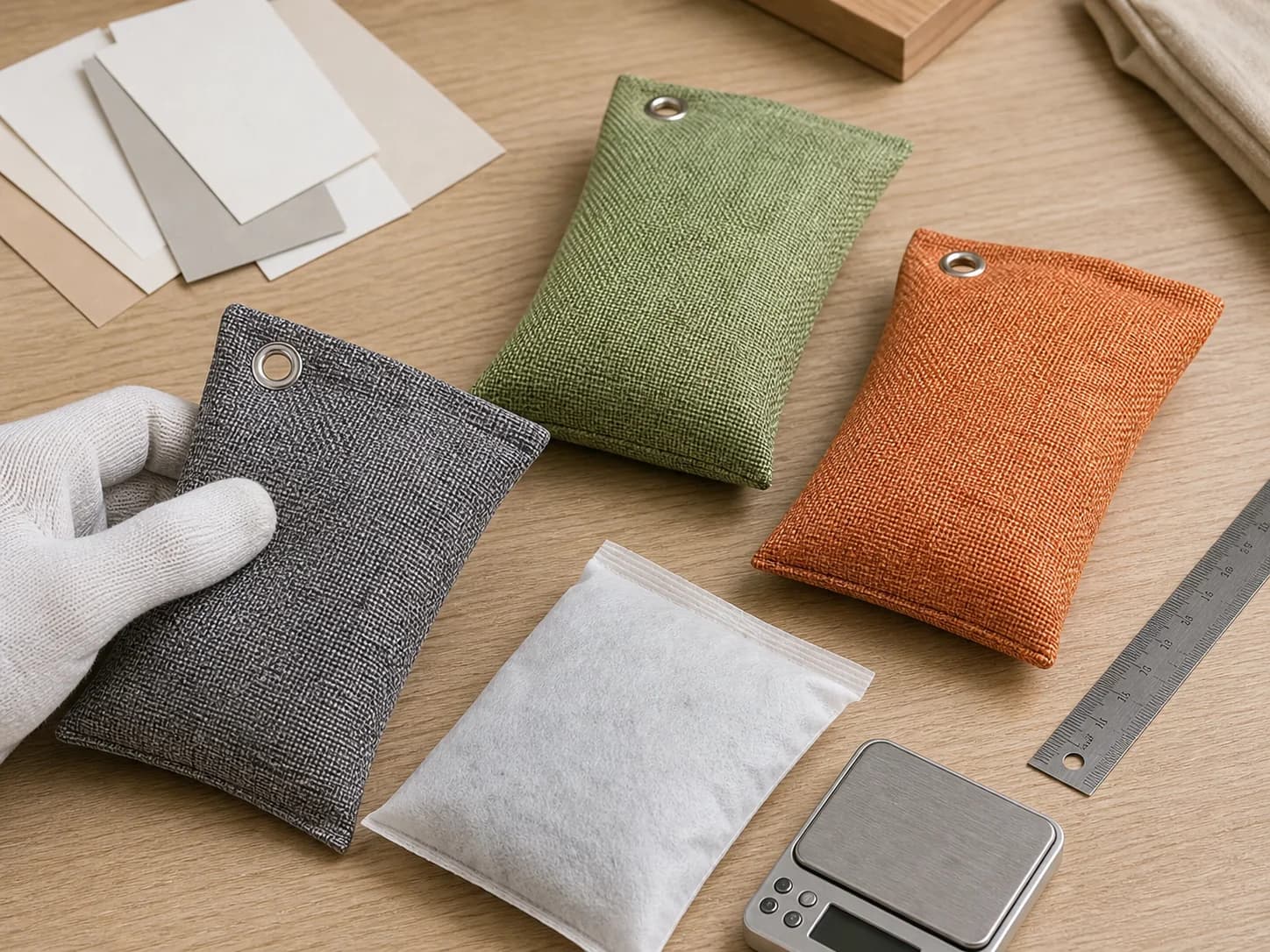
The buyer should also lock the physical unit. Define charcoal identity, net fill and tolerance, particle presentation, inner liner, outer fabric, seam, eyelet or cord, individual barrier packaging, pack count and batch coding. Then connect the claim to that approved unit. A raw-charcoal document cannot represent the leakage, breathability, handling or labeling of the finished pouch.
The bamboo charcoal bag safety guide covers dust containment, children, pets and damage rules in more detail. Those checks become especially important when a product is marketed near damp or contaminated storage, where users may handle and relocate it more often.
What should a representative sample trial record?
A representative trial should record the enclosure, corrected source, humidity condition, contents, pouch code, placement, observation period and stop conditions. It should test a narrow odor-support claim, not expose people to deliberate mold growth.
Use a normal, clean storage setting that reflects the intended channel. Confirm that no visible mold, leak or damp material remains. Record the baseline odor description without claiming laboratory precision, photograph placement, and keep both pouch faces exposed. Compare the same enclosure over a defined period while noting any change in weather, contents or door-opening pattern.
Do not create mold as a challenge organism for an informal factory or home test. Biological efficacy work belongs with qualified laboratories and an appropriate protocol. For a passive household pouch, a useful development trial can verify construction, air exposure, handling, instruction clarity and whether a mild residual-odor claim is repeatable in the intended dry enclosure.
Stop the trial if condensation, wet material, visible growth, pouch damage or a strong unidentified odor appears. Record the condition and correct the environment instead of extending the trial. Link accepted results to the signed sample, artwork and production specification, and state that the trial did not establish mold removal, spore capture, health protection, dehumidification or universal room coverage.
Conclusion: should you use a charcoal bag for a mold problem?
Do not use a charcoal bag as the solution to a mold problem. Fix moisture, inspect the affected area, clean or remove contaminated material safely, and use qualified help when the extent or source is unclear.
After those steps, a contained bamboo charcoal pouch may support residual odor care in a clean, dry closet or storage enclosure. Keep it exposed to enclosure air, inspect it, and treat any returning mustiness as a reason to investigate rather than a reason to add more bags.
For buyers, the approval rule is equally direct: reject "anti-mold" as a shortcut specification. Define the actual target, finished pouch, dry-use condition, placement, evidence, exclusions and customer stop rule before the claim reaches artwork.
Turn the claim into a reviewable specification
Send the intended enclosure, pouch construction, net fill, packaging copy and market. We will help identify which fields belong in the sample and claim review.